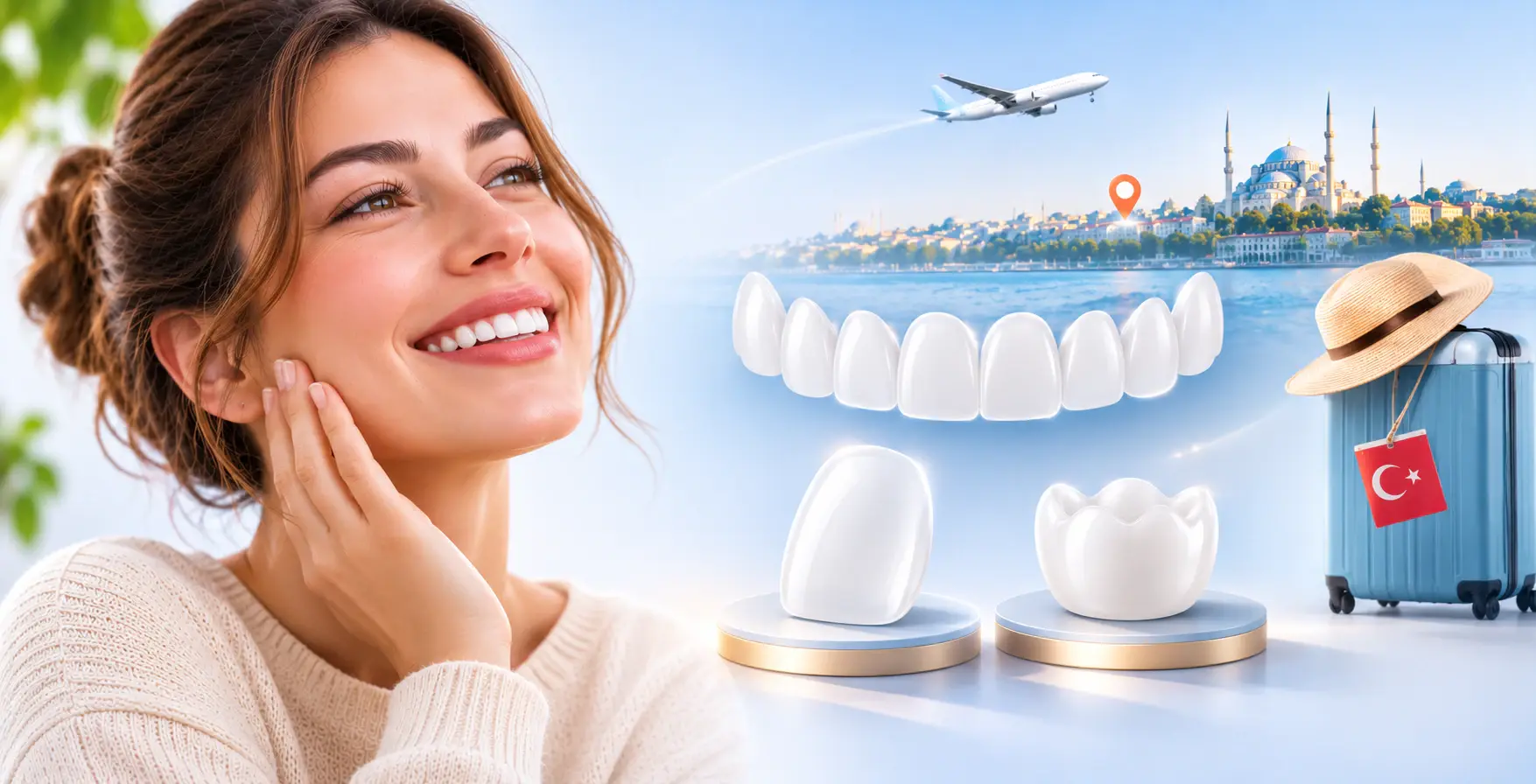
UK patients typically pay 60 to 70 percent less for a Hollywood Smile in Turkey than in the UK, but the price advantage only holds real value when the treatment plan, materials and aftercare match what a qualified cosmetic dentist would deliver at home.
More UK patients now travel to Turkey for cosmetic dental treatment than to any other European destination. Industry estimates suggest that dental procedures account for a large share of all medical travel from the UK, and the Hollywood Smile sits at the centre of that demand (Hanefeld et al. 2014). The reason is simple. A full smile makeover that costs £12,000 to £24,000 in UK private practice often costs £3,000 to £5,500 in Turkey.
The comparison, however, involves far more than treatment prices. A sound decision weighs clinical planning, material quality, dentist expertise, safety protocols, travel logistics and long-term dental maintenance. It also requires a clear understanding of what a Hollywood Smile actually is. It is not a single procedure or a standard package. It is a personalised cosmetic treatment plan built around your teeth, your bite and your face.
This guide compares Turkey and the UK across every dimension that matters, so you can evaluate both options on evidence rather than on advertising.
What Does a Hollywood Smile Treatment Actually Include?
A Hollywood Smile combines several cosmetic and restorative procedures, most often veneers or crowns on the visible teeth, and the exact mix depends on your smile line, dental condition and treatment goals.
A complete smile makeover aims to improve tooth colour, shape, alignment, proportion and gum symmetry at the same time. Dentists design the result around your facial features rather than applying one template to every patient.
The procedures that may appear in a Hollywood Smile plan include:
Porcelain or E-max veneers. Thin ceramic shells bonded to the front surface of teeth to correct colour, shape and minor alignment issues.
Zirconia or ceramic crowns. Full coverage restorations used when a tooth is heavily filled, fractured or root treated.
Composite bonding. Direct application of tooth coloured resin to repair chips and reshape edges in a single visit.
Teeth whitening. Professional bleaching, often applied to the untreated lower teeth so they match the restored upper arch (Carey 2014).
Gum contouring. Reshaping of the gum line to correct asymmetry or a gummy smile.
Dental implants. Included in selected cases where missing teeth must be replaced before the aesthetic work begins.
The number of teeth treated varies considerably. Most adults show six to ten upper teeth when they smile broadly, so many plans treat only that zone (Sarver 2001). A plan covering 16 to 20 teeth across both arches represents a far more invasive commitment, and patients should question any clinic that proposes it without a clinical examination.
The difference between veneers and crowns carries particular weight here. A veneer covers only the front of the tooth and preserves most of the natural structure. A crown covers the entire tooth and requires substantially more removal. Laboratory measurements show that crown preparations remove roughly two to four times more tooth tissue than veneer preparations, with crowns eliminating up to 60 to 70 percent of the visible tooth structure (Edelhoff and Sorensen 2002). That single fact should shape how you read any treatment plan.
Feature | E-max or porcelain veneer | Zirconia or ceramic crown |
Coverage | Front surface only | Entire tooth |
Tooth removal | Minimal, about 3 to 30 percent | Heavy, about 60 to 70 percent |
Best indication | Healthy teeth with colour, chip or shape issues | Heavily restored, broken or root treated teeth |
Enamel preservation | High | Low |
Typical role in a smile makeover | Primary aesthetic tool | Used only where structurally justified |
How much of your natural tooth do you keep?
Veneers and crowns can look alike in the mirror, but they leave very different amounts of tooth behind.
Veneer
Covers the front surface only. About 3–30% of the tooth is removed.
Crown
Covers the whole tooth. Around 60–70% of the visible tooth is removed.
Watch for: a plan with crowns on healthy teeth "for looks". Crowns should only be used where a tooth is broken, heavily filled or root-treated.
How Much Does a Hollywood Smile Cost in Turkey vs the UK?
A 16 to 20 tooth Hollywood Smile typically costs £2,800 to £5,500 in Turkey versus £12,000 to £24,000 in the UK, a saving of roughly 60 to 70 percent before travel expenses.
Price differences between the two countries are structural, not promotional. Turkish clinics benefit from lower laboratory fees, lower staff costs and favourable exchange rates, so they can offer the same branded materials at a fraction of UK prices. Within each country, prices still vary according to the number of teeth, the material, the clinic, the dentist and the complexity of the case.
Treatment item | Turkey (typical range) | UK (typical range) |
8 to 10 E-max veneers | £1,600 to £3,500 | £6,500 to £12,000 |
16 to 20 veneers or crowns | £2,800 to £5,500 | £12,000 to £24,000 |
E-max veneer per tooth | £200 to £400 | £800 to £1,500 |
Zirconia crown per tooth | £120 to £250 | £600 to £1,200 |
Composite bonding per tooth | £80 to £200 | £200 to £500 |
Professional teeth whitening | £150 to £350 | £300 to £700 |
Advertised headline prices rarely reflect the final bill. A package priced at £2,000 may exclude preparatory treatments, temporary restorations or the number of teeth you actually need. The only reliable comparison method is a like for like evaluation of equivalent treatment plans: same number of teeth, same material, same laboratory standard and same scope of preparatory work.
What Factors Influence Hollywood Smile Prices in Both Countries?
Six factors drive the final price in both countries, and material selection combined with the number of teeth treated usually accounts for the largest share.
Material selection and laboratory quality. E-max lithium disilicate costs more than composite, and a master ceramist charges more than a volume laboratory.
Number of teeth involved. Each additional unit adds material, laboratory and chair time costs.
Dentist experience and cosmetic specialisation. Clinicians with documented aesthetic portfolios command higher fees in both markets.
Preparatory treatments. Gum therapy, fillings or root canal treatment add cost before any aesthetic work begins.
Complexity of bite correction and aesthetic planning. Cases requiring occlusal adjustment need more planning and more appointments.
Clinic location and operational costs. Central London and premium Istanbul districts both price above their national averages.
What Is Included in a Hollywood Smile Package in Turkey?
Most Turkish dental tourism packages bundle the consultation, digital planning, restorations, hotel and transfers into one fixed price, but flights and several clinical extras usually sit outside the package.
A typical package includes an initial consultation and dental assessment, digital imaging and smile planning, temporary restorations, the final veneers or crowns, hotel accommodation, airport and clinic transfers, and a patient coordinator who manages your schedule.
Common exclusions include return flights, meals and personal spending, travel insurance, preparatory procedures such as root canal treatment or gum contouring, and any follow up visits after you return home. Some clinics also exclude the cost of replacing temporary restorations if the laboratory work runs late.
This is why a written, itemised quotation matters so much. The quotation should list every procedure, every material, the laboratory, the number of teeth and the warranty terms. A transparent document protects you and signals a professional operation. A vague package price protects only the seller.
What Additional Expenses Should UK Patients Budget for in Turkey?
Beyond the package price, UK patients should budget £400 to £900 for flights, insurance and daily expenses, plus a contingency fund for follow up care after returning home.
A realistic budget includes return flights (£100 to £300 depending on season), accommodation if the package excludes it, meals and personal expenses, comprehensive travel insurance that covers medical complications, and any additional dental procedures discovered during the examination. You should also plan for the possibility of a second trip and for emergency dental treatment in the UK if a complication arises after you fly home.
A simple total cost calculator prevents surprises:
True cost = package price + flights + insurance + daily expenses + preparatory work + contingency for follow up care
Patients who run this calculation before booking consistently report better financial outcomes than those who compare headline prices alone (Crooks et al. 2010).
Work out your true cost before you book
The package price is only the starting point.
Are Dental Materials and Treatment Quality Different in Turkey and the UK?
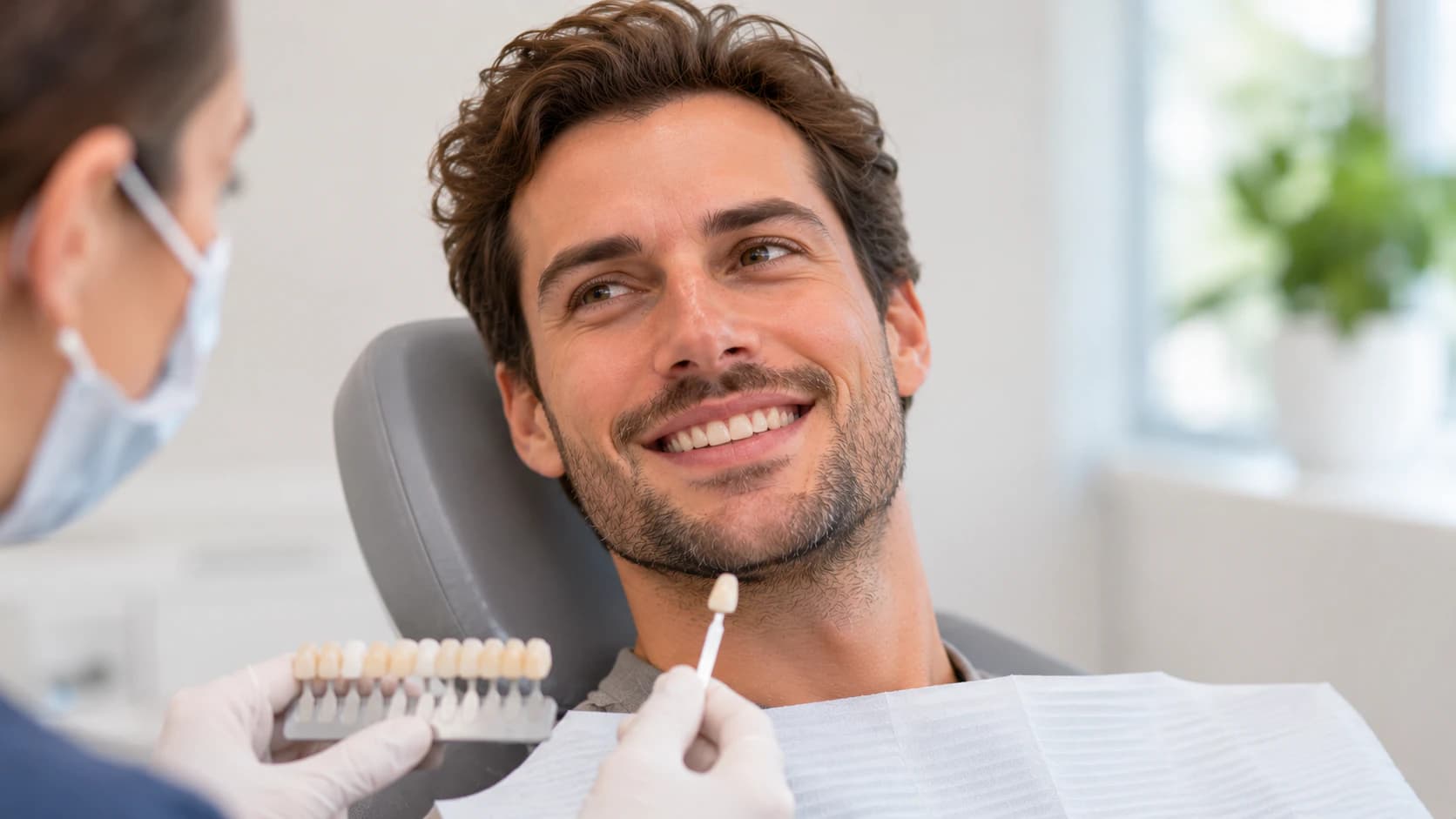
No, the internationally recognised materials are identical in both countries, but the final quality depends on the dentist, the laboratory and the bonding protocol rather than on the material alone.
E-max, porcelain, zirconia and composite resins are globally standardised products. A Turkish clinic and a London practice can order the same lithium disilicate blocks from the same manufacturer. Systematic reviews confirm that all ceramic restorations achieve high survival rates when clinicians follow correct protocols, regardless of where the treatment takes place (Della Bona and Kelly 2008).
Material alone never determines the quality or longevity of the result. Six clinical factors do:
Dentist led treatment planning based on a full diagnosis.
Accurate tooth preparation that respects enamel and pulp health.
Occlusal assessment to check how the new teeth meet under bite forces.
Laboratory craftsmanship in layering, contouring and surface texture.
Proper bonding protocols, because adhesive technique strongly influences veneer survival (Layton and Walton 2007).
Quality control and final adjustments before the patient leaves the chair.
For this reason, you should request material documentation and the name of the dental laboratory in writing. A clinic that refuses to disclose its materials or laboratory is telling you something important.
Does the Dentist's Experience Matter More Than the Country?
Yes, long term clinical data shows that operator skill and case selection influence restoration survival more than the country where treatment occurs.
Cosmetic dentistry is a craft discipline. Expertise in veneer preparation, crown design, bite evaluation and aesthetic proportions develops over years of supervised practice and documented cases. Prospective studies tracking porcelain veneers for up to 16 years report survival rates above 90 percent when experienced clinicians follow conservative protocols (Layton and Walton 2007). Large scale evaluations of all ceramic restorations reach similar conclusions, with failures clustering around poor case selection rather than geography (Beier, Kapferer and Dumfahrt 2012).
The practical lesson is direct. Review comparable clinical cases before you commit. Ask to see unedited photographs of patients with similar starting conditions. Marketing claims are cheap; demonstrable clinical expertise is verifiable.
How Does Smile Design and Treatment Planning Compare?
Reputable clinics in both countries now use Digital Smile Design to plan treatment around your facial proportions, and the planning stage matters as much as the technical execution.
Digital Smile Design software lets the dentist analyse facial proportions, tooth shape, smile line and gum symmetry on photographs and scans before touching a tooth. Research on smile aesthetics confirms that incisor position and the curve of the smile arc strongly influence how observers judge attractiveness (Sarver 2001).
Good planning follows a predictable sequence. The clinic creates a digital preview, produces a physical mock up or provisional restoration, and asks for your approval before any irreversible tooth preparation begins. This step protects you. A preview that you approve in the mirror prevents the most common complaint in cosmetic dentistry: a result that looks technically perfect but does not suit your face.
Personalised planning also prevents the overly uniform, artificial look sometimes associated with mass market smile packages. Natural teeth vary in shade, translucency and texture. A plan that respects that variation produces a smile that looks like yours, only better.
Can You Get a Natural Looking Hollywood Smile in Turkey or the UK?
Yes, natural results are achievable in both countries, and they depend on shade selection, translucency, surface texture and proportion rather than on whiteness.
Natural enamel transmits light. High quality ceramics replicate that behaviour through controlled translucency and layered surface texture. Teeth that are excessively white or oversized block light and immediately read as artificial. Studies of aesthetic perception consistently show that observers rate moderate shades and anatomical proportions as more attractive than maximum brightness (Sarver 2001).
Aesthetic preferences must also respect oral health. A shade that suits a 25 year old may look incongruous on a 55 year old face. Before you approve any design, ask to see unedited before and after photographs of actual patients treated by the same dentist, ideally cases documented several years after completion.
How Long Does a Hollywood Smile Treatment Take in Turkey vs the UK?
A straightforward veneer case in Turkey usually takes five to seven days in a single visit, while the same treatment in the UK typically spreads across three to five appointments over four to eight weeks.
Treatment in Turkey follows a compressed schedule: initial consultation and assessment, tooth preparation where indicated, digital impressions or scans, temporary restorations, laboratory fabrication, final fitting and bonding, then bite adjustment and a final review. Clinics with in house laboratories compress the laboratory phase into days rather than weeks.
Stage | Turkey | UK |
Consultation and assessment | Day 1 | Appointment 1 |
Preparation and impressions | Day 1 to 2 | Appointment 2 |
Temporary restorations | Same day | Same visit |
Laboratory fabrication | 3 to 5 days | 2 to 4 weeks |
Final fitting and bonding | Day 5 to 7 | Appointment 3 |
Bite adjustment and review | Before departure | Appointment 4 to 5 |
Complex cases should not follow the fast track. Implant based rehabilitation, gum surgery or full bite correction requires staged treatment with healing intervals. Any clinic that compresses a complex case into one short visit is prioritising schedule over biology.
The same veneer case on the same calendar
A straightforward case, from first appointment to final review.
Does a Hollywood Smile in Turkey Require a Second Trip?
Simple veneer cases rarely need a second trip, but implant work, gum surgery and complex rehabilitation usually require two visits separated by a healing period.
A second visit becomes necessary when treatment involves osseointegration of implants, surgical healing after gum procedures, or staged bite correction. Laboratory delays and clinical complications can also extend the schedule. Confirm the full treatment timeline in writing before you book flights, and keep your return arrangements flexible where possible.
Is Hollywood Smile Treatment in Turkey as Safe as in the UK?
Safety depends on clinical standards, sterilisation, diagnosis and dentist qualifications, not on geography, so a well regulated Turkish clinic can be as safe as a UK practice.
Every veneer or crown procedure carries biological risks wherever it is performed. Safe treatment begins with infection control and sterilisation protocols, continues with a thorough medical and dental history, and depends on a proper pre treatment evaluation of gum health, tooth vitality, existing restorations and bite function.
The most significant safety concern in the dental tourism market is over treatment. Preparing healthy teeth for crowns when veneers or bonding would suffice removes tissue that never grows back and raises the lifetime restorative burden (Edelhoff and Sorensen 2002). Medical tourism researchers have documented cases where patients received more invasive treatment than their condition required, precisely because fixed packages reward volume (Hanefeld et al. 2014). Avoid any plan that promises a fixed number of crowns before a clinical examination has taken place.
What Should UK Patients Check Before Choosing a Turkish Dental Clinic?
Verify nine items before booking, and treat any missing documentation as a reason to walk away.
Dentist qualifications, professional registration and clinical experience.
Unedited photographs of actual patient cases.
A transparent, itemised treatment plan.
A written quotation and treatment contract.
Named materials and dental laboratory information.
Sterilisation and infection control standards.
Communication channels and emergency protocols.
A clear warranty and complication policy.
Independent reviews and verifiable patient feedback.
What Are the Main Risks of Getting a Hollywood Smile Abroad?
The clinical risks of veneers and crowns are the same everywhere, but distance turns routine complications into logistical and financial problems.
Documented complications include tooth sensitivity, gum irritation or recession, bonding failure, veneer or crown fracture, bite related discomfort, pulp damage that may require root canal treatment, secondary decay and unnatural aesthetic outcomes. Systematic reviews of ceramic single crowns report five year complication rates that, while low, are not zero, with chipping and loss of retention among the most frequent technical issues (Sailer et al. 2015).
Excessive tooth preparation magnifies every one of these risks. The more enamel a dentist removes, the higher the chance of pulp involvement and the greater the lifetime need for replacement restorations. Distance then compounds the problem. Managing a debonded veneer requires a fifteen minute appointment if your dentist is local, and a flight plus time off work if the dentist is 2,500 kilometres away (Crooks et al. 2010).
How Does Aftercare Compare Between Turkey and the UK?
UK treatment offers structurally easier aftercare, while Turkish treatment requires a planned remote aftercare strategy agreed before you travel home.
Aftercare protects both the restorations and the natural teeth beneath them. A sound follow up process monitors gum health, bite alignment and restoration integrity through routine check ups and professional cleaning. Long term studies show that restored teeth maintained under regular professional review survive significantly longer than those without structured maintenance (Beier, Kapferer and Dumfahrt 2012).
If you treat abroad, your aftercare plan must exist before you fly home. It should name a UK dentist willing to see you, specify what the treating clinic will handle remotely, and state what happens financially if something fails within the warranty period.
What Happens if Your Hollywood Smile Needs Repair After Returning to the UK?
You contact the treating clinic first, then seek a local assessment, and your costs depend entirely on the warranty terms and the quality of your treatment records.
Arranging corrective treatment locally can be difficult. Some UK dentists decline to repair work done abroad because they cannot verify the materials or the preparation design. This is why your treatment records matter so much. Request copies of your radiographs, material certificates, shade maps and clinical notes before you leave Turkey. Clarify in writing who pays for corrective treatment and whether repair requires travel. A composite chip repair in UK private practice typically costs £80 to £250 per tooth, while replacing a fractured veneer costs the full per unit price again.
Before you fly home: your aftercare pass
Tick each item once it's sorted. Your aftercare plan should exist before you board.
to board✓ Ready
to fly
For reference: a composite chip repair in UK private practice typically costs £80–250 per tooth, while a fractured veneer means paying the full per-unit price again.
How Long Can a Hollywood Smile Last in Turkey vs the UK?
Porcelain veneers last 10 to 20 years in both countries, because longevity depends on materials, bonding technique and patient factors rather than on treatment location.
Prospective data places porcelain veneer survival above 90 percent at ten years, with many restorations functioning well beyond fifteen years (Layton and Walton 2007). Anterior composite restorations show shorter average lifespans of five to seven years, mainly due to staining and wear (Demarco et al. 2015).
The factors that determine lifespan are identical on both sides of the comparison: oral hygiene, bruxism or teeth grinding, bite forces, gum health, diet and habits, material quality, bonding technique and regular maintenance. Patients who grind their teeth face higher fracture rates regardless of material, and professional consensus treats unmanaged bruxism as a risk factor that requires a protective night guard (Lobbezoo et al. 2013). Every veneer and crown will eventually need repair or replacement. Geography does not change that biology.
Is It Better to Get a Hollywood Smile in Turkey or the UK?
Neither destination is universally better; Turkey wins on price and scheduling, while the UK wins on follow up access and complication management.
Factor | Turkey | UK |
Treatment cost | 60 to 70 percent lower | Higher private fees |
Scheduling | Often within days | Longer appointment waits |
Follow up care | Remote, requires planning | Local and immediate |
Complication management | May require travel | Handled by treating dentist |
Travel burden | Flights, hotel, time off | None |
Clinic selection risk | Requires careful vetting | Regulated domestic market |
Turkey's advantages are real: lower prices, integrated dental tourism packages, clinics that specialise in high volume cosmetic work and rapid scheduling. Its disadvantages are equally real: travel logistics, limited in person follow up, potential repeat travel for complications and the burden of careful clinic selection. The UK's advantages centre on continuity of care, while its disadvantages are cost and waiting time. The right answer depends on the complexity of your case, your budget and your tolerance for managing care across borders.
Istanbul price, London follow-up
Pick what matters most to you. With a practice in both cities, you don't have to choose one side.
Treatment itself is carried out in Istanbul. If you have urgent symptoms after returning home, see a dentist promptly rather than waiting for a scheduled review.
Who Is a Suitable Candidate for a Hollywood Smile?
Suitable candidates have healthy teeth and gums with cosmetic concerns such as discolouration, wear or minor chips, while patients with active disease need treatment before any aesthetic work.
Common concerns that a smile makeover addresses well include discolouration, worn teeth, minor chips, uneven tooth shapes, small gaps and mild aesthetic irregularities. Conservative options such as whitening, orthodontics or composite bonding often solve these problems with far less intervention, so a good dentist presents the full menu.
Several conditions contraindicate immediate cosmetic treatment or require prior therapy: active gum disease, untreated decay, severe malocclusion, significant tooth wear, bruxism and poor oral hygiene. Above all, healthy teeth should never be prepared for crowns purely for aesthetic reasons. The biological cost of full crown preparation on a healthy tooth outweighs any cosmetic gain (Edelhoff and Sorensen 2002).
How Can UK Patients Make an Informed Decision About a Hollywood Smile?
Collect written treatment plans from both countries, compare them line by line, calculate the complete cost including travel and follow up, and prioritise conservative treatment over the lowest price.
A disciplined decision process follows seven steps. First, obtain written treatment plans from dentists in both countries. Second, compare the number and type of restorations proposed, and question any large discrepancy. Third, compare material specifications and laboratory information. Fourth, review the clinical reasoning behind every tooth preparation. Fifth, calculate the complete cost using the true cost formula described earlier, including travel and follow up. Sixth, confirm the clinic's complication and aftercare policy in writing. Seventh, seek an independent dental opinion if anything remains unclear. Patients who follow this process choose long term oral health over headline price, and the clinical literature supports that priority (Hanefeld et al. 2014).
Frequently Asked Questions About Hollywood Smile Turkey vs UK
How Much Can I Save by Getting a Hollywood Smile in Turkey?
Most UK patients save between £5,000 and £12,000 on a full smile makeover, after deducting flights, insurance and living expenses.
Savings scale with the number of teeth and the restoration type. A 20 unit E-max case saves more in absolute terms than an 8 unit bonding case. Always subtract travel costs and a follow up contingency from the headline saving before you decide.
Are E-max Veneers in Turkey the Same Quality as E-max Veneers in the UK?
Yes, the branded material is identical, but the clinical outcome depends on preparation, bonding, design and laboratory work.
E-max is a globally manufactured lithium disilicate ceramic. Its performance in the mouth reflects how the dentist prepares the tooth, how the laboratory fabricates the restoration and how the team bonds it, not where the box was shipped (Della Bona and Kelly 2008).
How Many Days Do I Need to Stay in Turkey for a Hollywood Smile?
Plan five to seven days for a straightforward veneer case, and expect longer stays or a second visit for complex treatment.
The schedule covers consultation, preparation, laboratory work, fitting and final review. Cases involving implants, gum surgery or bite rehabilitation require staged visits with healing time between them.
Can I Get a Hollywood Smile Without Shaving Down My Teeth?
Sometimes, no prep and minimal prep veneers exist, but they only suit specific tooth positions, shapes and bite conditions.
No prep veneers add ceramic without removing enamel, while minimal prep designs remove a fraction of a millimetre. Suitability depends on tooth position, existing shape, enamel quality and occlusion. Many patients need conventional preparation for a predictable result, and a clinical examination is the only way to know which category you fall into.
What Happens if I Have a Problem with My Veneers After Returning to the UK?
Contact the treating clinic immediately, obtain a local dental assessment if symptoms are urgent, and use your treatment records and warranty terms to resolve costs.
Keep your radiographs, material documentation and clinical notes accessible. Warranty terms determine whether the clinic pays for repair, whether a UK dentist can perform it and whether travel is required.
Is Turkey a Good Choice for Cosmetic Dental Treatment?
Yes, for patients who vet clinics carefully, because Turkey combines competitive pricing with experienced cosmetic dentists, and clinic selection matters more than the destination itself.
Turkey treats a high volume of international dental patients every year, and many of its clinics hold international accreditations. The evidence points consistently to one conclusion: diagnosis, planning and operator skill determine outcomes, not the country on the clinic's address (Beier, Kapferer and Dumfahrt 2012).
Are Veneers or Crowns Better for a Hollywood Smile?
Veneers are the better choice for healthy teeth because they preserve natural structure, while crowns suit teeth that are already heavily damaged.
The two restorations differ fundamentally in coverage, preparation and biological cost. Veneers cover the front surface and preserve up to 97 percent of the tooth in conservative designs. Crowns encircle the whole tooth and sacrifice the majority of its structure. The condition of your teeth, not the package on offer, should dictate the choice (Edelhoff and Sorensen 2002).
References
Beier, U. S., I. Kapferer, and H. Dumfahrt. "Clinical Long-Term Evaluation and Failure Characteristics of 1,335 All-Ceramic Restorations." International Journal of Prosthodontics, vol. 25, no. 1, 2012, pp. 70-78.
Carey, C. M. "Tooth Whitening: What We Now Know." Journal of Evidence-Based Dental Practice, vol. 14, suppl., 2014, pp. 70-76.
Crooks, Valorie A., et al. "What Is Known about the Patient's Experience of Medical Tourism? A Scoping Review." BMC Health Services Research, vol. 10, 2010, article 266.
Della Bona, Alvaro, and J. Robert Kelly. "The Clinical Success of All-Ceramic Restorations." Journal of the American Dental Association, vol. 139, suppl., 2008, pp. 8S-13S.
Demarco, Flávio F., et al. "Anterior Composite Restorations: A Systematic Review on Long-Term Survival and Reasons for Failure." Dental Materials, vol. 31, no. 10, 2015, pp. 1214-1224.
Edelhoff, Daniel, and John A. Sorensen. "Tooth Structure Removal Associated with Various Preparation Designs for Anterior Teeth." Journal of Prosthetic Dentistry, vol. 87, no. 5, 2002, pp. 503-509.
Hanefeld, Johanna, et al. "What Do We Know about Medical Tourism? A Review of the Literature with Discussion of Its Implications for the UK National Health Service as an Example of a Public Health Care System." Journal of Travel Medicine, vol. 21, no. 6, 2014, pp. 410-417.
Layton, Danielle, and Terry Walton. "An Up to 16-Year Prospective Study of 304 Porcelain Veneers." International Journal of Prosthodontics, vol. 20, no. 4, 2007, pp. 389-396.
Lobbezoo, Frank, et al. "Bruxism Defined and Graded: An International Consensus." Journal of Oral Rehabilitation, vol. 40, no. 1, 2013, pp. 2-4.
Sailer, Irena, et al. "All-Ceramic or Metal-Ceramic Tooth-Supported Fixed Dental Prostheses (FDPs)? A Systematic Review of the Survival and Complication Rates. Part I: Single Crowns (SCs)." Dental Materials, vol. 31, no. 6, 2015, pp. 603-623.
Sarver, David M. "The Importance of Incisor Positioning in the Esthetic Smile: The Smile Arc." American Journal of Orthodontics and Dentofacial Orthopedics, vol. 120, no. 2, 2001, pp. 98-111.