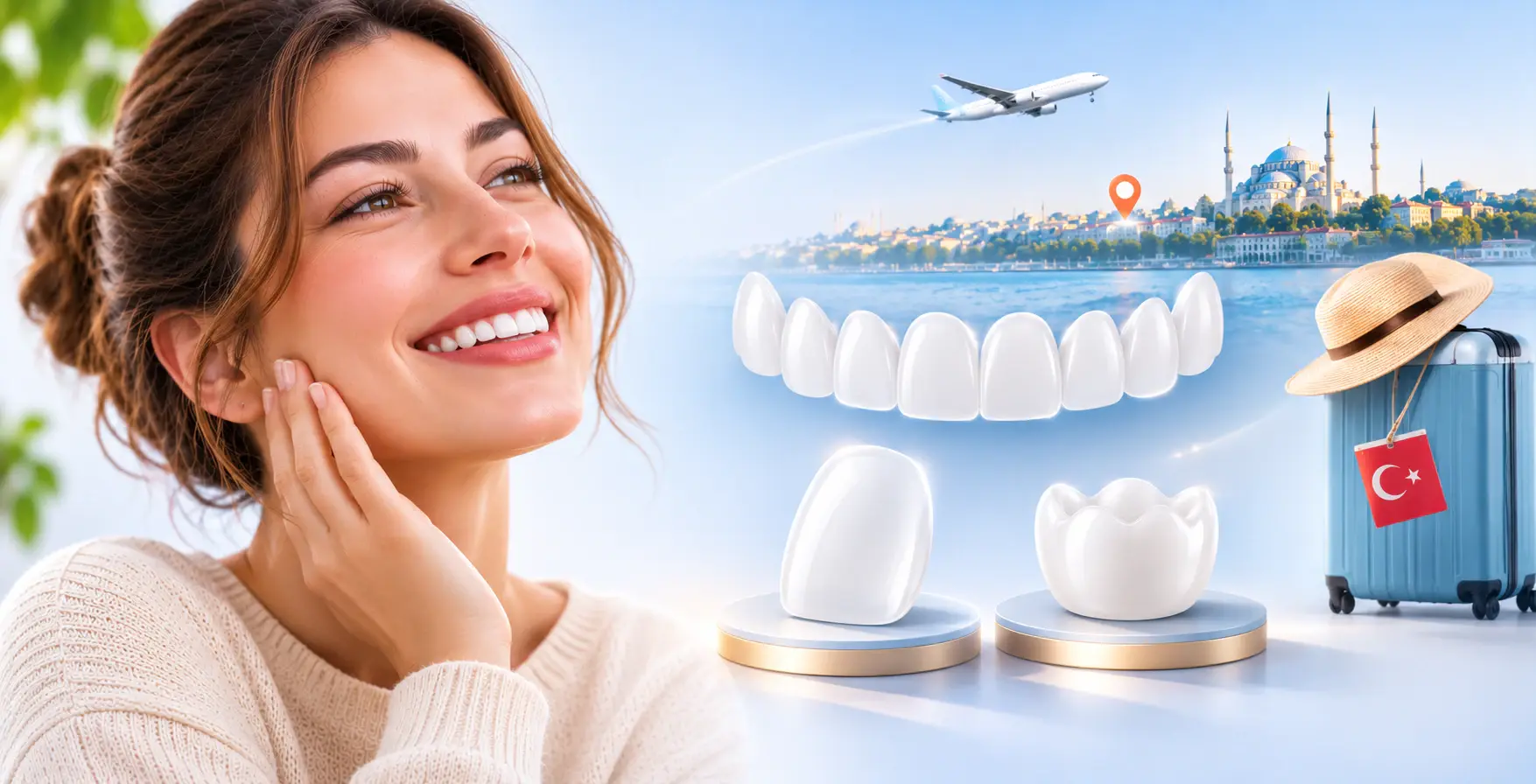
Most patients need 8 to 10 veneers on the upper front teeth for a Hollywood Smile. More comprehensive plans treat 16, 20, 24 or even 28 teeth across both arches. The right number depends on your smile width, lip dynamics, tooth condition and aesthetic goals, not on a fixed package.
A Hollywood Smile is a personalized cosmetic dentistry treatment, not a procedure with a standard number of veneers. When patients search for how many veneers a Hollywood Smile requires, they often expect one universal figure. Clinical reality works differently. Dentists design each treatment plan around the individual anatomy of the patient. Many patients ask how many veneers for a Hollywood Smile deliver the best result, and the honest answer is that the count follows the diagnosis, never the reverse.
Most smile makeovers focus on the 8 to 10 upper teeth that show during a normal smile. Wider smiles and higher aesthetic expectations can justify extending treatment to the lower arch. This is where the 16, 20, 24 and 28-tooth configurations come in. These numbers describe the total treated teeth across both dental arches. They do not describe a fixed number of veneers. Veneers, dental crowns and other restorations are not interchangeable terms, and a single plan can combine several of them.
What Does a Hollywood Smile Treatment Involve?
A Hollywood Smile combines one or more cosmetic procedures to improve tooth colour, shape, alignment and facial harmony. Typical components include porcelain or E.max veneers, crowns, whitening and gum contouring.
A Hollywood Smile pursues four aesthetic objectives. It creates a brighter and more uniform tooth colour. It establishes balanced tooth proportions and symmetry. It improves alignment and tooth shape. It builds harmony between the teeth, the lips and the facial features. Research on smile aesthetics confirms that observers judge attractiveness through the relationship between the teeth and the surrounding facial frame, not through the teeth alone (Sarver, 2001).
A Hollywood Smile differs from a traditional veneer treatment in scope. A traditional veneer case corrects one or a few flawed teeth. A Hollywood Smile redesigns the entire visible smile as one coordinated system.
The treatment can involve several procedures:
Porcelain veneers for colour, shape and minor alignment corrections.
E.max veneers, made from lithium disilicate glass-ceramic, for high translucency and strength.
Dental crowns for teeth with structural damage that veneers cannot repair.
Teeth whitening for natural teeth that remain outside the restoration plan.
Gum contouring for an uneven gum line or a gummy smile.
Some patients need a combination of cosmetic and restorative procedures. A tooth with a large filling or a root canal treatment may require a crown, while its healthy neighbours receive veneers. Perception studies show that lay observers detect asymmetries and shade mismatches across a smile quickly, so the dentist must plan every visible element together (Kokich, Kiyak and Shapiro, 1999).
How Many Veneers Are Usually Needed for a Hollywood Smile?
Most Hollywood Smile cases use 8 to 10 veneers on the upper arch. This count covers the visible smile zone for the average patient.
The visible smile zone decides the veneer count. Classic smile studies found that an average full smile displays about 10 maxillary teeth, from one premolar region to the other (Tjan, Miller and The, 1984). This anatomical fact explains why 8 to 10 upper veneers dominate comprehensive cosmetic makeovers.
Some patients achieve their goals with fewer restorations. A patient with a narrow smile, good enamel and minor flaws may need only 4 to 6 veneers. The lower teeth can also enter the plan when they stay visible during speech or laughter. Treating the visible teeth differs fundamentally from restoring an entire dental arch. The first approach pursues aesthetics. The second approach belongs to full-mouth rehabilitation and requires a restorative justification for every treated tooth.
What Is the Difference Between 16, 20, 24 and 28 Teeth in a Hollywood Smile?
These numbers describe the total treated teeth across the upper and lower arches. A 20-tooth plan can mix veneers, crowns and whitening-treated teeth. The figures illustrate possible configurations, not universal clinical standards.
Configuration | Typical Distribution | Best Suited For | Main Consideration |
16 teeth | 8 upper + 8 lower | Narrow to average smiles | Confirm lower teeth actually show |
20 teeth | 10 upper + 10 lower | Wide smiles with premolar visibility | Assess the lower smile line first |
24 teeth | 12 upper + 12 lower | Very wide smiles and laughter exposure | Match colour and shape precisely |
28 teeth | 14 upper + 14 lower | Extensive restorative or combined cases | Distinguish aesthetics from rehabilitation |
The following sections explain each configuration in detail.
16 Teeth – A Focused Full Smile Makeover
A Hollywood Smile 16 teeth plan usually treats 8 upper and 8 lower teeth. It suits patients whose visible smile zone stops before the back teeth.
Treating both arches improves colour and shape consistency. A bright upper veneer set next to darker natural lower teeth creates a visible contrast, so the lower 8 often join the plan. The dentist must still assess whether all 16 teeth genuinely need restorations. Whitening can sometimes replace lower veneers when the enamel stays healthy and the alignment looks acceptable.
20 Teeth – A More Comprehensive Smile Transformation
A Hollywood Smile 20 teeth plan usually covers 10 upper and 10 lower teeth. It fits patients with wider smiles and greater tooth visibility.
Extending treatment towards the premolars creates a consistent appearance across the whole smile. A narrow 8-tooth veneer set can leave darker premolars visible at the corners of a wide smile, an effect sometimes called a dark corridor. Before the dentist adds restorations to the lower arch, the evaluation of the lower smile line decides whether those teeth actually display during speech and laughter.
24 Teeth – Extended Coverage Across Both Dental Arches
A Hollywood Smile 24 teeth plan usually includes 12 upper and 12 lower teeth. It serves cases where additional posterior teeth become visible during wide smiles or laughter.
This configuration demands precise matching of colour, shape and proportions across a large restoration set. Small discrepancies multiply across 24 units and become noticeable. Extending treatment beyond the visible smile zone rarely adds aesthetic benefit. Every additional tooth needs a clinical or visual justification, and the laboratory workload grows with each unit.
28 Teeth – A Near-Full-Arch Cosmetic or Restorative Approach
A Hollywood Smile 28 teeth plan treats 14 upper and 14 lower teeth. It usually indicates extensive restorative planning rather than a purely cosmetic makeover.
Dentists and patients must separate cosmetic enhancement from full-mouth rehabilitation. A cosmetic case improves appearance. A rehabilitation case rebuilds worn, damaged or missing tooth structure across the mouth. Molars and other posterior teeth should only receive restorations when a clinical indication exists, such as fractures, large fillings or severe wear. Preserving healthy natural tooth structure remains the guiding principle, because every preparation removes tissue that the body cannot regenerate (Edelhoff and Sorensen, 2002).
Which Factors Determine the Number of Veneers Required?
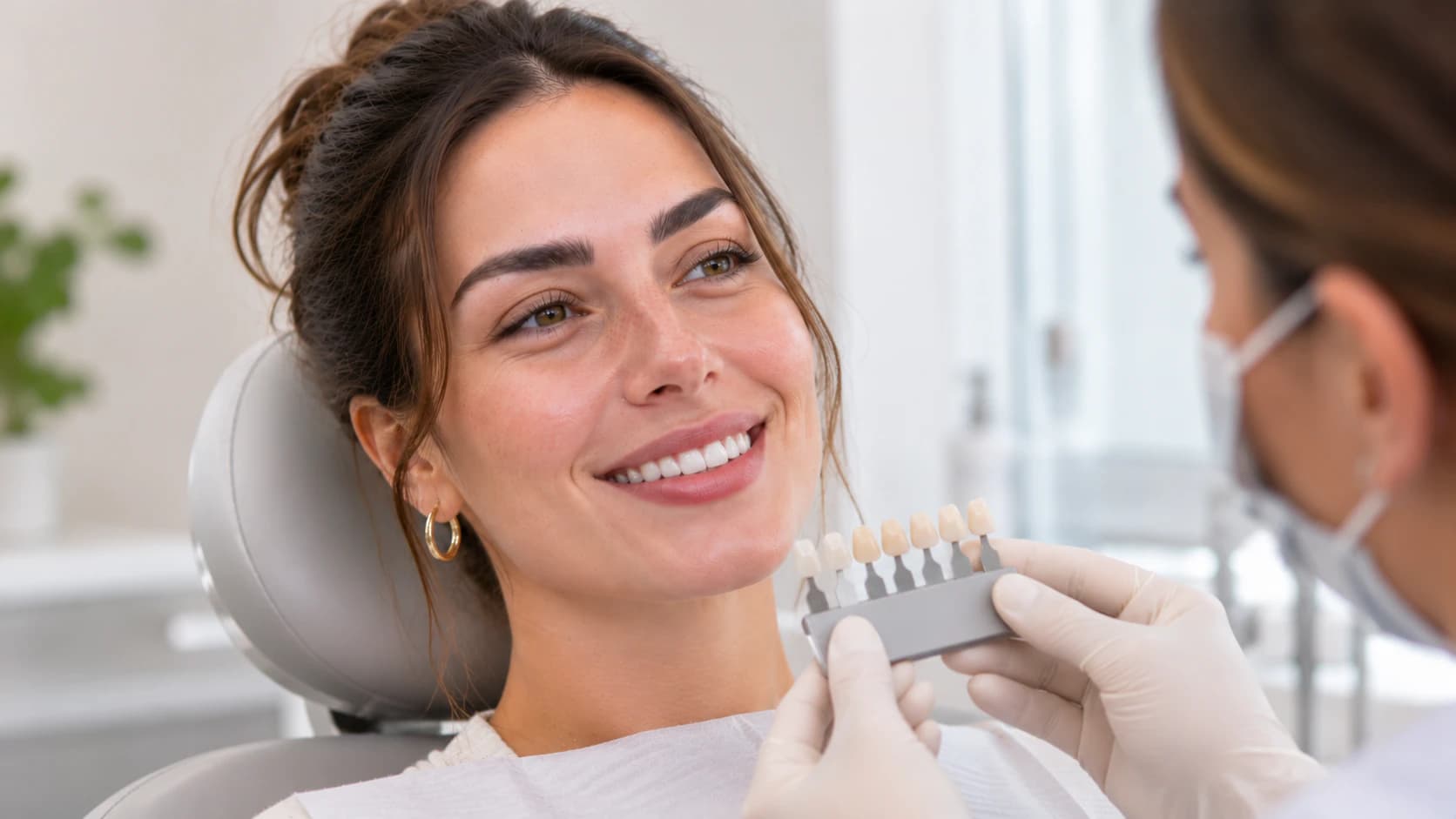
Dentists evaluate smile width, lip lines, natural tooth colour, alignment and structural condition. No fixed veneer count applies to every patient.
Individual dental anatomy drives the treatment plan. The number of veneers needed varies because faces, lips, teeth and expectations vary. Four main considerations shape the decision.
Smile Width and Visible Teeth
A wider smile exposes more premolars and often requires more veneers for a consistent result.
A wide smile can display 12 or more teeth per arch. If the veneer set stops at 6 teeth, the untreated premolars show a colour and texture difference at the smile corners. The dentist evaluates the smile from the front and from both sides, because profile views reveal teeth that a frontal mirror check misses.
Upper and Lower Lip Lines
Lip movement controls how much tooth surface shows during speech and smiling, and it directly shapes the treatment plan.
Upper lip movement determines the visibility of the upper teeth and the gum line. The lower teeth appear during speech and during broad smiles, especially in patients with active lower lip dynamics. Patients with different lip dynamics therefore need different plans. A patient who rarely shows lower teeth may skip lower veneers entirely, while a patient with a highly mobile lower lip often benefits from treating both arches.
Natural Tooth Colour and Existing Discolouration
Strong natural discolouration pushes the plan towards more veneers, while mild staining often responds to whitening alone.
Clinicians separate intrinsic discolouration, which sits inside the tooth structure, from extrinsic discolouration, which stains the enamel surface. Veneers mask intrinsic defects such as tetracycline staining effectively. A visible shade difference between restored and natural teeth harms the aesthetic harmony of the whole smile. Professional whitening can reduce the need for additional veneers when it lifts the natural teeth close enough to the planned veneer shade.
Tooth Alignment, Shape and Structural Condition
Chipped, worn or misaligned teeth change the veneer count, and severe cases may need orthodontics or crowns instead.
Chipped, worn, uneven or irregularly shaped teeth each require individual assessment. Existing restorations and the remaining enamel condition influence the choice between a veneer and a crown, because veneers bond most reliably to intact enamel (Magne and Belser, 2002). Significant crowding or rotation calls for orthodontic treatment before any veneer work, since veneers cannot correct major alignment problems without aggressive and unhealthy preparation.
Do You Need Veneers on Both Upper and Lower Teeth?
No, most patients need veneers on the upper teeth only. Lower veneers help when the lower teeth show prominently or clash with the new upper shade.
Upper teeth receive priority in cosmetic smile makeovers because they dominate the visual field of a smile. Upper and lower veneers together make sense in specific situations:
The lower teeth appear prominently during speech.
The natural lower teeth contrast with the new upper veneer shade.
Tooth wear or irregular shapes disturb the symmetry of the smile.
The patient wants a coordinated appearance across both arches.
Treating both arches does not mean treating every tooth. The dentist assesses the relationship between the upper and lower teeth, including contact points and the bite, and treats only the teeth that contribute to the visual or functional problem.
Can You Get a Hollywood Smile with Only 6, 8 or 10 Veneers?
Yes. Many patients achieve a full Hollywood Smile effect with 6, 8 or 10 veneers, provided the restorations match the untreated teeth in colour and shape.
A partial smile makeover treats only the most visible teeth, while an extensive treatment covers a larger zone. Smaller veneer counts cost less and preserve more natural enamel. Their limitation appears when the untreated teeth show clear differences in shade or texture next to the new restorations. Preventing visible colour and shape differences between restored and untreated teeth is the central challenge of any partial plan.
The 4-8-10 rule offers a simplified way to understand upper smile zone coverage. Four veneers cover the front teeth only, eight veneers reach the first premolars on many patients, and ten veneers cover the full visible zone of an average wide smile. Clinicians use this rule as a planning guideline, not as a clinical requirement.
How Does a Dentist Determine the Ideal Number of Veneers?
Dentists combine Digital Smile Design, radiographic examination and bite analysis to build an individualized treatment plan before they decide on any veneer count.
A clinical examination always precedes the decision about the number of restorations. Three diagnostic steps structure this process.
Digital Smile Design and Facial Analysis
Digital Smile Design software simulates the planned result on photographs and video, so the patient and dentist can agree on the outcome before any treatment starts.
Digital Smile Design evaluates facial symmetry, lip proportions and tooth dimensions against facial reference lines. The software produces digital simulations that help patients understand the proposed changes and give informed consent (Coachman and Calamita, 2012). This step turns an abstract discussion about veneer numbers into a visible preview.
Dental X-Rays and Oral Health Assessment
X-rays reveal the condition of roots, fillings and bone, and every oral health problem needs treatment before cosmetic work begins.
The dentist evaluates tooth roots, existing fillings and the surrounding bone on radiographs. Cavities, gum disease and other pathology must receive treatment first, because veneers placed on unhealthy foundations fail early. The assessment also checks whether each tooth suits a veneer or requires an alternative restoration such as a crown.
Bite Analysis and Occlusal Evaluation
Bite analysis measures how the upper and lower teeth meet, and it identifies grinding habits that can fracture veneers.
The dentist examines how the teeth interact during biting and chewing. The evaluation looks for bruxism, excessive pressure and bite irregularities. An unsuitable bite concentrates force on the veneer edges and raises the risk of chipping, fracture and debonding, so the dentist corrects or protects the bite before finalizing the restoration plan.
Do All Teeth Need Veneers to Achieve a Hollywood Smile?
No. A Hollywood Smile rarely requires veneers on every tooth. Selective veneer placement on the visible teeth creates a balanced appearance in most cases.
Full mouth veneers sound comprehensive, but the concept conflicts with minimally invasive dentistry for most patients. Healthy enamel deserves preservation, because no restorative material matches the longevity and biological integration of natural tooth structure. Conservative preparation and selective placement deliver the aesthetic change while they limit tissue loss (Strassler, 2007).
Alternative treatments can replace veneers where they fit better:
Professional teeth whitening for colour correction on healthy enamel.
Orthodontic treatment for alignment problems.
Composite bonding for small chips and shape corrections.
Dental crowns when structural damage makes a crown clinically necessary.
Minimally invasive treatment planning avoids unnecessary dental preparation. The best plan treats the fewest teeth that still achieve the aesthetic goal.
How Does the Number of Veneers Affect Hollywood Smile Costs?
The total Hollywood Smile cost scales with the number of restorations, because laboratories and clinics charge per unit. Treating 28 teeth costs substantially more than treating 16.
The number of restorations drives the overall price, but several factors shape the final figure:
Veneer material, such as porcelain or E.max.
Laboratory fabrication and the level of customization.
Dentist expertise and clinic facilities.
Preliminary treatments, including gum therapy and fillings.
Digital smile planning and temporary restorations.
Treating 28 teeth generally involves a larger investment than treating 16 teeth, and complex restorative cases raise the per-unit cost as well. A trustworthy quotation reflects the actual clinical treatment plan. Patients should treat predetermined package prices with caution, because the package model assumes a tooth count before any diagnosis exists.
What Are the Risks of Getting Too Many Veneers?
Unnecessary veneers remove healthy enamel and add avoidable risks, including sensitivity, fracture, gum irritation, bite problems and future replacement costs.
Every veneer preparation removes enamel, and enamel removal can increase tooth sensitivity. The amount of removed structure varies widely with the preparation design, which makes conservative planning essential (Edelhoff and Sorensen, 2002). Potential complications include:
Enamel loss and increased tooth sensitivity.
Veneer chipping or fracture under functional load.
Gum irritation and inflammation at the restoration margins.
Bite discomfort and occlusal problems.
Future maintenance and replacement requirements.
Proper case selection and conservative preparation protect long-term outcomes. Clinical studies report high survival rates for porcelain veneers placed on suitable candidates, with up to 5-year survival estimates around 95 percent in systematic reviews (Layton, 2012). Veneers are not permanent restorations. They may eventually require replacement, and every replacement cycle can remove further tooth structure.
How Long Does a Hollywood Smile with Multiple Veneers Last?
Porcelain veneers typically last 10 to 15 years or longer with good care. Composite veneers usually last 5 to 7 years.
Veneer longevity depends on material quality, preparation technique and oral hygiene. Long-term clinical data show that porcelain laminate veneers maintain high survival rates beyond a decade when dentists bond them primarily to enamel (Peumans et al., 2004). Prospective trials report 10-year success rates above 90 percent for carefully selected cases (Fradeani, Redemagni and Corrado, 2005).
Material | Expected Lifespan | Strengths | Limitations |
Porcelain (feldspathic) | 10 to 15+ years | Superior aesthetics, colour stability | Higher cost, requires lab work |
E.max (lithium disilicate) | 10 to 15+ years | High strength and translucency | Needs adequate enamel for bonding |
Composite | 5 to 7 years | Lower cost, single visit | Stains and wears faster |
Teeth grinding, biting hard objects and poor oral hygiene shorten the lifespan of every restoration type. Regular dental check-ups and professional maintenance allow the dentist to detect margin problems early. Patients with bruxism benefit from a night guard that protects the veneers during sleep.
Frequently Asked Questions About the Number of Veneers for a Hollywood Smile
The following questions cover the decisions patients raise most often during consultation.
Is 16 Teeth Enough for a Hollywood Smile?
Yes, 16 restorations provide sufficient coverage for many patients with average smile width.
This configuration covers 8 upper and 8 lower teeth, which matches the visible zone of most smiles. The decisive question is whether the upper and lower teeth show enough to justify the count. A consultation with photographs and a smile analysis answers this question reliably.
Is 20 Teeth a Standard Hollywood Smile Treatment?
No, 20 teeth represent one possible configuration, not a universal standard.
Smile width and aesthetic expectations influence this choice. Patients with wide smiles often benefit from premolar coverage, while patients with average smiles reach the same visual result with fewer units.
Is 24 Teeth Too Many for a Hollywood Smile?
Extended coverage is justified when posterior teeth show during wide smiles or laughter. Without that visibility, the extra restorations add cost and risk without aesthetic gain.
Treating additional teeth without a clinical reason is not recommended. Each prepared tooth carries lifelong maintenance obligations, so the plan should stop where the visible zone ends.
Does a Hollywood Smile Always Require 28 Veneers?
No. Full-arch coverage is unnecessary for most cosmetic cases.
A 28-tooth approach usually signals full-mouth rehabilitation rather than a cosmetic makeover. Rehabilitation addresses worn, damaged or missing teeth and follows functional indications. Cosmetic cases concentrate on the visible smile zone.
Can I Get a Hollywood Smile Without Shaving My Teeth?
Yes, no-prep and minimal-preparation veneers exist, but they suit only selected cases.
Tooth position, enamel condition and the desired aesthetic change determine suitability. No-prep veneers work best on small or slightly recessed teeth. Prominent or severely discoloured teeth often need some preparation to avoid a bulky result (Magne and Belser, 2002).
Are Veneers Better Than Crowns for a Hollywood Smile?
Veneers suit healthy teeth with aesthetic flaws. Crowns suit teeth with structural damage. Neither option is universally better.
Criterion | Veneer | Crown |
Tooth preparation | Minimal, front surface only | Full circumference |
Coverage | Facial surface | Entire clinical crown |
Best indication | Colour, shape, minor alignment | Fractures, large fillings, root canal treated teeth |
Enamel preservation | High | Lower |
Dentists select the restoration according to the condition of each tooth. A single Hollywood Smile plan can combine veneers on healthy teeth with crowns on damaged teeth.
Can I Get a Hollywood Smile If I Have Missing Teeth?
Yes. Dental implants, bridges and other restorative options replace missing teeth and integrate into a coordinated Hollywood Smile plan.
The dentist sequences the treatment so the implants or bridges heal and settle before the final veneer work. This coordination guarantees that every restoration matches in colour, shape and proportion.
How Can You Choose the Right Hollywood Smile Treatment Plan?
Choose the plan that a professional diagnosis supports, and prioritize natural-looking results and long-term dental health over the number of restorations.
The ideal number of veneers depends on individual dental anatomy and aesthetic goals. A professional examination, Digital Smile Design and bite analysis turn the vague question of how many veneers a Hollywood Smile needs into a precise, personal answer. The evidence supports conservative planning: veneers placed on well-selected cases show excellent long-term survival, while unnecessary preparation permanently sacrifices healthy tissue (Layton, 2012).
A successful Hollywood Smile enhances the existing smile and preserves as much healthy tooth structure as possible. The best number of veneers is the smallest number that achieves the patient's goal.
References
Coachman, Christian, and Marcelo Calamita. "Digital Smile Design: A Tool for Treatment Planning and Communication in Esthetic Dentistry." Quintessence of Dental Technology, vol. 35, 2012, pp. 103-111.
Edelhoff, Daniel, and John A. Sorensen. "Tooth Structure Removal Associated with Various Preparation Designs for Anterior Teeth." Journal of Prosthetic Dentistry, vol. 87, no. 5, 2002, pp. 503-509.
Fradeani, Mauro, Marco Redemagni, and Marco Corrado. "Porcelain Laminate Veneers: 6- to 12-Year Clinical Evaluation. A Retrospective Study." International Journal of Periodontics and Restorative Dentistry, vol. 25, no. 1, 2005, pp. 9-17.
Kokich, Vincent O., H. Asuman Kiyak, and Peter A. Shapiro. "Comparing the Perception of Dentists and Lay People to Altered Dental Esthetics." Journal of Esthetic and Restorative Dentistry, vol. 11, no. 6, 1999, pp. 311-324.
Layton, Danielle M. "A Systematic Review and Meta-Analysis of the Survival of Feldspathic Porcelain Veneers over 5 and up to 10 Years." International Journal of Prosthodontics, vol. 25, no. 6, 2012, pp. 590-603.
Magne, Pascal, and Urs Belser. Bonded Porcelain Restorations in the Anterior Dentition: A Biomimetic Approach. Quintessence Publishing, 2002.
Peumans, Marleen, et al. "A Prospective Ten-Year Clinical Trial of Porcelain Veneers." Journal of Adhesive Dentistry, vol. 6, no. 1, 2004, pp. 61-68.
Sarver, David M. "The Importance of Incisor Positioning in the Esthetic Smile: The Smile Arc." American Journal of Orthodontics and Dentofacial Orthopedics, vol. 120, no. 2, 2001, pp. 98-111.
Strassler, Howard E. "Minimally Invasive Porcelain Veneers: Indications for a Conservative Esthetic Dentistry Treatment Modality." General Dentistry, vol. 55, no. 7, 2007, pp. 686-694.
Tjan, Anthony H. L., Gary D. Miller, and Josephine G. P. The. "Some Esthetic Factors in a Smile." Journal of Prosthetic Dentistry, vol. 51, no. 1, 1984, pp. 24-28.