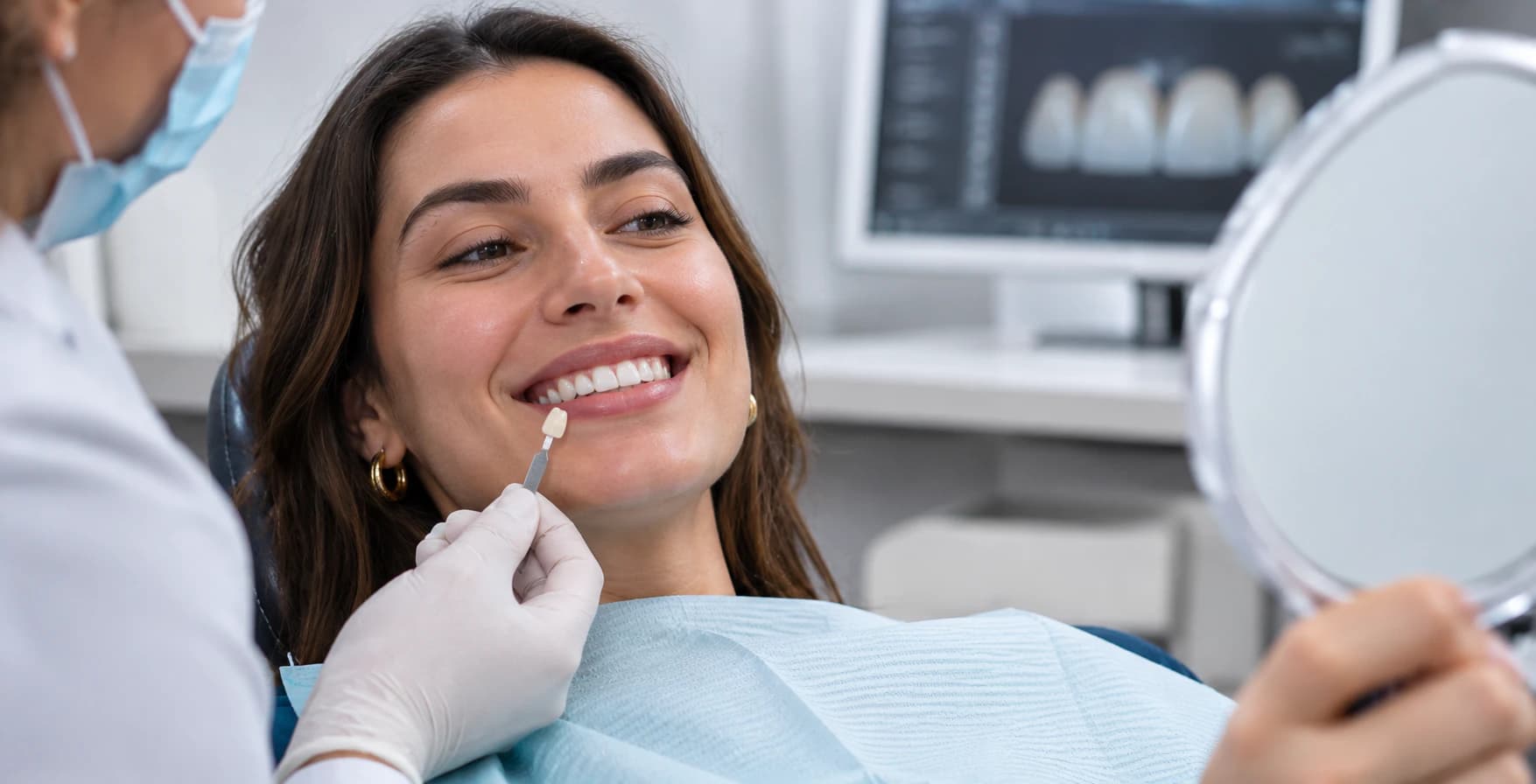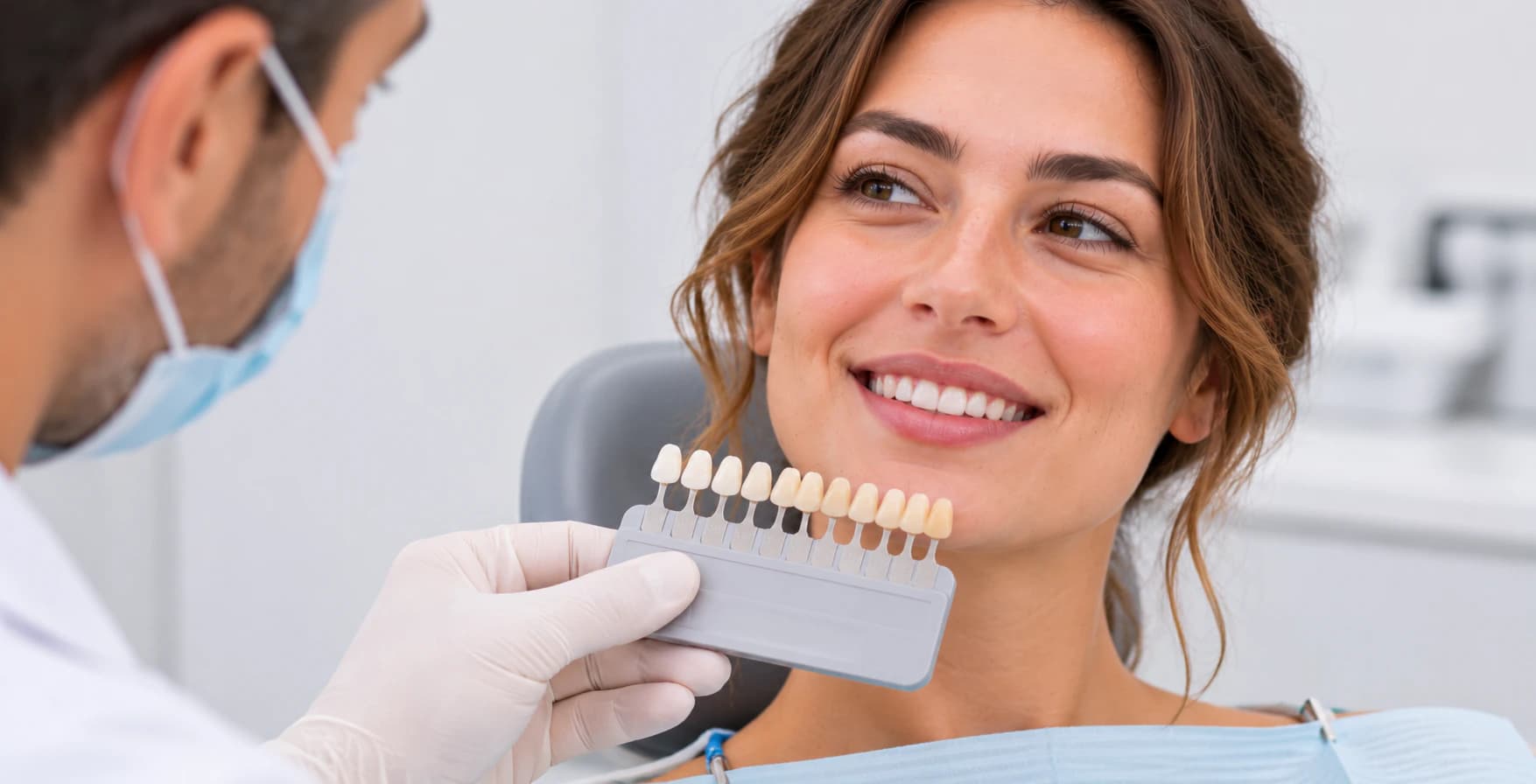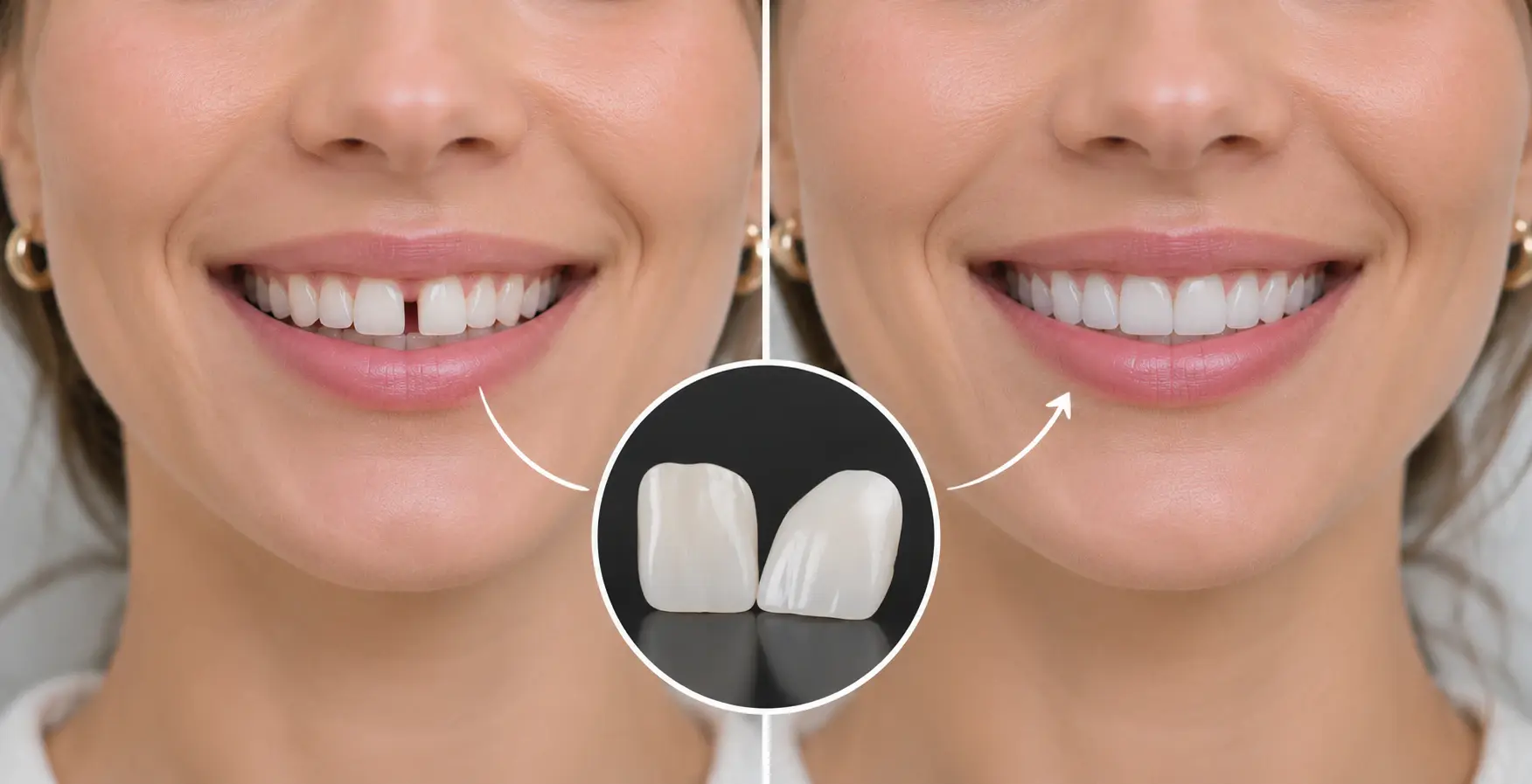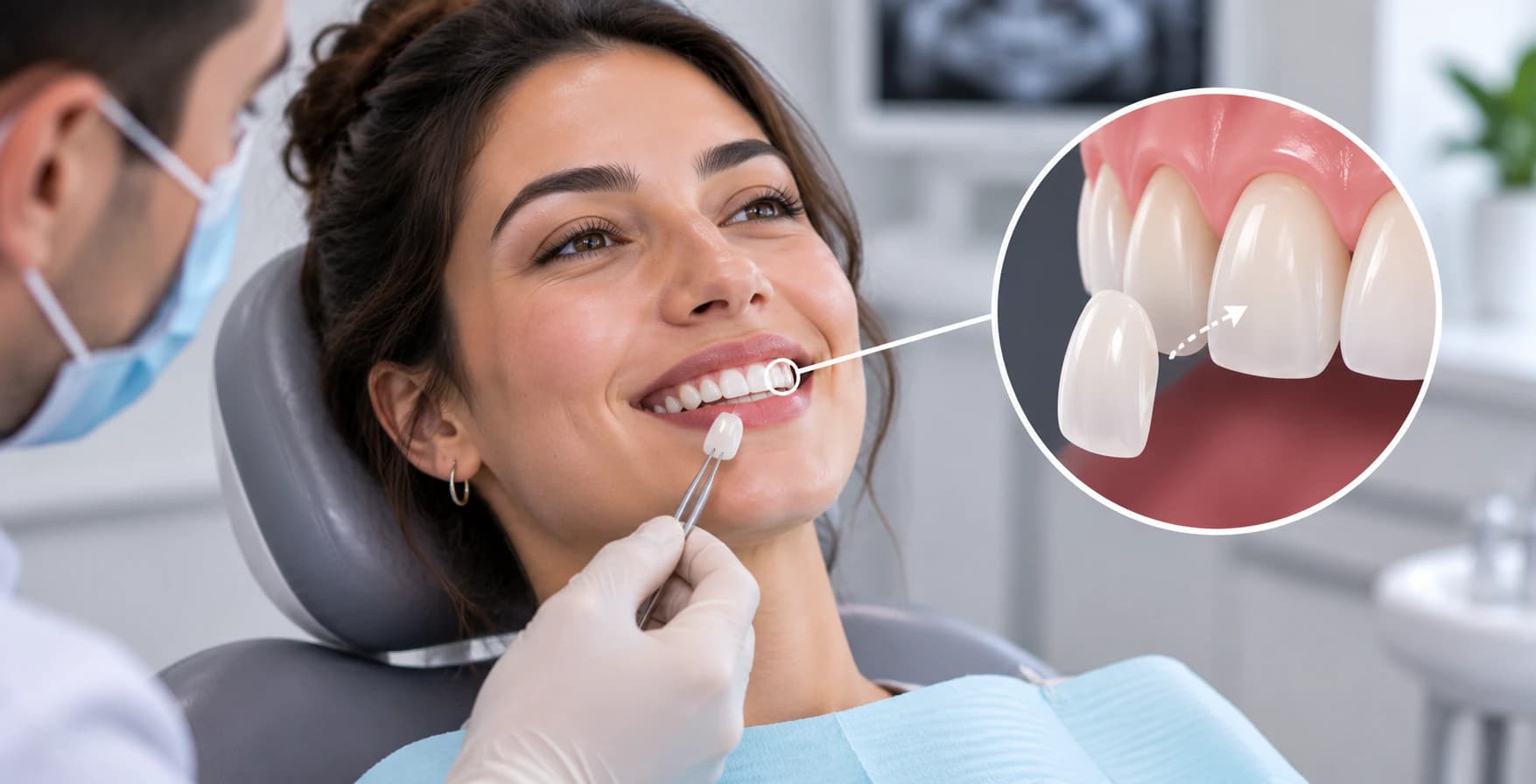
E.max veneers are thin ceramic shells that a dentist bonds to the front surface of a tooth to improve its colour, shape, size, and symmetry. Patients researching common questions about E.max veneers usually want one thing: reliable, science-based answers before they commit to treatment. This guide provides exactly that.
Each section below answers one question in full. The first lines give you the direct answer; the paragraphs that follow explain the clinical reasoning, the evidence, and the practical details. The topics move from the material itself to suitability, procedure, durability, maintenance, cost, and alternatives, so you can read the article from start to finish or jump to the question that matters most to you.
E.max veneers belong to the lithium disilicate glass-ceramic family, one of the most studied materials in modern restorative dentistry (Zarone et al. 2019). Understanding the material first makes every later answer easier to judge.
What Are E.max Veneers Made Of?
E.max veneers consist of lithium disilicate glass-ceramic, a material that the manufacturer Ivoclar produces under the IPS e.max brand. The ceramic contains roughly 70 percent needle-shaped lithium disilicate crystals locked inside a glassy matrix, and this microstructure gives the material a flexural strength of about 360 to 400 megapascals (Kelly and Benetti 2011).
That microstructure explains the two properties dentists value most. The crystal network deflects cracks, so the ceramic resists fracture better than older porcelains. The glassy phase transmits and scatters light in a way that closely copies natural enamel, so the veneer looks alive rather than flat (Holand and Beall 2012).
Conventional feldspathic porcelain contains far fewer reinforcing crystals and reaches only about 90 to 120 megapascals. Composite resin, the other common veneer material, mixes a polymer base with glass filler particles and matches neither the strength nor the light behaviour of lithium disilicate (Zarone et al. 2019).
What Is the Difference Between IPS e.max Veneers and E.max Crowns?
Both restorations use the same ceramic, but they cover different amounts of the tooth. A veneer is a thin facing bonded to the front surface only. A crown wraps around the whole tooth. Dentists choose a veneer when the tooth is structurally sound and a crown when the tooth needs full protection (Guess et al. 2011). Laboratories produce the material as pressable ingots (IPS e.max Press) or as blocks for computer-aided milling (IPS e.max CAD).
What Dental Problems Can E.max Veneers Correct?
E.max veneers correct visible imperfections on otherwise healthy front teeth: deep discolouration that whitening cannot lift, chips, worn edges, uneven shapes, small gaps, and mild alignment irregularities.
Intrinsic stains respond especially well. Tetracycline staining and fluorosis sit inside the tooth structure, so bleaching agents rarely reach them; a veneer masks the colour completely (Peumans et al. 2000). The same shell can rebuild a chipped biting edge, lengthen a worn tooth, or close a small gap between the front teeth.
Veneers can also disguise slightly rotated or crooked teeth in selected cases. This works only for minor irregularities. A patient with a true bite disorder still needs orthodontic treatment, because a veneer changes what you see, not how the teeth meet.
Structural problems fall outside the veneer's scope. Extensive decay, large existing fillings, and fractured teeth need restorative treatment such as crowns, and active gum disease needs periodontal care first (Peumans et al. 2000). This boundary defines who makes a good candidate.
Who Is a Suitable Candidate for E.max Veneers?
A suitable candidate has healthy teeth, enough natural enamel for bonding, stable gums, and a balanced bite. Enamel matters most, because resin cement bonds to enamel far more reliably than to the softer dentine beneath it (Magne and Belser 2002).
Existing restorations and bite alignment also shape eligibility. Large fillings reduce the amount of sound enamel available. A deep bite or an edge-to-edge bite concentrates force on the ceramic. Your dentist weighs these factors during the examination.
Some conditions rule veneers out entirely: extensive decay, severe structural damage, and untreated periodontal disease. Teeth with such problems need crowns or other restorative care instead.
Patients who grind or clench their teeth (bruxism) need extra precautions rather than automatic exclusion. Systematic reviews estimate that about 13 percent of adults grind during sleep, and even more clench while awake (Manfredini et al. 2013). This habit matters: one long-term study measured a 7.7 times higher veneer failure risk in patients with parafunction (Beier et al. 2012). A protective night guard reduces this risk substantially. Only an individual dental examination can confirm candidacy, because X-rays and bite analysis reveal what a mirror cannot.
Do Dentists Need to Shave Natural Teeth for E.max Veneers?
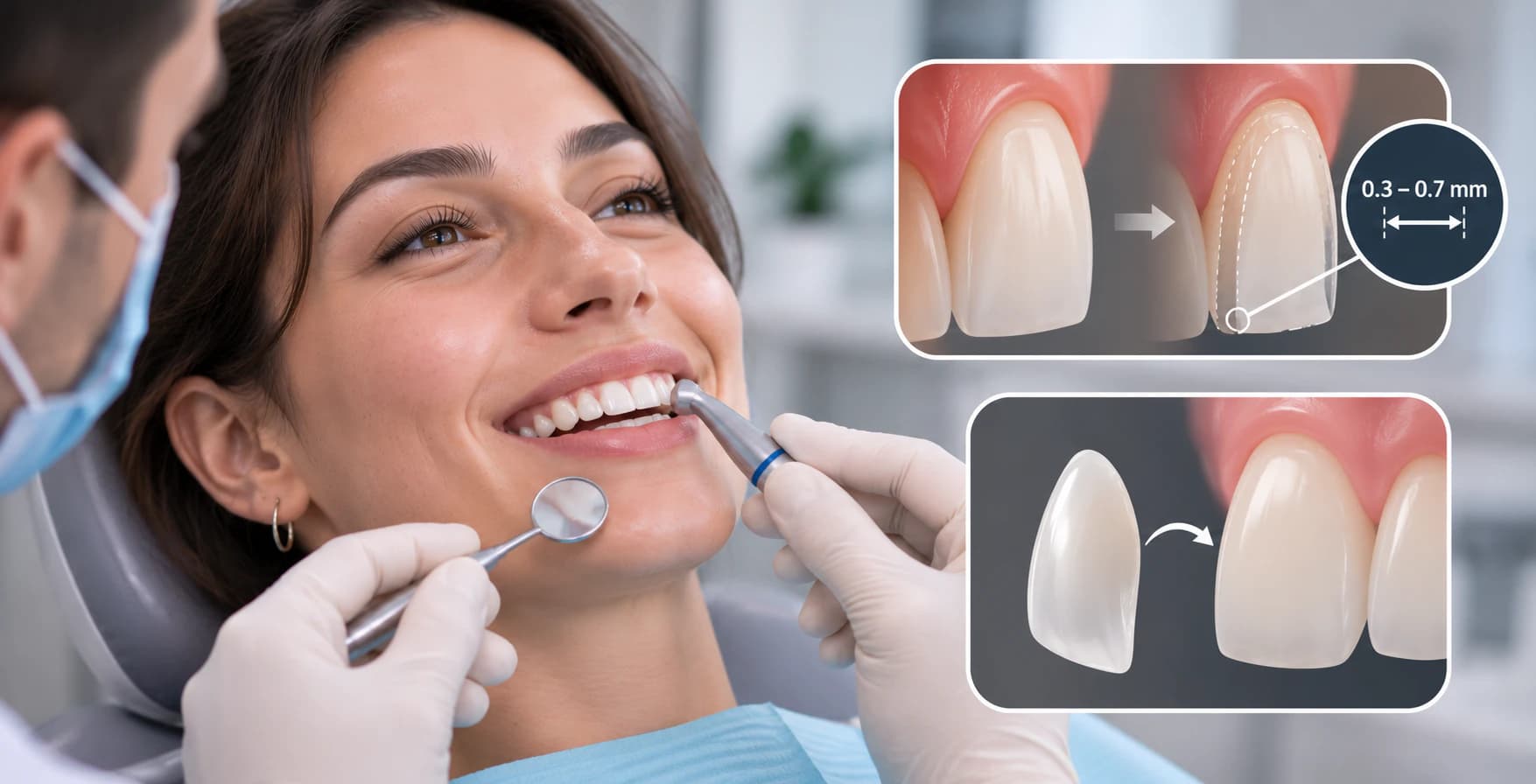
In most cases the dentist removes a thin layer of enamel, usually 0.3 to 0.7 millimetres from the front surface. This creates space for the ceramic so the finished veneer sits flush with neighbouring teeth instead of looking bulky.
Three preparation philosophies exist. Traditional preparation removes enamel evenly across the face of the tooth and often wraps the biting edge. Minimal-prep designs stay within enamel and reshape only where needed. No-prep veneers add ceramic directly onto the untouched tooth. Laboratory research shows that preparation design, not just depth, determines how much tissue the dentist removes (Edelhoff and Sorensen 2002).
Preserving enamel matters for two reasons. Adhesive bonds to enamel last longer than bonds to dentine, and untouched enamel keeps the tooth strong and insensitive. Excessive removal invites the opposite: temperature sensitivity, weakened tooth structure, and a higher chance of needing root canal treatment later (Magne and Belser 2002).
No-prep treatment does not suit every patient. Protruding or severely darkened teeth still need reduction; otherwise the added ceramic makes the smile look over-contoured. The preparation question connects directly to material choice, because thinner ceramics demand less space.
Are E.max Veneers Better Than Traditional Porcelain Veneers?
E.max veneers offer higher fracture resistance and consistent quality, while traditional feldspathic porcelain can achieve extremely fine, hand-layered aesthetics in expert hands. Neither wins automatically; the right choice depends on the case.
Property | E.max (lithium disilicate) | Feldspathic porcelain |
Material class | Glass-ceramic with crystal reinforcement | Traditional dental porcelain |
Flexural strength | About 360 to 400 MPa | About 90 to 120 MPa |
Typical minimum thickness | Around 0.3 mm | Around 0.3 to 0.5 mm |
Fabrication | Heat-pressed or CAD/CAM milled | Hand-layered and fired |
Translucency | High, in several grades | Very high with skilled layering |
Best suited for | Most routine veneer cases | Ultra-fine aesthetic cases |
Manufacturing technique shapes the outcome as much as composition. Pressed lithium disilicate shows a dense, homogeneous structure, and milled versions allow precise digital design; both outperform conventionally stacked porcelain in strength testing (Guess et al. 2011). Clinical data support the gap: a meta-analysis estimated survival of 94 percent for glass-ceramic veneers against 87 percent for feldspathic porcelain over a median of nine years (Morimoto et al. 2016). Your dental condition and treatment goals still make the final call.
How Long Do E.max Veneers Last?
Clinical evidence shows that glass-ceramic veneers last well beyond a decade in most patients. Long-term data report survival rates around 93 percent at 10 years and roughly 83 percent at 20 years for silicate ceramic veneers (Beier et al. 2012), and a dedicated review of non-feldspathic veneers confirmed comparably high survival at five and ten years (Layton and Clarke 2013).
Longevity depends on four controllable factors: bonding quality at cementation, daily oral hygiene, the forces your bite applies, and habits such as chewing hard objects. A veneer bonded to intact enamel under strict moisture control starts with the strongest possible foundation (Magne and Belser 2002).
Premature failure follows a predictable pattern. Fracture and chipping top the list, followed by debonding, marginal leakage, and secondary decay. The meta-analysis by Morimoto and colleagues measured fracture or chipping in about 4 percent and debonding in about 2 percent of veneers (Morimoto et al. 2016).
Regular dental examinations protect the investment, because a dentist spots marginal gaps and early cracks long before you feel them. Veneers are durable restorations, but no responsible clinician promises they will last a lifetime.
Can E.max Veneers Break, Chip, or Crack?
Yes, they can, although lithium disilicate resists damage better than older ceramics. Its interlocking crystals slow crack growth, which is why fracture stays a rare complication rather than a common one (Morimoto et al. 2016).
Damage usually traces back to a cause. Accidents and sports injuries deliver trauma the material never evolved to handle. Biting fingernails, pens, or ice concentrates force on a thin ceramic edge. Night-time grinding adds thousands of uncontrolled loading cycles, and it remains the strongest behavioural risk factor for veneer failure (Beier et al. 2012).
Not all damage looks the same. A minor surface chip may need only polishing. A partial fracture through the ceramic usually means replacement. A veneer that pops off intact (debonding) can often be rebonded after the dentist checks the tooth and the fitting surface.
Prevention is straightforward: never use your front teeth as tools, and wear a night guard if you grind. The same dense surface that resists fracture also shapes how the veneer handles stains.
Are E.max Veneers Resistant to Stains?
Yes. Lithium disilicate has a dense, glazed, low-porosity surface, so pigments from coffee, tea, red wine, and tobacco cannot penetrate it the way they penetrate natural enamel or composite resin.
Stain resistance does not mean the whole smile stays frozen in time. The ceramic keeps its shade, but the resin cement at the margin can pick up surface stain over the years, and the natural teeth beside the veneers continue to darken with age and diet. Long-term research confirms this pattern: smokers in one 20-year study showed significantly more marginal discolouration, even though the ceramic itself stayed stable (Beier et al. 2012).
Good hygiene keeps the match seamless. Professional cleaning removes extrinsic stain from margins and natural enamel, and careful polishing restores the glaze. Patients who drink coffee or red wine daily simply need more consistent maintenance, not different veneers.
Is Getting E.max Veneers Painful?
Most patients feel little to no pain. Dentists normally numb the teeth with local anaesthesia before preparation, so you notice pressure and vibration rather than sharp sensations. The bonding appointment usually needs less anaesthesia, because it involves no cutting into tooth structure.
Mild sensitivity to hot and cold drinks is common for a few days after both preparation and final bonding. Freshly prepared enamel conducts temperature more easily until the tooth settles (Peumans et al. 2000).
Learn to separate expected symptoms from warning signs. Sensitivity that fades within a week or two is normal. Spontaneous throbbing, pain that wakes you at night, or pain when biting down needs prompt dental assessment, because these signs can indicate deeper irritation of the tooth nerve.
Comfort varies between patients. Thin enamel, the number of treated teeth, and individual pain thresholds all play a role; your dentist can adjust the anaesthetic plan to match.
How Many Appointments Are Needed for E.max Veneers?
The standard pathway takes two to three appointments spread over roughly two to four weeks. Laboratory fabrication time sets the pace.
The first visit covers consultation, examination, and smile assessment: photographs, X-rays where needed, and a discussion of goals. At the second visit the dentist prepares the teeth, takes a digital scan or conventional impression, and places temporary veneers to protect the prepared surfaces while the laboratory builds the ceramics. The final visit includes try-in, shade verification under different lighting, adhesive bonding, and bite adjustment.
Digital workflows are compressing this timeline. CAD/CAM systems can design and mill restorations inside the practice, so selected cases finish in fewer visits, although laboratory-made veneers still offer the most refined surface characterisation (Alghazzawi 2016). Complex smile designs and busy laboratory schedules extend the overall timeline; ask for a written schedule before you start.
Can E.max Veneers Look Natural?
Yes. Lithium disilicate reproduces the translucency of natural enamel better than almost any other restorative material, so light enters the veneer, scatters, and reflects much as it does in a real tooth (Kelly and Benetti 2011).
A natural result depends on more than the material. Shade selection must match your skin tone, age, and neighbouring teeth. Tooth proportions follow measured ratios. Surface texture breaks up reflections the way real enamel does, and characterisation adds the subtle colour gradients found at the neck and the biting edge of the tooth.
Smile design also respects the frame around the teeth. Lip position at rest and during smiling, facial symmetry, and the curve of the lower lip all guide the final shape; the biomimetic approach builds veneers to integrate with these landmarks (Magne and Belser 2002).
The difference between natural and artificial comes down to restraint. Excessively white, uniform, opaque veneers advertise themselves; well-designed ones disappear into the face. Custom fabrication by a skilled laboratory makes this possible.
Do E.max Veneers Affect Eating and Speaking?
After a short adaptation period, most patients eat and speak exactly as before. The first days feel different: your tongue notices the new contours, and your bite feels slightly unfamiliar while the brain recalibrates.
Speech changes occasionally appear when veneers lengthen the front teeth. Sounds such as "f" and "v" form where the lower lip meets the biting edges, so altered length can shift pronunciation for a few days. The effect fades as muscle memory adapts.
Proper thickness, positioning, and bite adjustment decide how invisible the change feels. A well-adjusted veneer distributes chewing force evenly; a poorly adjusted one creates pressure points that you feel immediately.
Certain habits still carry risk. Biting directly into very hard foods with veneered front teeth, chewing ice, or tearing packages with your teeth concentrates force on thin ceramic. If discomfort or bite changes persist beyond two weeks, book a review instead of waiting.
How Should You Care for E.max Veneers After Treatment?
Care for veneers the way you care for natural teeth: brush twice daily with a soft-bristled brush and a non-abrasive fluoride toothpaste, and clean between the teeth every day. The ceramic cannot decay, but the tooth underneath and the margin where they meet can.
Flossing around veneer margins deserves special attention. Plaque accumulates at the junction between ceramic and tooth, and neglected margins invite decay and gum inflammation. Interdental brushes work well where spaces allow.
Professional maintenance completes the routine. Attend check-ups and hygienist cleanings, typically every six months, and mention your veneers so the team uses ceramic-safe polishing pastes rather than coarse abrasives.
Protective habits extend lifespan. Avoid chewing ice, biting nails, and opening packaging with your teeth. If you grind or clench at night, wear the night guard your dentist provides, because parafunction remains a proven failure driver (Beier et al. 2012). Healthy gums matter just as much, since receding gums expose the veneer margin and spoil the aesthetic line.
Can E.max Veneers Be Repaired, Removed, or Replaced?
Minor chips can sometimes be polished smooth or patched with composite resin, but a severely fractured veneer needs full replacement. A debonded veneer can be rebonded if it came off intact and the tooth surface is still sound; the dentist must assess both before deciding.
Removal is strictly professional work. A dentist grinds the ceramic away with fine burs under magnification; attempts to lever a veneer off can fracture the underlying tooth.
Replacement becomes necessary for several reasons: unrepairable damage, margins that leak or discolour, or changes in the supporting tooth such as new decay. This is where the permanent side of treatment matters. Enamel does not regrow. Once a tooth has been prepared for a veneer, it will always need a veneer or another restoration on top, so the decision commits you to lifelong maintenance of that tooth (Magne and Belser 2002).
How Much Do E.max Veneers Cost?
Costs vary widely by country, clinic, and case, so no single figure applies everywhere. What you can compare meaningfully is what drives the price.
Cost factor | How it affects the final price |
Number of veneers | More units raise the total; smile packages often lower the per-tooth price |
Laboratory and material quality | Certified IPS e.max ceramic and an experienced ceramist cost more than generic alternatives |
Complexity of smile design | Digital design, mock-ups, and characterisation add clinical and laboratory time |
Tooth preparation needs | Extra reshaping, gum contouring, or temporaries add procedures |
Additional treatments | Whitening, fillings, or gum therapy before veneers raise the overall plan |
Per-tooth pricing suits patients fixing one or two teeth. Full smile makeover packages bundle design, temporaries, and reviews, and usually cover six to ten veneers at a better unit rate.
Compare treatment plans line by line. Check what the quote includes: consultation, temporaries, follow-up visits, night guard, and any guarantee. A cheaper plan that excludes these items often costs more in the end. Judge clinical quality first; a veneer done well once outperforms a cheap veneer replaced twice.
Are E.max Veneers Better Than Composite Veneers or Zirconia?
No material wins in every situation. E.max usually offers the strongest balance of aesthetics and durability for visible front teeth, but composite and zirconia each hold clear advantages in specific cases.
Criterion | E.max (lithium disilicate) | Composite veneers | Zirconia |
Aesthetics and translucency | Excellent | Good, but dulls over time | More opaque |
Durability | High, with strong clinical evidence | Lower; wears and chips more | Highest strength, about 900 to 1200 MPa |
Stain resistance | Excellent | Moderate; picks up stain | Excellent |
Repair options | Limited; usually replaced | Easy to repair in the chair | Limited |
Cost per tooth | Higher | Lower | Higher |
Typical use | Front tooth aesthetics | Budget or interim fixes, small repairs | Crowns and high-load back teeth |
Lithium disilicate and zirconia differ fundamentally. Zirconia is a polycrystalline ceramic with exceptional strength but less translucency, so it suits crowns and load-bearing posterior work; lithium disilicate trades some strength for the optical properties that front teeth demand (Zarone et al. 2019). Composite resin, sculpted directly in the mouth, costs less and repairs easily, but it stains, wears, and loses polish faster than ceramic (Della Bona and Kelly 2008). The correct question is not which material is best, but which material fits your tooth.
What Should You Ask Your Dentist Before Getting E.max Veneers?
Go into the consultation with a written list. Good dentists welcome informed questions, and the answers reveal both the plan and the clinician.
Are my teeth and gums healthy enough for veneers, or do I need treatment first?
How much enamel will you remove from each tooth, and can any tooth stay prep-free?
Could alternatives such as whitening, orthodontics, or composite bonding achieve my goals?
What lifespan should I expect with my specific bite, and which complications apply to me?
Which laboratory and ceramic system will you use, and who performs each stage of treatment?
What is the total cost, what does it include, and what happens if a veneer chips or debonds?
Write the answers down. A clear, specific plan signals a clinician who selects cases carefully rather than selling veneers to everyone.
Are E.max Veneers Worth Considering for a Smile Makeover?
For the right candidate, yes. E.max veneers can correct colour, shape, size, and minor alignment concerns within one personalised treatment plan, and the evidence supports their long-term performance: roughly nine in ten glass-ceramic veneers still function after a decade (Morimoto et al. 2016; Beier et al. 2012).
Weigh the trade-offs honestly. The preparation is irreversible, the cost is significant, and the restorations need maintenance and eventual replacement. Patients who accept these terms and hold realistic expectations report high satisfaction; patients chasing perfection set themselves up for disappointment.
If these common questions about E.max veneers have clarified the treatment for you, the logical next step is not a purchase but a consultation. An individual examination tells you whether your enamel, bite, and gums support veneers, and turns general information into a personal treatment plan.
References
Alghazzawi, Tariq F. "Advancements in CAD/CAM Technology: Options for Practical Implementation." Journal of Prosthodontic Research, vol. 60, no. 2, 2016, pp. 72-84.
Beier, Ulrike S., et al. "Clinical Performance of Porcelain Laminate Veneers for up to 20 Years." The International Journal of Prosthodontics, vol. 25, no. 1, 2012, pp. 79-85.
Della Bona, Alvaro, and John R. Kelly. "The Clinical Success of All-Ceramic Restorations." The Journal of the American Dental Association, vol. 139, 2008, pp. 8S-13S.
Edelhoff, Daniel, and John A. Sorensen. "Tooth Structure Removal Associated with Various Preparation Designs for Anterior Teeth." The Journal of Prosthetic Dentistry, vol. 87, no. 5, 2002, pp. 503-09.
Guess, Petra C., et al. "All-Ceramic Systems: Laboratory and Clinical Performance." Dental Clinics of North America, vol. 55, no. 2, 2011, pp. 333-52.
Holand, Wolfram, and George H. Beall. Glass-Ceramic Technology. 2nd ed., Wiley, 2012.
Kelly, J. Robert, and Pierre Benetti. "Ceramic Materials in Dentistry: Historical Evolution and Current Practice." Australian Dental Journal, vol. 56, 2011, pp. 84-96.
Layton, Danielle M., and Michelle Clarke. "A Systematic Review and Meta-Analysis of the Survival of Non-Feldspathic Porcelain Veneers over 5 and 10 Years." The International Journal of Prosthodontics, vol. 26, no. 2, 2013, pp. 111-24.
Magne, Pascal, and Urs C. Belser. Bonded Porcelain Restorations in the Anterior Dentition: A Biomimetic Approach. Quintessence Publishing, 2002.
Manfredini, Daniele, et al. "Epidemiology of Bruxism in Adults: A Systematic Review of the Literature." Journal of Orofacial Pain, vol. 27, no. 2, 2013, pp. 99-110.
Morimoto, Susana, et al. "Main Clinical Outcomes of Feldspathic Porcelain and Glass-Ceramic Laminate Veneers: A Systematic Review and Meta-Analysis of Survival and Complication Rates." The International Journal of Prosthodontics, vol. 29, no. 1, 2016, pp. 38-49.
Peumans, Michel, et al. "Porcelain Veneers: A Review of the Literature." Journal of Dentistry, vol. 28, no. 3, 2000, pp. 163-77.
Zarone, Fernando, et al. "Current Status on Lithium Disilicate and Zirconia: A Narrative Review." BMC Oral Health, vol. 19, no. 1, 2019, article 134.