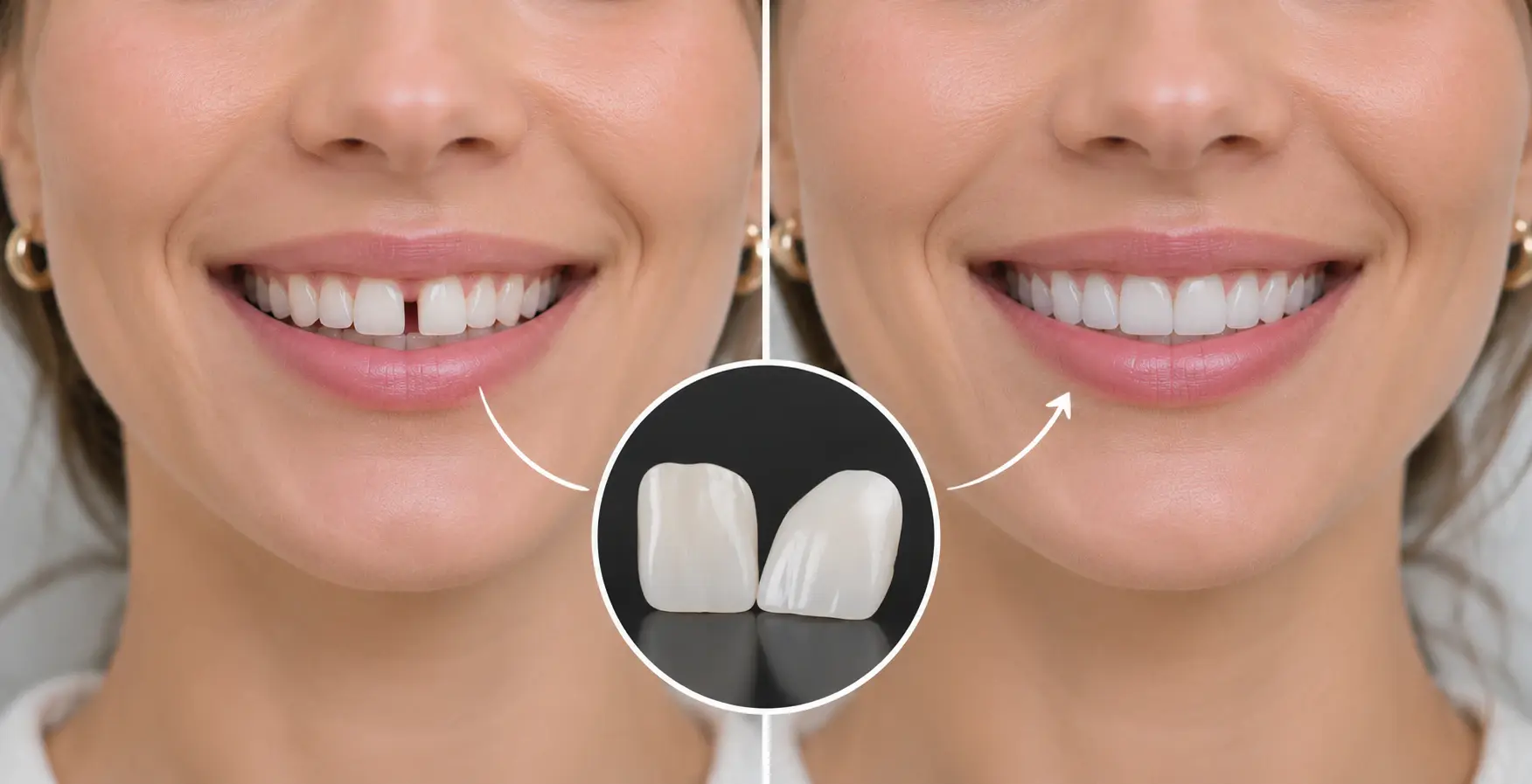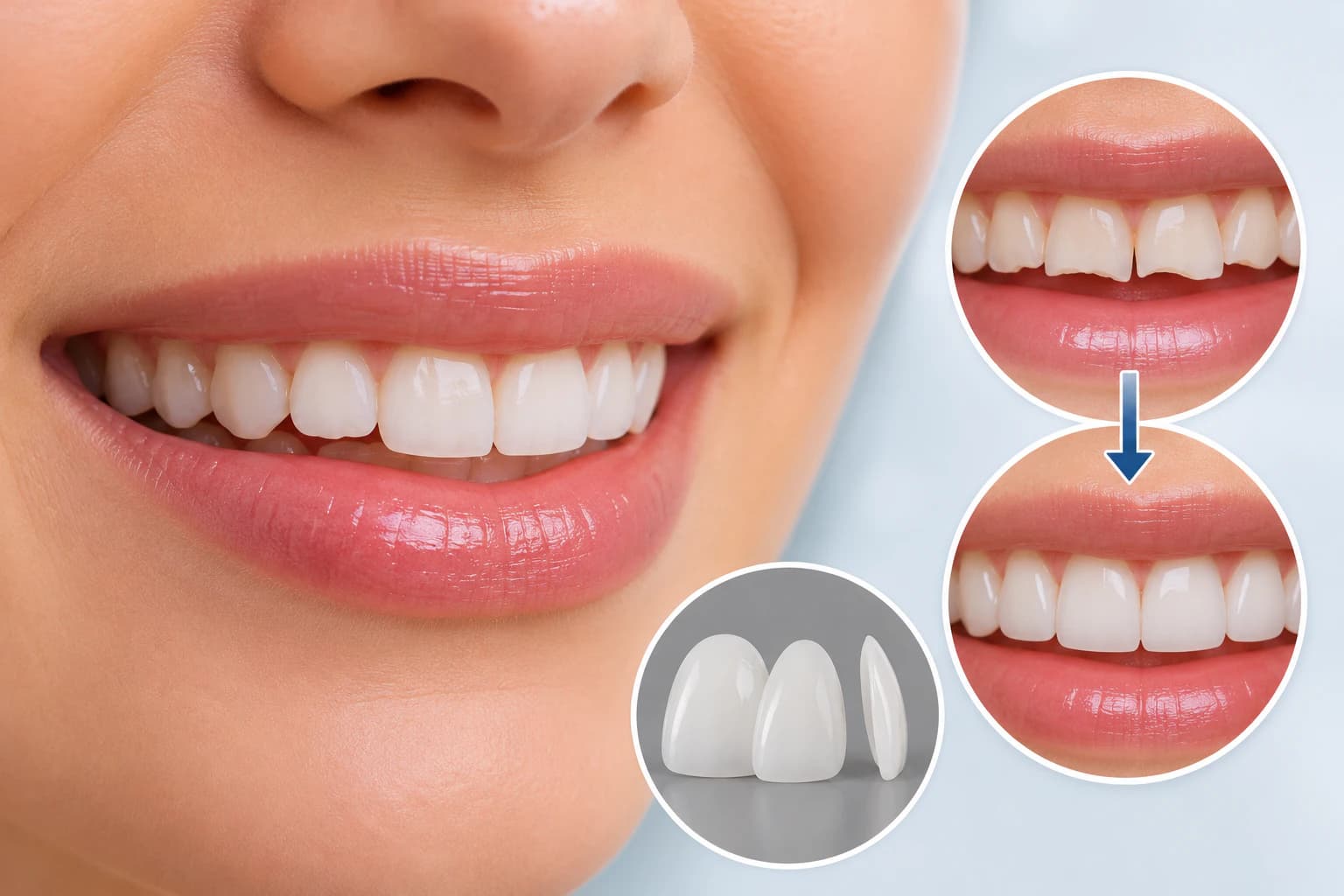
E.max veneers for smile makeovers use lithium disilicate glass-ceramic to rebuild the colour, shape, proportion, and symmetry of visible front teeth. Clinicians choose this material because it combines enamel-like translucency with enough strength for thin, conservative restorations on anterior teeth.
A smile makeover does more than brighten teeth. It re-engineers how the teeth relate to the lips, the gums, and the rest of the face. Cosmetic dentistry has shifted away from aggressive tooth reduction toward adhesive, enamel-preserving techniques, and lithium disilicate ceramics sit at the centre of that shift (Kelly and Benetti 2011). IPS E.max, the most widely studied lithium disilicate system, allows dentists to restore several anterior teeth with restorations that transmit and reflect light much like natural enamel.
A successful makeover still depends on biology, not only on ceramic science. The clinician must protect enamel, stabilise the bite, and treat any active disease before bonding restorations. Aesthetic goals must serve oral health and function, not compete with them. This article explains how the material works, which imperfections it corrects, how digital planning shapes the result, who qualifies as a candidate, what the treatment involves, and how long patients can expect the outcome to last.
What Makes E.max Veneers Suitable for a Complete Smile Transformation?
E.max suits full smile transformations because lithium disilicate glass-ceramic reproduces the optical depth of natural enamel while reaching flexural strengths of roughly 360 to 500 MPa, which permits thin restorations on visible anterior teeth (Guess et al. 2011).
IPS E.max consists of a glass matrix reinforced with about 70 percent by volume of lithium disilicate crystals. These needle-shaped crystals interlock and deflect cracks, which gives the ceramic its fracture resistance (Guess et al. 2011). This microstructure lets laboratories mill or press veneers as thin as 0.3 to 0.5 mm in selected cases, so the dentist removes less healthy enamel.
Optics matter as much as mechanics on front teeth. Natural enamel scatters, absorbs, and transmits light at different depths, which creates the layered colour observers perceive as a living tooth. Lithium disilicate offers controlled translucency in several ingot grades, so the technician can match the light behaviour of enamel and dentine rather than painting colour onto an opaque core (Kelly and Benetti 2011). Systematic reviews confirm that this material class achieves high survival rates in the anterior region, which supports its use across several teeth in one treatment plan (Sailer et al. 2015).
Material capability alone does not create beauty. The ceramic must respect natural tooth anatomy: line angles, surface texture, and the transition between tooth and gum. Because anterior teeth dominate what other people see when a patient speaks or smiles, even small optical errors become obvious. E.max earns its place in smile makeovers precisely because it gives clinicians the margin for error that visible teeth demand.
Which Smile Imperfections Can E.max Veneers Address?
E.max veneers correct intrinsic discolouration, uneven edges, chips, worn enamel, small gaps, size discrepancies, asymmetric shapes, and mild alignment irregularities, provided the underlying teeth stay healthy enough to bond to.
Intrinsic stains from tetracycline exposure, fluorosis, or trauma often resist bleaching agents because the discolouration sits deep inside the dentine. A veneer masks such stains with an opaque or medium-translucency ceramic layer while preserving a natural surface appearance. Veneers also rebuild chipped or worn incisal edges, restore uneven tooth lengths, close small interdental spaces, and harmonise teeth that differ in width or contour. Mild rotations or minor crowding sometimes disappear visually when the clinician reshapes the facial surface of the teeth, a technique called instant orthodontics in older literature, though current practice favours real orthodontics for anything beyond minor cases.
Veneers cannot solve every problem. Severe malocclusion, active decay, untreated gum disease, and extensively broken-down teeth require orthodontics, restorative treatment, periodontal therapy, or full crowns first (Morimoto et al. 2016). The table below summarises which conditions veneers manage well and which demand alternatives.
Concern | E.max veneer appropriate? | Preferred alternative when not |
Intrinsic discolouration | Yes, after whitening fails | None needed in most cases |
Chips and minor wear | Yes | Composite bonding for very small defects |
Small gaps and size discrepancies | Yes | Orthodontics for large spaces |
Mild misalignment | Selected cases | Clear aligners or braces |
Severe crowding or bite problems | No | Orthodontic treatment first |
Extensively damaged tooth | No | Full-coverage crown |
How Does Digital Smile Design Shape the Final Appearance?
Digital Smile Design (DSD) uses calibrated photographs, intraoral scans, and facial measurements to simulate the proposed veneers on screen, so the patient approves the design before any irreversible tooth preparation takes place (Coachman and Calamita 2012).
The DSD workflow starts with records. The team captures high-resolution facial photographs, video of the patient speaking and smiling, intraoral scans, and measurements that relate tooth position to the pupils, the lip line, and the facial midline. Software then overlays proposed tooth shapes onto these records and tests them against reference lines that describe an attractive smile, including the smile line, the position of the upper lip at rest, and how much gum shows during a full smile (Coachman and Calamita 2012).
A digital proposal becomes physical through a diagnostic wax-up and a mock-up. The clinician transfers the design to the patient's mouth with provisional resin, so the patient sees and feels the planned length and contour in real life. This step converts an abstract screen image into a testable prototype. Because the patient participates in approving the mock-up, the final ceramic design reflects informed consent rather than guesswork, and the laboratory receives precise targets for each veneer.
How Are Tooth Shape and Proportions Selected for E.max Veneers?
Clinicians select tooth shapes through proportional analysis, starting with a central incisor width-to-length ratio near 75 to 80 percent, then adjusting lateral incisors and canines to support symmetry while preserving each patient's individual anatomy (Chu 2007).
The central incisors anchor the smile. Research on aesthetic perception shows that observers judge smiles as attractive when central incisors appear dominant and roughly 75 to 80 percent as wide as they are long (Chu 2007). Lateral incisors appear slightly shorter and narrower, and the canines close the corners of the smile with a softer contour. The concept of a recurring aesthetic proportion, sometimes linked to the golden proportion described by Lombardi, offers a starting grid rather than a rigid rule (Lombardi 1973).
Incisal edge position then defines the smile arc. Ideally the edges of the upper front teeth follow the curve of the lower lip during a smile. A flat or reversed arc ages the smile, so veneer design often adds length where wear has flattened the edges. Yet identical, template-based teeth look artificial. Gender, age, lip mobility, and facial form all influence what reads as natural on a given face, so the clinician preserves characteristic features such as slight asymmetries or rounded corners when they suit the patient.
How Is the Right E.max Veneer Shade Chosen?
Shade selection balances the patient's skin tone, facial features, and personal preference against optical parameters such as value, chroma, translucency, and opacity, and clinicians verify the choice under natural lighting before the laboratory layers the ceramic.
Shade selection starts with the face, not the tooth. Very bright veneers can look harsh against darker skin tones or mature facial features, while a shade matched to complexion and age reads as healthy rather than artificial. Clinicians use classical shade guides such as the VITA systems alongside digital spectrophotometers that measure value, chroma, and hue objectively and reduce the error of visual matching under operatory lighting.
The colour of the prepared tooth underneath the veneer also shapes the outcome. A thin, translucent ceramic lets the underlying dentine show through, which helps a natural tooth but can betray a dark or metal-stained substrate. The technician compensates by adjusting ingot opacity and by layering porcelains of different fluorescence and opalescence over the core, building colour from the inside as nature does (McLaren 1998). Because operatory lights distort perception, the team confirms the shade beside a window or with colour-corrected lamps before final fabrication.
Who Is a Good Candidate for an E.max Veneer Smile Makeover?
A good candidate has healthy teeth, stable gums, sufficient enamel for adhesive bonding, and aesthetic concerns across several visible teeth, without untreated decay, active periodontal disease, or uncontrolled bruxism.
Bonding strength depends on enamel. Adhesive protocols bond to enamel far more reliably than to dentine, so candidates need enough enamel to support the restoration margins (Peumans et al. 2004). Existing large fillings, thin or eroded enamel, and structurally compromised teeth reduce predictability and may push the plan toward crowns. A full examination with radiographs confirms that no hidden decay, infection, or periodontal instability threatens the foundations of the makeover.
Bite forces complete the assessment. Dental occlusion, the way upper and lower teeth meet, determines how much load each veneer will carry. Patients who clench or grind, a condition called bruxism, place ceramic under cyclic stress that raises the risk of chipping or debonding (Morimoto et al. 2016). Such patients can still receive veneers when the clinician manages the bite and prescribes a protective nightguard, but severe cases may need alternative materials or orthodontic correction first. Honest case selection separates patients who genuinely need veneers from those who would gain the same improvement from whitening or bonding alone.
How Are E.max Veneers Combined with Other Cosmetic Dental Treatments?
Clinicians combine veneers with whitening, gum contouring, orthodontics, composite bonding, crowns, or implants when each additional procedure solves a specific clinical or aesthetic problem that veneers alone cannot address.
Whitening comes first in sequence. Natural teeth surrounding the veneers should reach their final shade before shade selection, because ceramic does not respond to bleaching after placement. Whitening the remaining teeth first lets the technician match the veneers to a stable, brighter baseline and improves colour consistency across the whole smile.
Gingival contouring corrects uneven gum margins that make equal teeth look unequal. A few millimetres of laser or surgical reshaping can restore balanced proportions before veneer design begins. Clear aligners handle significant alignment problems more conservatively than grinding crooked teeth into line, so many comprehensive plans include short orthodontic phases before restoration. Composite bonding repairs minor defects on teeth that do not justify a veneer, while crowns replace veneers on teeth with extensive damage, and implants fill gaps so the smile rehabilitation covers every visible position. The guiding rule stays simple: every added procedure must answer a documented need.
What Happens During an E.max Veneer Smile Makeover?
Treatment moves through consultation, records, digital design, a testable mock-up, conservative preparation, final impressions, laboratory fabrication, and adhesive cementation, usually across three to five appointments.
The first appointment establishes goals. The dentist records the patient's aesthetic expectations, examines the teeth and gums, takes photographs, and orders radiographs where indicated. Digital impressions capture the existing tooth structure without physical moulds. The team then develops the proposed smile design and produces a diagnostic wax-up, which the clinician transfers to the mouth as a temporary mock-up for the patient to evaluate.
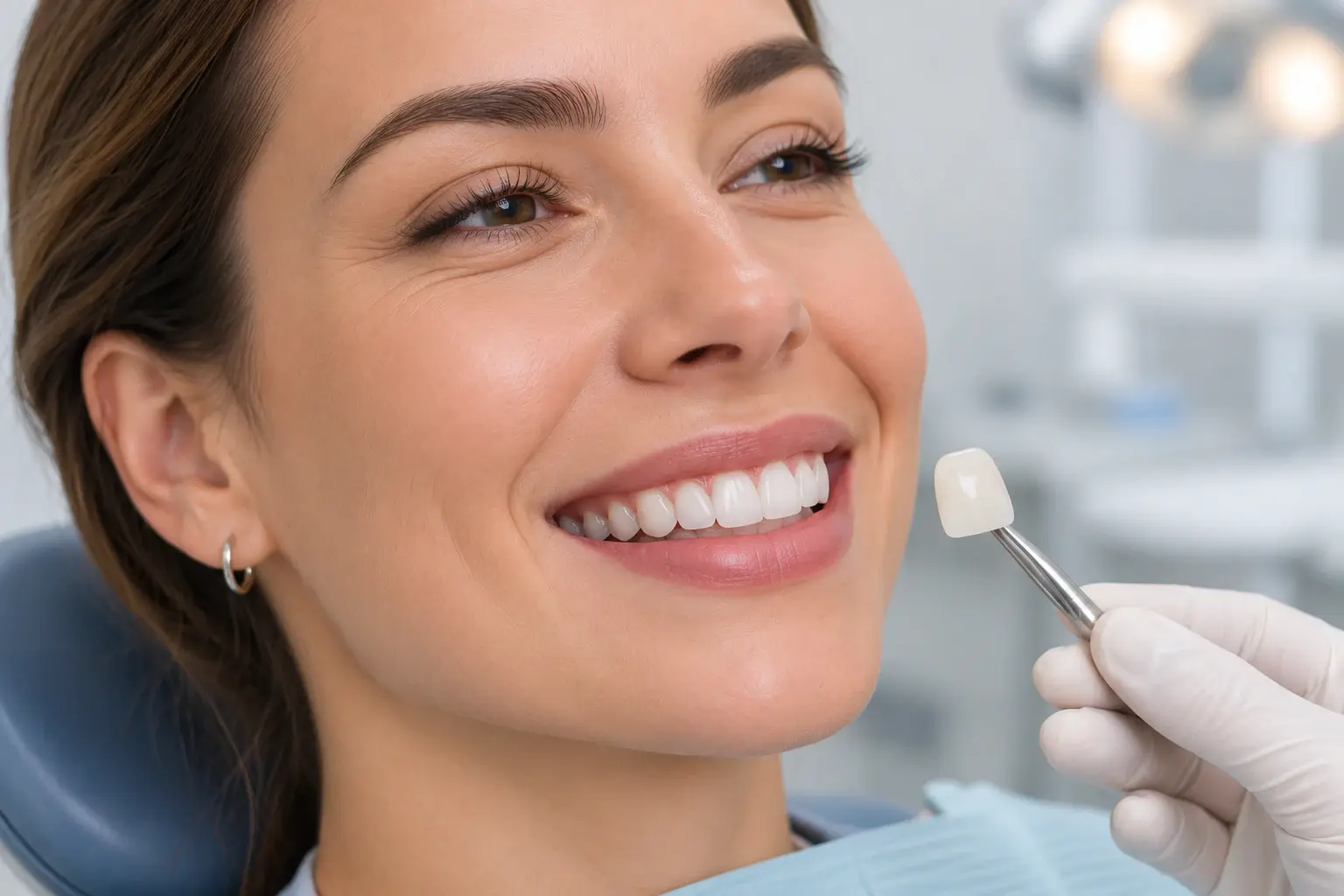
Once the patient approves the design, preparation begins. The dentist removes a conservative layer of enamel guided by depth cuts derived from the mock-up, then records final digital impressions for the laboratory. Temporary veneers protect the prepared teeth during fabrication. At the delivery appointment, the clinician tries in each ceramic restoration, checks fit, contacts, colour, and shape with the patient, and only then proceeds to dental bonding under rubber dam isolation. Adhesive cementation, careful bite adjustment, and a final aesthetic review complete the active phase of treatment.
How Important Is Enamel Preservation During Smile Makeovers?
Enamel preservation is critical because adhesive bonds to enamel are stronger and more durable than bonds to dentine, and every preparation choice should keep margins in enamel wherever anatomy allows (Peumans et al. 2004).
Enamel is a highly mineralised tissue that accepts micromechanical resin bonding with exceptional reliability. When preparation exposes large areas of dentine, the bond depends on a more variable substrate and long-term survival falls. Prospective clinical data show that veneers bonded predominantly to enamel achieve survival rates above 90 percent over a decade, while dentine exposure increases failure risk (Peumans et al. 2004).
Preparation design therefore follows the principle of maximum conservation. Minimal-prep veneers remove roughly 0.3 to 0.6 mm, guided by the planned final contour rather than by a fixed depth. No-prep veneers add ceramic without any reduction and suit only selected cases, typically small or retruded teeth that need volume. Excessive reduction increases postoperative sensitivity, weakens the tooth, and complicates future replacement. Even minimal removal remains irreversible, because enamel never regenerates. A responsible plan preserves healthy tissue first and uses the ceramic to add form rather than to compensate for over-preparation.
How Do E.max Veneers Create a Natural-Looking Smile?
Natural appearance comes from ceramic translucency interacting with the underlying tooth colour, combined with realistic surface texture, anatomical contour, and hand-finished characterisation by a skilled dental technician (McLaren 1998).
Lithium disilicate transmits light through its glass phase and scatters it within its crystal phase. This behaviour mimics the way natural enamel handles light, so a well-designed veneer shows depth rather than a flat, painted surface. The degree of translucency, the thickness of the ceramic, and the shade of the underlying tooth all interact. Thicker veneers mask more substrate colour; thinner veneers blend with it.
Surface character completes the illusion. Natural enamel shows fine horizontal ridges, subtle vertical anatomy, and a specific lustre. Technicians reproduce these features during contouring, staining, and glazing, then verify them under different lighting angles. This level of detail requires coordination among three parties: the dentist who plans and prepares, the technician who fabricates, and the patient who judges the result. When all three align, observers perceive teeth rather than restorations.
What Should Patients Expect from E.max Veneer Before-and-After Results?
Patients can expect measurable changes in tooth colour, shape, length, and symmetry, but individual results vary with anatomy, preparation design, and clinical execution, so honest before-and-after photographs under consistent lighting remain the best preview of outcome quality.
A typical transformation corrects several variables at once. Stained teeth reach a stable, lighter shade; worn edges regain youthful length; gaps close; and asymmetric contours become harmonious. The proper way to judge success is to evaluate the whole smile in the face, not each veneer in isolation. A single perfect veneer in an unbalanced smile still fails aesthetically.
Patients should read before-and-after galleries critically. Trustworthy documentation uses the same camera angle, magnification, and lighting in both images, because lighting alone can fake a dramatic colour change. Patients should also distinguish between subtle enhancement, which refreshes a smile while keeping its character, and a full transformation, which changes proportions and shade decisively. Anatomy sets the ceiling: lip mobility, gum architecture, and existing tooth position all limit what ceramic can achieve, and no responsible clinician promises identical outcomes across different mouths.
What Are the Limitations and Possible Complications of E.max Veneer Treatment?
Reported complications include temporary sensitivity, ceramic chipping or fracture under excessive load, debonding, gum irritation from poor margins, and colour mismatch, though careful case selection, bonding protocol, and follow-up keep failure rates low (Morimoto et al. 2016).
Transient sensitivity to temperature is common after preparation and usually resolves within weeks as the dentine adapts. Fracture and chipping represent the most frequent mechanical failures in long-term studies, especially in patients with heavy bite forces or untreated bruxism (Morimoto et al. 2016). Debonding occurs when bonding conditions are unfavourable, for example when margins sit largely on dentine or when contamination compromises the adhesive interface.
Soft tissue and aesthetic problems follow a different pattern. Over-contoured or poorly finished margins trap plaque and irritate the gums, which can inflame the gingiva and spoil the emergence profile. Colour mismatch appears when shade selection ignores the adjacent natural teeth or when those teeth change colour after cementation. Veneers that end up too thick create a bulky, prominent look. None of these complications is random. Each one maps to a controllable step: candidate selection, conservative preparation, isolated bonding, occlusal adjustment, and scheduled review. Damaged or worn restorations eventually require replacement, and patients should plan for that lifecycle from the start.
How Long Can an E.max Veneer Smile Makeover Maintain Its Results?
Clinical studies report survival rates of roughly 91 to 95 percent for ceramic veneers at ten years, and lithium disilicate performs at the upper end of that range when bonding stays in enamel and the bite remains controlled (Sailer et al. 2015).
Long-term data support confidence in the material. A systematic review by Sailer and colleagues found high cumulative survival for lithium disilicate restorations in the anterior zone, and Layton and Walton reported veneer survival above 90 percent at ten years in their cohort analysis (Layton and Walton 2007). Morimoto and colleagues calculated an estimated cumulative survival of about 95.5 percent at ten years for feldspathic and glass-ceramic veneers across the literature (Morimoto et al. 2016).
Survival statistics describe the ceramic, not the whole system. Dental veneer longevity depends on bonding quality, occlusal load, oral hygiene, and the health of the tooth underneath. Bruxism and accidental trauma shorten lifespan measurably, while a nightguard and stable bite protect the investment. The natural tooth behind the veneer can still decay at the margins if hygiene slips, so periodic examinations matter as much as daily care. Clinicians monitor margins, contacts, and bite at each review and intervene early, repairing small chips or replacing individual veneers before problems spread.
How Should Patients Maintain Their E.max Veneers After Treatment?
Maintenance combines gentle twice-daily brushing with a non-abrasive paste, daily interdental cleaning, regular professional examinations, and a custom nightguard for anyone who grinds their teeth.
Daily care protects the margin where ceramic meets tooth. A soft brush and low-abrasion toothpaste clean without dulling the glaze, and floss or interdental brushes keep the gumline free of plaque. The ceramic itself cannot decay, but the natural tooth at the margin can, and gum recession around inflamed tissue exposes margins and ruins the aesthetic frame of the smile.
Habits decide how long the restorations serve. Biting fingernails, opening packaging with the teeth, chewing ice, or biting hard objects concentrates force on ceramic edges and invites chipping. Patients with bruxism should wear their nightguard every night, because unprotected grinding loads veneers far beyond design limits. Professional reviews let the dentist check margin integrity, bite changes, and gum health, and catch small problems while repair remains simple.
What Factors Determine the Cost of an E.max Veneer Smile Makeover?
Cost depends mainly on the number of veneers, the complexity of the design, laboratory and material specifications, clinician expertise, and any supporting procedures, so a personalised written plan gives a far more accurate estimate than a per-tooth price.
The number of restorations drives the largest share of the budget. A smile line that shows eight or ten upper teeth requires more laboratory work than one that shows four. Design complexity adds cost as well: multi-layered characterisation, custom staining, and prototypes demand more technician hours than simple single-shade veneers. Laboratory fees vary with the fabrication method, pressed or milled, and with the grade of IPS E.max ingot selected.
Clinical factors complete the calculation. An experienced cosmetic dentist invests time in diagnosis, photography, digital planning, and mock-up appointments that cheaper offers skip, and that planning directly affects the result. Additional procedures such as whitening, gingival contouring, or aligner therapy add their own fees, as do temporary restorations and follow-up visits. A written plan that lists every procedure, material, and appointment protects the patient from surprise costs far better than a headline price per tooth.
How Can Patients Evaluate a Dentist Before Choosing an E.max Smile Makeover?
Patients should verify documented experience with lithium disilicate cases, a structured diagnostic and digital design process, transparent material and laboratory specifications, a clear bonding protocol, and a written treatment plan with stated follow-up and replacement policies.
Portfolio evidence speaks first. Prospective patients should review before-and-after photographs of cases similar to their own, taken under consistent conditions, and ask how many lithium disilicate smile makeovers the dentist completes each year. A serious clinician explains the diagnostic workflow, shows the digital smile design step, and offers a mock-up before preparation.
Technical transparency matters equally. Patients should ask which ceramic system the laboratory uses, which ingot translucency the plan specifies, how the dentist approaches enamel preservation, and which bonding protocol and isolation method the team follows. A written plan should itemise procedures, costs, and the policy for repairs or replacement. Finally, post-treatment support, review schedules, and emergency contact arrangements reveal whether the practice treats the makeover as a long-term commitment or a one-day transaction.
Frequently Asked Questions About E.max Veneers for Smile Makeovers
Can E.max veneers transform an entire smile?
Yes. Multiple individually designed veneers can rebuild every visible tooth in the smile zone, and the exact number depends on how many teeth show when the patient smiles.
Wide smiles display eight to ten upper teeth, sometimes including premolars, while narrow smiles may show only four to six. The clinician counts the visible teeth in a full smile and designs veneers for each position that needs correction, so the ceramic work covers the whole aesthetic zone rather than stopping at an abrupt border.
How many E.max veneers are needed for a smile makeover?
Most smile makeovers involve six to ten veneers, but the true number follows tooth visibility, smile width, and the patient's goals rather than any fixed rule.
Some patients need only two veneers to correct a single pair of problem teeth. Others require ten or more to harmonise colour and proportion across a broad smile. The mock-up appointment answers this question concretely, because it shows exactly which teeth change the outcome.
Do E.max veneers look like natural teeth?
Yes, when the clinician and technician plan translucency, ceramic layering, shade selection, and surface texture together, lithium disilicate veneers reproduce the optical depth of natural enamel (McLaren 1998).
Realism fails only when one variable is ignored. A correct shade with flat, textureless surfaces still looks artificial, and perfect texture with the wrong translucency shows the substrate through. The laboratory builds all four variables into each restoration.
Can E.max veneers make teeth look longer?
Yes. Veneers can add incisal length and restore youthful proportions, but the clinician must verify that the bite tolerates the new length before finalising the design.
Longer edges reshape the smile arc and often rejuvenate a worn smile. If the lower teeth strike the lengthened edges heavily, the risk of chipping rises, so occlusal analysis precedes any length increase.
Are E.max veneers better than composite veneers for smile makeovers?
For multi-tooth makeovers, ceramic generally outperforms composite in aesthetics, stain resistance, and longevity, while composite suits small corrections and tighter budgets.
Property | E.max ceramic | Composite resin |
Aesthetics | Enamel-like translucency and depth | Good initially, dulls over time |
Stain resistance | High | Moderate, picks up stains |
Expected lifespan | 10 to 15 years or more | 4 to 8 years |
Tooth preparation | Minimal to moderate | Often none to minimal |
Repairability | Usually replaced if fractured | Easily repaired in the chair |
Cost per tooth | Higher | Lower |
Clinical condition still decides. A young patient needing one edge repair benefits from bonding, while a full-colour and proportion makeover justifies ceramic (Kelly and Benetti 2011).
Can E.max veneers be placed without shaving natural teeth?
Sometimes. No-preparation veneers exist, but they suit only selected cases, typically small, retruded, or spaced teeth that can accept added volume without bulk.
Most smiles need at least minimal preparation so the ceramic does not over-contour the teeth. The difference matters: minimal-prep removes a fraction of a millimetre of enamel, while true no-prep removes none, and the mock-up reveals which approach each tooth can support.
Can patients with crooked teeth have an E.max smile makeover?
Patients with mild irregularities often can, but significant crowding or bite problems require orthodontic treatment before veneers.
Veneers camouflage minor rotations and small overlaps by reshaping the visible surface. Using them to mask severe malocclusion forces aggressive preparation and creates unstable results, so aligners or braces come first in those cases (Morimoto et al. 2016).
Is an E.max veneer smile makeover permanent?
The enamel preparation is permanent and irreversible, but the ceramic restorations themselves have a finite lifespan and will need replacement eventually.
Once enamel is removed, the tooth will always require a restoration. The veneers typically serve a decade or longer with good care, and replacement cycles depend on oral health, bite forces, and maintenance rather than on a fixed expiry date.
Can E.max veneers be whitened after placement?
No. Ceramic does not respond to bleaching agents, so the desired shade must be established before final fabrication.
Whitening gels act on organic pigments inside natural tooth structure, not on glass-ceramic. Patients who want a brighter overall smile whiten their natural teeth first, then the technician matches the veneers to that result, which is why treatment sequencing matters.
Conclusion: Are E.max Veneers the Right Choice for Your Smile Makeover?
E.max veneers suit patients with healthy mouths and multi-tooth aesthetic concerns who accept irreversible preparation and commit to maintenance; they do not suit untreated disease, uncontrolled bruxism, or problems better solved by simpler treatments.
Lithium disilicate veneers occupy a distinctive position in cosmetic dentistry. They deliver enamel-like optics, clinically proven survival above 90 percent at ten years, and preparation designs conservative enough to preserve the bond-critical enamel layer (Peumans et al. 2004; Sailer et al. 2015). Combined with digital smile design, they let patients preview and approve the outcome before any permanent change occurs.
The deciding factors remain biological and personal. Healthy teeth and gums, a stable bite, realistic expectations, and a clinician who plans conservatively predict success far better than the brand of ceramic alone. Any patient considering E.max veneers for smile makeovers should begin with a comprehensive examination and an honest conversation about alternatives, because the best aesthetic result is the one that also protects long-term oral health.
References
Chu, Stephen J. "Range and Mean Distribution Frequency of Individual Tooth Width of the Maxillary Anterior Dentition." Journal of Prosthetic Dentistry, vol. 97, no. 2, 2007, pp. 135-136.
Coachman, Christian, and Marcelo Calamita. "Digital Smile Design: A Tool for Treatment Planning and Communication in Esthetic Dentistry." Quintessence of Dental Technology, vol. 35, 2012, pp. 103-111.
Guess, Petra C., et al. "All-Ceramic Systems: Laboratory and Clinical Performance." Dental Clinics of North America, vol. 55, no. 2, 2011, pp. 333-352.
Kelly, J. Robert, and Piero Benetti. "Ceramic Materials in Dentistry: Historical Evolution and Current Practice." Australian Dental Journal, vol. 56, suppl. 1, 2011, pp. 84-96.
Layton, Danielle M., and Terry R. Walton. "The Up to 21-Year Clinical Outcome and Survival of Feldspathic Porcelain Veneers: Accounting for Clustering." International Journal of Prosthodontics, vol. 25, no. 6, 2012, pp. 604-612.
Lombardi, Richard E. "The Principles of Visual Perception and Their Clinical Application to Denture Esthetics." Journal of Prosthetic Dentistry, vol. 29, no. 4, 1973, pp. 358-382.
McLaren, Edward A. "The 3D-Master Shade-Matching System." Practical Periodontics and Aesthetic Dentistry, vol. 10, no. 5, 1998, pp. 587-591.
Morimoto, Susana, et al. "Survival Rate of Resin and Ceramic Inlays, Onlays, and Overlays: A Systematic Review and Meta-Analysis." Journal of Prosthodontic Research, vol. 60, no. 4, 2016, pp. 219-230.
Peumans, Marleen, et al. "A Prospective Ten-Year Clinical Trial of Porcelain Veneers." Journal of Adhesive Dentistry, vol. 6, no. 1, 2004, pp. 65-76.
Sailer, Irena, et al. "All-Ceramic or Metal-Ceramic Tooth-Supported Fixed Dental Prostheses (FDPs)? A Systematic Review of the Survival and Complication Rates. Part I: Single Crowns (SCs)." Dental Materials, vol. 31, no. 6, 2015, pp. 603-623.