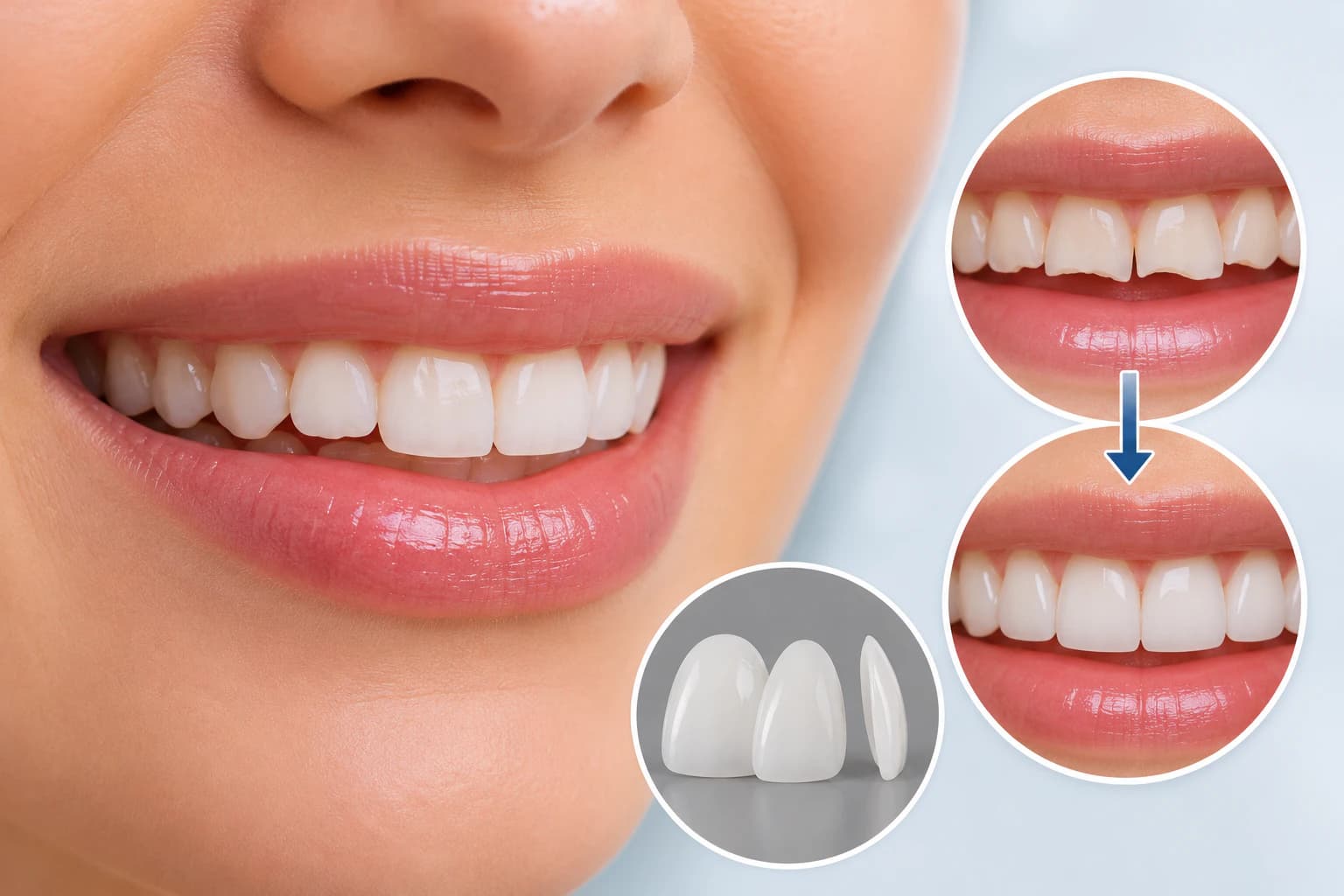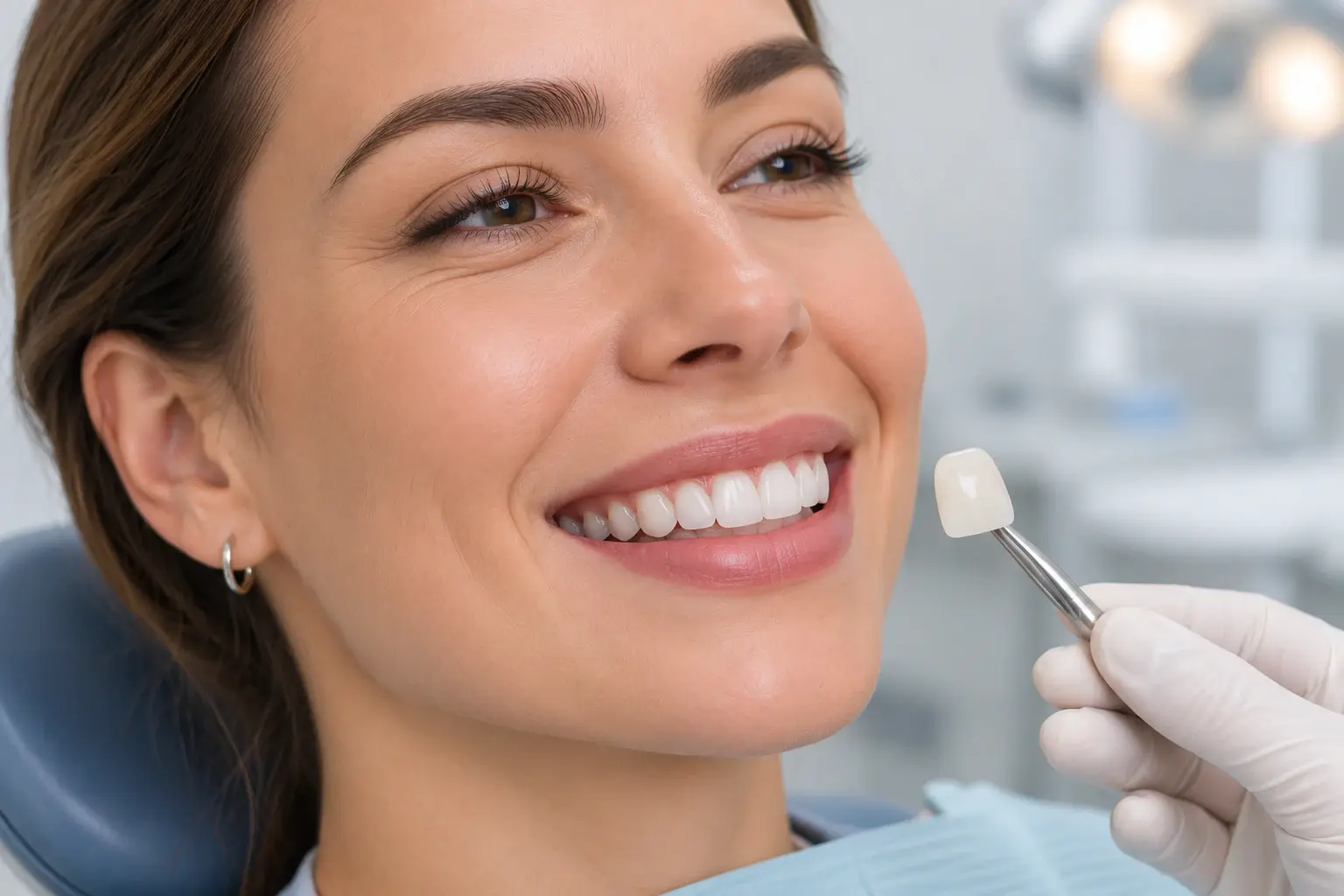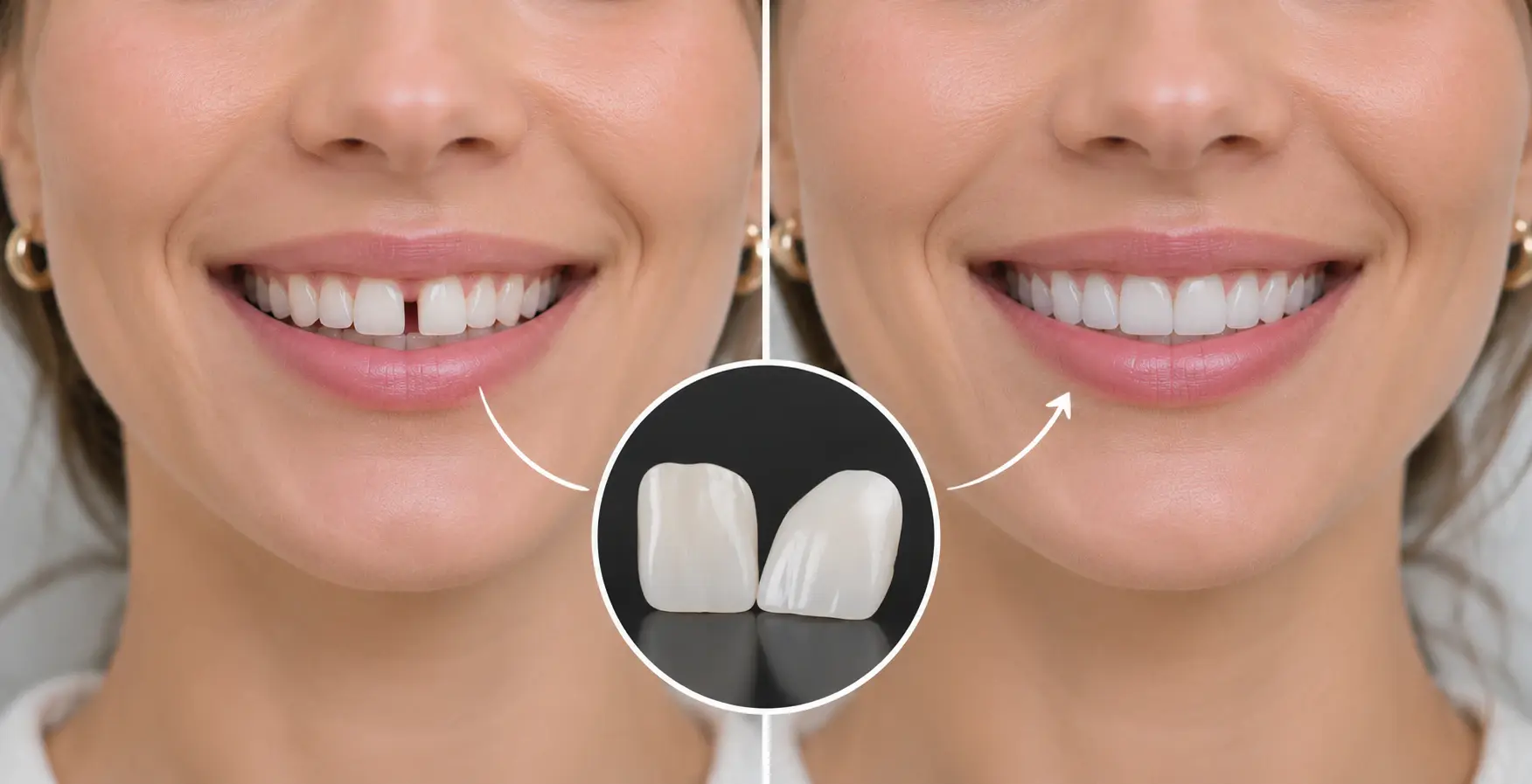
Gaps between the front teeth are one of the most common reasons patients seek cosmetic dental treatment. E.max veneers, made from lithium disilicate glass-ceramic, offer a well-documented way to close visible spaces by reshaping the teeth rather than moving them. They combine high strength with enamel-like translucency, which makes them a leading option for aesthetic anterior restorations (Zarone et al. 2016). This article explains how E.max veneers close gaps between teeth, who they suit, how they compare with composite bonding and orthodontics, and what patients should expect over the long term.
What Are E.max Veneers and How Do They Work?
E.max veneers are thin, custom-made ceramic shells manufactured from lithium disilicate glass-ceramic. A dentist bonds them to the visible front surfaces of selected teeth to change their width, shape, length, and colour. They mask spacing cosmetically instead of physically repositioning the teeth.
Lithium disilicate is a particle-filled glass-ceramic. Its elongated crystals sit inside a glassy matrix, which gives the material a flexural strength of about 440 MPa in its heat-pressed form (Zarone et al. 2016). This strength allows technicians to produce very thin restorations that still resist fracture. The material is also translucent, so it transmits and reflects light in a way that closely resembles natural enamel (Zarone et al. 2016).
Conventional porcelain veneers use feldspathic ceramic. Feldspathic porcelain offers excellent aesthetics, but it is weaker than lithium disilicate and usually needs more tooth reduction to achieve adequate thickness. E.max veneers combine comparable translucency with greater strength, which supports more conservative preparation in many cases. Because the glass-ceramic contains silica, it bonds reliably to enamel through hydrofluoric acid etching, silane coupling, and resin cement (Zarone et al. 2016).
One point needs emphasis. Veneers improve the appearance of dental spacing. They do not move teeth or correct the underlying cause of a gap.
What Causes Gaps Between Teeth?
A gap between two adjacent teeth is called a diastema. When it sits between the upper central incisors, clinicians call it a midline diastema. Dental spacing is multifactorial, and several causes can act together in the same patient (Abu-Hussein et al. 2016).
Common causes include:
Genetic factors. Inherited tooth and jaw proportions run in families. Midline diastema shows a clear familial pattern in the literature (Huang and Creath 1995).
Tooth size and jaw size discrepancy. Teeth that are small relative to the dental arch leave excess space. Undersized or peg-shaped lateral incisors are a classic example.
Missing teeth. Congenitally absent or extracted teeth allow neighbouring teeth to drift, which distributes spacing across the arch.
An oversized or low-attached labial frenum. A thick band of tissue between the central incisors can hold them apart. Research shows this factor explains only a small proportion of persistent diastemas (Huang and Creath 1995).
Childhood habits. Thumb sucking and tongue thrusting can push the front teeth forward and create spaces.
Periodontal disease. Loss of bone support allows teeth to migrate, and new gaps can appear in adulthood as a result.
Dentists also distinguish between gaps that have existed since tooth eruption and gaps that develop later. A new or widening space in an adult can signal active periodontal problems or harmful oral habits. Identifying the underlying cause matters because treatment should address that cause first, not just close the visible space (Gkantidis, Kolokitha, and Topouzelis 2008).
Six common causes of gaps, and what they mean for treatment
The cause decides whether veneers are enough or something else should come first.
Genetics
Spacing that runs in the family, with otherwise healthy teeth.
Veneers can helpSmall or narrow teeth
Teeth that are small for the jaw, such as peg-shaped laterals.
Veneers can helpLarge lip frenum
A low or thick band of tissue between the front teeth. Only explains a small share of gaps.
Needs assessmentHabits
Thumb sucking or tongue thrusting that pushes teeth apart.
Treat the cause firstMissing teeth
Neighbouring teeth drift into the empty space.
Implant or bridgeGum disease
Loss of support lets teeth shift and new gaps appear in adulthood.
Treat the cause firstCan E.max Veneers Close Gaps Between Teeth?
Yes. Dentists use E.max veneers to close gaps by making selected teeth slightly wider than their natural dimensions. The ceramic shell covers the front surface and wraps towards the contact area, so two neighbouring veneers can meet in the middle of the original space. This approach works best for small gaps and for selected moderate gaps.
E.max veneers suit several spacing patterns:
A small gap between the upper central incisors.
Multiple minor spaces spread across the front teeth.
Unevenly distributed spacing.
Gaps associated with narrow or undersized teeth, such as peg-shaped laterals.
When a gap is larger, the dentist usually distributes the extra width across both adjacent teeth, and sometimes across several teeth. This keeps every restored tooth within natural proportions and avoids a single oversized central incisor.
Veneers have clear limits, however. They do not reposition teeth, and they do not treat the cause of the spacing. Large gaps, rotated or crowded teeth, and bite discrepancies often respond better to orthodontic treatment. Section 10 discusses these situations in detail.
Veneers reshape teeth. Braces move them.
Compare the three ways a gap between the front teeth can be closed.
Veneers make the teeth slightly wider
The teeth stay where they are. Each veneer adds a little width so neighbouring veneers meet at the midline. Best for small, stable gaps in well-aligned teeth.
Orthodontics moves the teeth together
Clear aligners or braces close the space by repositioning the teeth. Usually the better choice for large gaps, crooked or rotated teeth and bite problems.
Move first, then refine with veneers
Aligners or braces bring the teeth closer, then veneers fine-tune shape, size and colour. This often gives the most natural proportions for wider spacing.
How Do Dentists Determine Whether E.max Veneers Are Suitable for Diastema Closure?
Dentists decide through a comprehensive clinical examination. They assess the width and location of the gaps, the size and shape of the teeth, existing alignment, enamel thickness and quality, gum health, bite relationships, and any signs of bruxism or other damaging habits. The patient's expectations form part of the same assessment.
Several findings shape the decision. Closing a gap must not create disproportionate tooth dimensions, so the dentist compares the available space with the width-to-length ratio that natural incisors normally show. The enamel needs enough thickness and quality to support a durable adhesive bond, because the bond to enamel is the foundation of veneer longevity (Layton and Walton 2007). The gums must be healthy, and any active periodontal disease or untreated decay requires treatment before cosmetic work begins. Finally, the bite must not overload the front teeth, and heavy grinding or clenching needs management, since excessive forces raise the risk of ceramic fracture.
The best results occur when clinical suitability and patient expectations align. A good consultation therefore includes an honest discussion of what veneers can and cannot achieve.
What Makes E.max Veneers Suitable for Natural-Looking Gap Closure?
Lithium disilicate glass-ceramic reproduces the optical behaviour of natural enamel. Its translucency lets light pass into the restoration and scatter, much as it does in real tooth structure. This optical depth is the main reason E.max veneers look natural rather than flat or opaque (Zarone et al. 2016).
Three further elements support a realistic result:
Shade selection. The clinician matches the ceramic to the surrounding natural teeth, including subtle colour gradations from the gumline to the biting edge.
Surface texture and light reflection. Technicians add fine surface anatomy, so the veneer reflects light like enamel rather than like polished plastic.
Individual tooth contours. Each veneer keeps its own shape and character. Slight natural variation between teeth prevents the uniform, artificial look that poorly designed restorations can produce.
Precise laboratory fabrication and meticulous adhesive bonding complete the picture. Even an excellent ceramic fails aesthetically if the fit, margins, or cement line are poorly managed.
How Are E.max Veneers Designed to Close Dental Spaces Without Looking Bulky?
Dentists avoid bulky results by planning tooth proportions before they touch the teeth. They calculate the width-to-length ratio of the restored teeth and distribute the additional width needed for space closure across all the teeth involved.
Why the extra width is shared, not added to one tooth
Same gap, two designs. Switch between them to see the difference.
One tooth takes the whole gap
- ✕The tooth becomes noticeably wider than its neighbour
- ✕The contact point moves off the facial midline
- ✕The smile looks lopsided
Each central incisor takes half
- ✓Both front teeth stay symmetrical
- ✓The contact point sits on the midline
- ✓Wider gaps can be shared with the lateral teeth too
Dentists plan this with photos, digital smile design and a mock-up before any tooth is prepared.
This planning matters most for a gap between the central incisors. If a dentist closes the space by widening only one tooth, the smile becomes asymmetrical. Adding roughly half the space to each central incisor keeps the dental midline centred and the proportions balanced. For wider spacing, the design may extend to the lateral incisors or canines so that no single tooth absorbs too much extra width.
Design also protects the contact points where neighbouring teeth touch. Well-formed contacts prevent food trapping and give the teeth a natural outline. The dentist considers the dental midline, the smile arc, and the proportions of the face as a whole. Digital smile design software, photographs, and diagnostic mock-ups let the patient preview the proposed dimensions before treatment starts. The central goal throughout is to avoid excessively wide central incisors and unnatural contours.
What Is the E.max Veneer Procedure for Closing Gaps Between Teeth?
The procedure moves through six stages: consultation, smile design, tooth preparation, laboratory fabrication, temporary veneers where needed, and final bonding. The whole process typically takes two to three appointments.
What Happens During the Consultation and Examination?
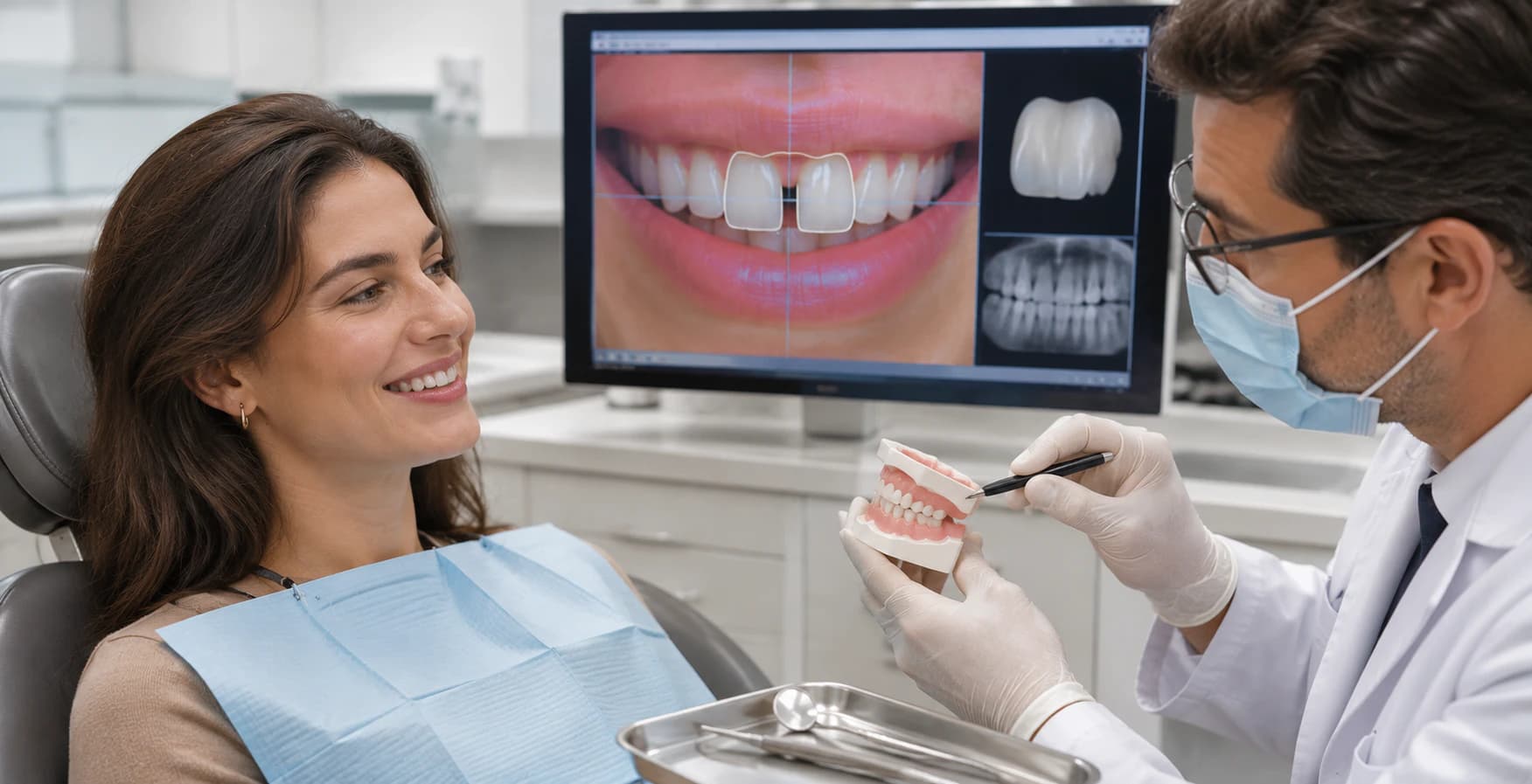
The dentist assesses the dental spacing, general oral health, and aesthetic expectations. This visit includes an examination of tooth proportions, enamel condition, gum health, and the bite. The dentist then decides how many teeth need treatment.
How Is the Smile Designed and the Treatment Planned?
The team evaluates the desired width, length, colour, and shape of the teeth. Photographs, digital scans, or impressions record the starting situation. The dentist plans how the space closure will be distributed across the selected teeth and discusses the proposed result with the patient, often using a mock-up for preview.
How Are the Teeth Prepared?
The dentist removes a thin, controlled layer of enamel from the front surfaces of the selected teeth. Conservative preparation stays within enamel whenever possible, because bonding to enamel produces the most durable result (Layton and Walton 2007). Preparation depth varies with tooth position and the planned veneer thickness. In suitable cases, minimal-preparation or even no-preparation designs are possible.
How Are the Veneers Fabricated?
Digital scans or conventional impressions capture the prepared anatomy. Dental technicians then manufacture the custom lithium disilicate restorations by heat pressing or CAD/CAM milling. They select the ceramic shade, translucency, and surface characterisation to match the plan (Zarone et al. 2016).
When Are Temporary Veneers Placed?
Temporary restorations protect prepared teeth while the laboratory makes the permanent veneers. They are not always necessary, particularly when preparation has been minimal. When used, they also let the patient test the planned shapes and give feedback.
How Are the Final Veneers Fitted and Bonded?
The dentist checks the fit, contact points, and appearance of each veneer. The ceramic is then conditioned with hydrofluoric acid and silane, and the tooth is conditioned with etchant and adhesive. Resin cement bonds the veneer permanently in place (Zarone et al. 2016). A final bite assessment and any necessary adjustments complete the appointment.
How Many E.max Veneers Are Needed to Close Gaps?
The number depends on the location and distribution of the spaces, not on a fixed package. A single gap between two adjacent teeth usually needs two veneers, one on each tooth. Multiple spaces across the front teeth often call for four veneers. When spacing affects a wider section of the visible smile, six or more veneers may be appropriate.
Smile proportions should drive the decision. Treating extra teeth can sometimes create a more consistent and natural appearance, because the ceramic work then blends seamlessly across the smile. Only a clinical examination can determine the appropriate scope for an individual patient.
How many veneers do you need to close your gaps?
Pick the spacing that looks most like yours.
Usually the two central incisors
Each front tooth takes half of the gap, so the midline stays centred.
Central and lateral incisors
Sharing the space over four teeth keeps every tooth in natural proportion.
Including the canines
Wider spacing is spread across all visible teeth. Treating extra teeth can also give a more consistent smile.
Veneers alone would look too wide
Aligners or braces move the teeth into place first. Veneers can refine shape and colour afterwards if needed.
A typical guide only. The final number of veneers is decided after a clinical examination.
Are E.max Veneers Better Than Dental Bonding for Closing Gaps?
Neither treatment is universally better. Composite bonding closes gaps by adding tooth-coloured resin directly to the tooth surface in a single visit. It is cheaper and more conservative, but it stains and wears faster than ceramic. E.max veneers cost more and involve laboratory fabrication, yet they offer superior aesthetics, stain resistance, and durability. A randomised trial with up to ten years of follow-up found that ceramic laminate veneers outperformed indirect resin composite veneers over time (Gresnigt et al. 2019).
Factor | E.max veneers | Composite bonding |
Material | Lithium disilicate glass-ceramic | Composite resin |
Aesthetics | Enamel-like translucency and depth | Good initially, may dull over time |
Stain resistance | High (Zarone et al. 2016) | Moderate, prone to discolouration |
Durability | High long-term survival (Klein et al. 2025) | Shorter lifespan, more wear |
Repair | Usually needs replacement | Easily repaired chairside |
Tooth preparation | Usually some enamel removal | Little or none |
Treatment time | Two to three appointments | Usually one appointment |
Cost | Higher per tooth | Lower per tooth |
Bonding often makes sense for very small gaps, especially when preserving natural tooth structure is the priority. E.max veneers suit patients who also want to change tooth colour, shape, or proportions. In every case, the most conservative treatment that meets the goal should take priority.
When Should Orthodontic Treatment Be Considered Instead of E.max Veneers?
Orthodontics moves teeth; veneers only change their visible dimensions. When the spacing itself is the problem, tooth movement often provides the more appropriate and more conservative solution.
Orthodontic treatment is usually preferable for:
Large spaces between teeth.
Significant misalignment of the front teeth.
Rotated or crowded teeth.
Bite discrepancies, such as deep overbite or open bite.
Multiple spaces caused by the proportions of the dental arch.
Clear aligners such as Invisalign and traditional fixed braces both correct dental spacing. Aligners suit many mild to moderate cases and are removable, while fixed braces manage more complex movements. Because orthodontics repositions natural teeth rather than covering them, it preserves tooth structure.
Retention is essential afterwards. Without retainers, gaps can reopen as teeth drift back towards their original positions (Gkantidis, Kolokitha, and Topouzelis 2008). In some patients, the best plan combines both approaches: orthodontics first to align the teeth, then selected veneers to refine the final shape and colour.
What Are the Advantages of E.max Veneers for Closing Gaps?
E.max veneers offer a combination of aesthetics, strength, and design flexibility that suits gap closure well.
Natural aesthetics. Translucent ceramic reproduces the appearance of natural enamel (Zarone et al. 2016).
Customised tooth proportions. Dentists can modify the visible width and shape of selected teeth to close spaces in a balanced way.
Stain resistance. Lithium disilicate resists surface discolouration better than resin-based materials.
Durability. A systematic review and meta-analysis reported a pooled survival rate of 96.81% for lithium disilicate veneers at a mean follow-up of 10.4 years, with low complication rates (Klein et al. 2025).
Comprehensive cosmetic improvement. Treatment can address spacing alongside chips, irregular contours, and certain types of discolouration.
Precise smile design. Custom fabrication allows individual adjustment of every tooth.
Immediate cosmetic improvement. The spaces disappear as soon as the final restorations are bonded.
What Are the Limitations and Potential Risks of E.max Veneers for Gap Closure?
E.max veneers are a safe and well-documented treatment, but they carry real limitations. Patients should weigh these carefully before committing.
Irreversible enamel removal. Traditional preparation removes natural enamel permanently. Once prepared, the tooth will always need a restoration.
Postoperative sensitivity. Some patients notice temporary sensitivity to hot and cold after preparation and bonding.
Risk of a bulky appearance. Excessive veneer width creates unnatural proportions. Careful smile design prevents this.
Chipping and fracture. Ceramic can chip under excessive biting forces, although fracture rates are low for lithium disilicate (Klein et al. 2025).
Debonding. A veneer can occasionally detach and then needs professional rebonding. Fractures, debonding, marginal discoloration, and secondary caries are the main complications reported across veneer studies (Morimoto et al. 2016).
Gum irritation. Poorly designed margins or contours can irritate the gingival margins.
No effect on disease. Veneers cannot treat periodontal disease, and they cannot correct significant orthodontic problems.
Bruxism risk. Unmanaged grinding and clenching increases the chance of failure, so the bite needs evaluation before treatment.
Ongoing maintenance. Veneers require lifelong care and may eventually need replacement.
How Long Do E.max Veneers Last After Closing Tooth Gaps?
Clinical studies suggest that well-planned E.max veneers commonly serve for ten years or more. A meta-analysis calculated a 10-year pooled survival of 96.81% for lithium disilicate veneers (Klein et al. 2025), and a ten-year study of heat-pressed lithium disilicate veneers reported a survival rate of 97.4% (Aslan, Uludamar, and Özkan 2019). Data on porcelain veneers generally show similar longevity: a prospective trial recorded 93% survival at ten to eleven years (Layton and Walton 2007), and a long-term study reported 93.5% at ten years and 82.93% at twenty years (Beier et al. 2012).
How long do veneers last? What the studies show
Share of veneers still in place at follow-up.
After about 10 years
After 20 years
The ceramic itself is very stable. What needs watching is the tooth and gum around it, so regular check-ups protect both the veneer and the natural tooth.
Several factors influence how long an individual veneer lasts:
The quality of the lithium disilicate material and its fabrication.
Tooth preparation design and the quality of adhesive bonding.
Bite alignment and the forces placed on the front teeth.
Daily oral hygiene.
Teeth grinding and clenching.
Regular dental examinations.
Longevity differs between patients because these factors differ. It also helps to distinguish two things: the durability of the ceramic itself and the long-term health of the natural tooth beneath it. A veneer can remain intact while decay or gum disease develops around it. Regular monitoring allows the dentist to catch such problems early, before they compromise the restoration (Peumans et al. 2004).
How Should You Care for E.max Veneers After Closing Gaps?
Care after veneer placement is straightforward and follows the same principles as caring for natural teeth.
Brush twice daily with fluoride toothpaste, using a soft brush.
Floss daily or use appropriate interdental cleaning around the veneer margins.
Avoid biting fingernails, chewing ice, and opening packaging with the teeth.
Wear a dentist-prescribed night guard if you grind or clench.
Attend professional dental examinations and hygiene appointments regularly.
Keep the gums healthy, since healthy gingival tissue protects the natural teeth supporting the restorations.
Contact your dentist promptly if a veneer feels loose, develops a sharp edge, or causes discomfort.
How Much Do E.max Veneers Cost for Closing Gaps Between Teeth?
E.max veneer pricing varies considerably between clinics and countries, so a single figure would mislead. The total cost depends on several factors: the number of veneers required, the complexity of the spacing, the amount of preparation, material quality, the expertise of the dental laboratory, the dentist's experience, and any preliminary treatment needed before veneer placement.
Patients should also distinguish per-tooth pricing from the total cost of a multi-tooth smile makeover. A useful question to ask any clinic is what the quoted price includes. Consultation, digital smile design, temporary restorations, and follow-up appointments may or may not be part of the figure. Finally, veneers are generally classified as elective cosmetic treatment, so insurance policies usually do not reimburse them. Confirm the details with your provider before treatment.
Are E.max Veneers the Right Long-Term Solution for Your Smile?
E.max veneers close gaps quickly, look natural, and last well. Long-term clinical data support their durability (Klein et al. 2025; Beier et al. 2012). They are not the right answer for every patient, however.
The cause of the gap should determine the treatment. Small, stable spaces in well-aligned teeth suit veneers. Large gaps, misalignment, and bite problems often need orthodontics first. Wherever possible, treatment should preserve natural tooth structure, which means considering composite bonding or tooth movement before irreversible enamel removal. The right decision balances immediate cosmetic improvement against long-term oral health. An individualised clinical assessment remains the essential first step before committing to any irreversible treatment.
Frequently Asked Questions About E.max Veneers for Closing Gaps Between Teeth
Can E.max veneers close gaps between the front teeth?
Yes. Veneers increase the apparent width of the adjacent teeth so the visible space closes. They work best for small gaps and selected moderate gaps.
Do E.max veneers look natural when closing gaps?
Yes, when they are well designed. Translucent lithium disilicate, careful shade matching, natural tooth proportions, and custom fabrication all contribute to a realistic result (Zarone et al. 2016).
Can E.max veneers close large gaps without braces?
Only to a limited extent. Very wide spaces would require unnaturally wide veneers. Orthodontic treatment is usually the more appropriate option for large gaps.
How many E.max veneers do I need to close a gap?
It depends on the gap's location, the dimensions of your teeth, and the smile design. A single gap usually needs two veneers, while wider spacing patterns may need four or more.
Can E.max veneers close gaps without removing enamel?
Sometimes. Minimal-preparation and no-preparation techniques exist, but they do not suit every patient. The decision depends on tooth position, shape, and the planned final dimensions.
Will my teeth look wider after E.max veneer treatment?
Only slightly, if the design is done well. Dentists distribute the additional width across the treated teeth so each tooth keeps natural proportions.
Can gaps reopen after E.max veneer placement?
The veneers themselves keep the spaces covered, because they are bonded restorations. However, veneers do not reposition teeth, so an unmanaged underlying cause such as tongue thrust or gum disease can still move teeth and create new spaces at the margins.
Are E.max veneers permanent?
Lithium disilicate restorations are designed for long-term use, and studies report survival rates above 90% at ten years (Klein et al. 2025). They may still need replacement eventually. Traditional veneer preparation is also irreversible, so the treated teeth will always require restorations.
Can E.max veneers fix gaps caused by missing teeth?
No. Veneers cannot replace missing teeth. Dental implants and bridges are the standard restorative solutions for tooth loss.
Can I eat normally after getting E.max veneers?
Yes. Once the veneers are bonded, most patients return to normal eating quickly. Avoid habitually biting very hard objects, since excessive force can chip any ceramic restoration.
Are E.max veneers stronger than composite veneers?
Yes. Lithium disilicate offers much higher strength and wear resistance than composite resin, and clinical studies show ceramic veneers outperforming resin composite veneers over time (Gresnigt et al. 2019). Composite remains easier to repair chairside.
Can E.max veneers be combined with Invisalign?
Yes. A common combined approach uses clear aligner treatment first to correct tooth positioning, followed by selected veneers to refine shape, size, or colour where needed.
References
Abu-Hussein, Muhamad, et al. "Revisiting the Factors Underlying Maxillary Midline Diastema." The Scientific World Journal, vol. 2016, 2016, article 1564506.
Aslan, Yasemin Ülkü, Altan Uludamar, and Yalçın Özkan. "Retrospective Analysis of Lithium Disilicate Laminate Veneers Applied by Experienced Dentists: 10-Year Results." International Journal of Prosthodontics, vol. 32, no. 6, 2019, pp. 471-474.
Beier, Ulrike S., et al. "Clinical Performance of Porcelain Laminate Veneers for up to 20 Years." International Journal of Prosthodontics, vol. 25, no. 1, 2012, pp. 79-85.
Gkantidis, Nikolaos, Olga-Elpis Kolokitha, and Nick Topouzelis. "Management of Maxillary Midline Diastema with Emphasis on Etiology." Journal of Clinical Pediatric Dentistry, vol. 32, no. 4, 2008, pp. 265-272.
Gresnigt, Marco M. M., et al. "Randomized Clinical Trial on Indirect Resin Composite and Ceramic Laminate Veneers: Up to 10-Year Findings." Journal of Dentistry, vol. 86, 2019, pp. 102-109.
Huang, Winston J., and Charles J. Creath. "The Midline Diastema: A Review of Its Etiology and Treatment." Pediatric Dentistry, vol. 17, no. 3, 1995, pp. 171-179.
Klein, Patrick, et al. "Survival and Complication Rates of Feldspathic, Leucite-Reinforced, Lithium Disilicate and Zirconia Ceramic Laminate Veneers: A Systematic Review and Meta-Analysis." Journal of Esthetic and Restorative Dentistry, vol. 37, no. 3, 2025, pp. 601-619.
Layton, Danielle, and Terry Walton. "An up to 16-Year Prospective Study of 304 Porcelain Veneers." International Journal of Prosthodontics, vol. 20, no. 4, 2007, pp. 389-396.
Morimoto, Susana, et al. "Main Clinical Outcomes of Feldspathic Porcelain and Glass-Ceramic Laminate Veneers: A Systematic Review and Meta-Analysis of Survival and Complication Rates." International Journal of Prosthodontics, vol. 29, no. 1, 2016, pp. 38-49.
Peumans, M., et al. "A Prospective Ten-Year Clinical Trial of Porcelain Veneers." Journal of Adhesive Dentistry, vol. 6, no. 1, 2004, pp. 65-76.
Zarone, Fernando, et al. "'Digitally Oriented Materials': Focus on Lithium Disilicate Ceramics." International Journal of Dentistry, vol. 2016, 2016, article 9840594.