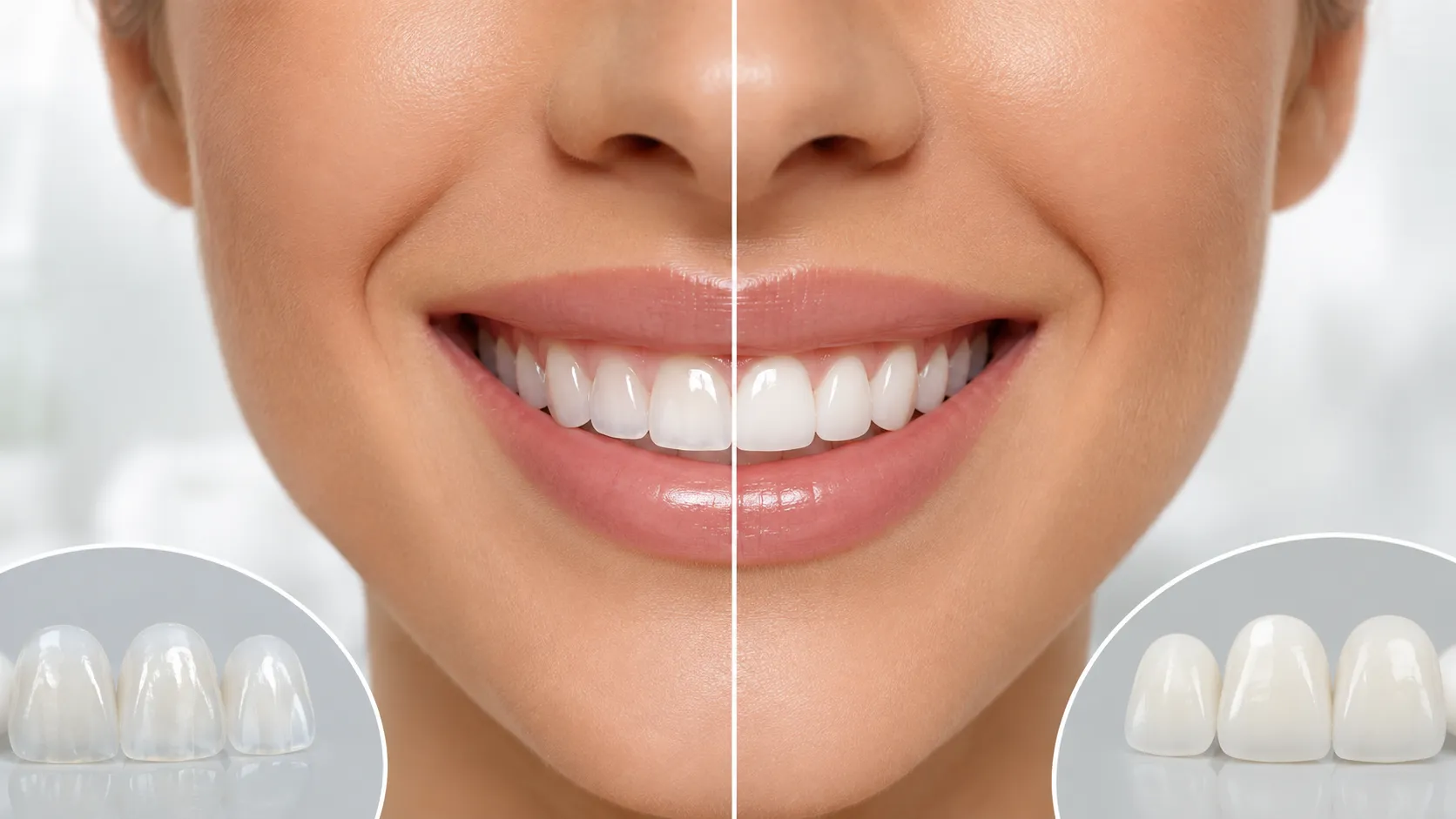
Both E.max and zirconia veneers deliver excellent results. Your dentist will select the material that matches your bite force, tooth color, and smile goals.
Modern cosmetic dentistry gives patients more choices than ever before. Two materials stand out in the world of ceramic veneers. Lithium disilicate glass ceramic, known as E.max, and yttria-stabilized zirconium dioxide, known as zirconia, dominate the field. Each material brings unique strengths to the dental chair. This article compares both options using real clinical data. You will learn how these materials differ in strength, beauty, preparation needs, and long-term performance. By the end, you will understand why individualized treatment planning matters more than picking the most popular material.
What Are E.max Veneers?
E.max veneers are thin shells made from lithium disilicate glass ceramic. Dentists use them to create natural-looking smile makeovers with minimal tooth reduction.
E.max veneers belong to the family of glass-ceramic restorations. They have transformed aesthetic dentistry since their introduction. These veneers combine beauty with reliable performance. Dentists often choose them for patients who want a luminous, enamel-like smile.
What Is the Material Composition of E.max Veneers?
E.max veneers contain lithium disilicate crystals embedded in a glass matrix. Manufacturers produce them using either CAD/CAM milling or heat-press techniques.
E.max veneers start as blocks of lithium disilicate glass ceramic. This material contains silicon dioxide and lithium oxide. During manufacturing, heat treatment grows lithium disilicate crystals within the glass phase. This crystal structure gives the material its unique properties. Manufacturers create E.max veneers through two main methods. The pressed technique heats the ceramic and presses it into a mold. The CAD/CAM method mills the veneer from a pre-crystallized block using computer-guided tools. Both methods produce highly accurate restorations. Aslan et al. (2019) tracked pressable glass-ceramic veneers for up to 20 years and found they maintained excellent clinical performance over time.
What Are the Main Characteristics of E.max Veneers?
E.max veneers offer high translucency, natural appearance, conservative preparation, and strong adhesive bonding.
E.max veneers transmit light much like natural enamel. This translucency creates depth and vitality in the finished smile. The material reflects and refracts light in ways that mimic real tooth structure. Dentists can prepare teeth conservatively because E.max bonds strongly to enamel. The adhesive connection actually strengthens the remaining tooth structure. E.max also polishes to a smooth, glossy surface that resists plaque accumulation. Kourkouta et al. (1994) found that porcelain laminate veneers reduced plaque index and bacterial vitality around restored teeth.
What Are the Typical Clinical Indications for E.max Veneers?
Dentists use E.max veneers for smile makeovers, minor discoloration, small gaps, and mild shape irregularities.
E.max veneers work best in the aesthetic zone. They excel on anterior teeth where light transmission matters most. Dentists place them to close small diastemas between front teeth. They also cover mild tetracycline stains or age-related yellowing. Patients with worn incisal edges benefit from E.max veneers because the material blends seamlessly with adjacent teeth. Malchiodi et al. (2019) evaluated 79 lithium disilicate anterior veneers and reported a 98.7% cumulative survival rate over three years.
What Are Zirconia Veneers?
Zirconia veneers are ultra-strong ceramic shells made from yttria-stabilized zirconium dioxide. They withstand extreme bite forces while offering improved aesthetics in newer formulations.
Zirconia has earned a reputation as the strongest ceramic in dentistry. Dental zirconia is not the same as cubic zirconia jewelry stones. It is a polycrystalline ceramic engineered specifically for oral use. Recent advances have made zirconia more translucent than earlier generations.
What Is the Material Composition of Zirconia Veneers?
Zirconia veneers contain zirconium dioxide stabilized with yttria. Manufacturers offer monolithic and layered versions.
Dental zirconia starts as zirconium dioxide powder. Manufacturers add yttrium oxide, or yttria, to stabilize the crystal structure at room temperature. The yttria content determines the material's properties. Three main types exist. 3Y-TZP contains 3 mol% yttria and offers maximum strength. 4Y-TZP contains 4 mol% yttria and balances strength with translucency. 5Y-TZP contains 5 mol% yttria and provides the highest translucency but lower strength. Monolithic zirconia veneers come from a single block of material. Layered zirconia has a zirconia core covered with aesthetic porcelain. Borba et al. (2011) studied flexural strength and failure modes in layered ceramic structures and found that core material properties significantly influence overall performance.
What Are the Main Characteristics of Zirconia Veneers?
Zirconia veneers offer exceptional flexural strength, high fracture resistance, improved translucency in newer generations, and excellent durability.
Zirconia veneers resist fracture better than any other ceramic veneer material. Their polycrystalline structure stops crack propagation through a mechanism called transformation toughening. When a crack approaches a tetragonal crystal, the crystal transforms to a monoclinic phase. This transformation expands the crystal by about 4% and compresses the crack tip. Modern high-translucency zirconia narrows the aesthetic gap with glass ceramics. However, even 5Y-TZP reaches only about 73% of the translucency of lithium disilicate at equal thickness.
What Are the Typical Clinical Indications for Zirconia Veneers?
Dentists choose zirconia veneers for patients with heavy bite forces, bruxism, dark teeth needing masking, and complex restorative cases.
Zirconia veneers suit patients who grind their teeth at night. They also work well when underlying tooth structure is deeply discolored. Patients with high occlusal loads or edge-to-edge bites benefit from zirconia's mechanical reliability. Dentists may select zirconia when previous veneers have fractured due to excessive force.
E.max Veneers vs Zirconia Veneers: How Do They Compare Side by Side?
E.max leads in aesthetics and conservative preparation. Zirconia leads in strength and masking ability. Both materials succeed when dentists match them to the right clinical situation.
The following table summarizes key differences between these two ceramic veneer systems.
Feature | E.max Veneers | Zirconia Veneers |
Material Type | Lithium disilicate glass ceramic | Yttria-stabilized zirconium dioxide |
Flexural Strength | 350–530 MPa | 500–1,500 MPa (varies by yttria content) |
Fracture Toughness | 2.0–2.5 MPa·m¹/² | 2.0–5.0 MPa·m¹/² (varies by generation) |
Translucency | Higher | Lower (improved in 5Y-TZP) |
Tooth Preparation | More conservative (0.3–0.5 mm) | Slightly more reduction needed |
Bonding Protocol | HF etch + silane | Air abrasion + MDP primer |
Best Use Case | Aesthetic anterior cases | High-load or dark-tooth cases |
Chipping Risk | ~5% | ~1.4% (monolithic) |
Opposing Tooth Wear | Low | Low (when polished) |
Stain Resistance | Excellent | Excellent |
Biocompatibility | Excellent | Excellent |
How Do These Materials Differ in Strength and Fracture Resistance?
Zirconia offers two to three times the flexural strength of E.max. E.max provides adequate strength for most anterior cases but requires more careful patient selection.
Zirconia dominates in raw mechanical strength. Full-strength 3Y-TZP delivers 1,000–1,500 MPa of flexural strength. E.max ranges from 350–530 MPa. However, strength alone does not predict clinical success. Fracture toughness matters more in real mouths. Here the gap narrows. 5Y-TZP overlaps with lithium disilicate at 2.0–2.7 MPa·m¹/². The retrospective cohort study (2025) compared 5-year outcomes and found zirconia restorations had a 94.0% survival rate versus 89.0% for lithium disilicate. Zirconia showed fewer fractures (6.0% vs. 12.0%).
How Do These Materials Compare in Aesthetic Performance?
E.max creates more natural-looking results due to superior light transmission. Zirconia works well for aesthetics but may look slightly more opaque.
E.max veneers transmit light like natural enamel. The glass matrix creates internal reflections that give teeth their lifelike appearance. Zirconia reflects more light from the surface. This makes zirconia look slightly flatter or more chalky in some lighting conditions. However, skilled dental technicians can layer and stain zirconia to achieve beautiful results. Fawakhiri et al. (2023) conducted a 3-year controlled clinical trial comparing high-translucency zirconia with E.max. They found no significant differences in overall clinical performance, though E.max showed slightly better aesthetic and translucency scores.
How Do Translucency and Light Transmission Differ?
E.max transmits more light than any zirconia formulation. Zirconia blocks more light, which helps mask dark underlying tooth structure.
Translucency parameter (TP) measures how much light passes through a material. Natural enamel has a TP of approximately 18.7. E.max closely approaches this value. Kwon et al. (2018) measured translucency parameters at 1 mm thickness and confirmed that lithium disilicate outperforms all zirconia types. The 2023 comparative study of translucency and color perception in monolithic zirconia and lithium disilicate veneers found that zirconia veneers showed significantly lower translucency values than lithium disilicate. Changing thickness affected zirconia's color perception more than E.max.
What Are the Tooth Preparation Requirements for Each Material?
E.max allows more conservative preparation. Zirconia may need slightly more reduction for strength and masking.
E.max veneers often require only 0.3–0.5 mm of enamel removal. This preserves more natural tooth structure. Zirconia veneers typically need 0.5–0.8 mm of reduction. The extra space accommodates the material's lower translucency and ensures adequate thickness for fracture resistance. However, modern minimal-prep techniques continue to reduce these differences.
How Does the Bonding Mechanism Differ?
E.max bonds through hydrofluoric acid etching and silane coupling. Zirconia bonds through air abrasion and MDP-containing primers.
The bonding protocol directly affects veneer longevity. E.max contains silica in its glass phase. Hydrofluoric acid dissolves this glass phase and creates micro-undercuts. Silane then forms covalent bonds with the ceramic surface. Lee et al. (2017) found that surface treatment of lithium disilicate using hydrofluoric acid and silane increased bond strength of resin cement significantly. Zirconia lacks silica. It needs airborne-particle abrasion with aluminum oxide to roughen the surface. Then an MDP-based primer creates chemical bonds with the zirconium oxide. The MDP primer study (2018) confirmed that MDP-based primers yielded the highest bond strength between Y-TZP ceramics and adhesive resin cement.
How Long Do These Veneers Last?
Both materials last 10–15 years or longer with proper care. E.max shows 98.6% survival at 14 years in some studies. Zirconia shows 94.0% survival at 5 years.
Longevity depends on patient habits, oral hygiene, and bonding quality. The 14-year survival study (2024/2025) found pressed E.max restorations had an overall survival rate of 98.6% with an annual failure rate of only 0.1%. All anterior crowns in that study survived. The retrospective cohort study (2025) reported 5-year cumulative survival rates of 94.0% for zirconia and 89.0% for lithium disilicate. Both materials demonstrate excellent long-term reliability.
Which Material Resists Chipping Better?
Monolithic zirconia resists chipping better than E.max. E.max has a clinical chipping rate of approximately 5%.
Zirconia's polycrystalline structure resists crack initiation. Monolithic zirconia veneers show chipping rates around 1.4%. E.max veneers chip more frequently because they are glass-ceramics. However, E.max chips are usually small and repairable. Zirconia rarely chips but may fracture completely if overloaded beyond its limits.
How Do These Materials Wear Against Opposing Teeth?
Both materials wear opposing enamel similarly to natural tooth enamel when properly polished.
Patients often worry that hard ceramics will grind down their natural teeth. Research disproves this concern. Lawson et al. (2014) measured opposing enamel wear and found polished zirconia caused 0.33 mm³ of wear while polished lithium disilicate caused 0.36 mm³. Natural enamel against enamel produced comparable values. Veneering porcelain caused six times more wear at 2.15 mm³. The key factor is surface finish, not material hardness. Dentists must polish any adjusted ceramic surface to restore its smooth glaze.
Which Material Resists Staining Better?
Both materials resist staining extremely well under normal oral conditions.
Neither E.max nor zirconia absorbs coffee, tea, or wine stains like natural enamel or composite resin. The glazed ceramic surface is non-porous. Shade matching accuracy depends more on laboratory technique than on the material itself. Both materials maintain their color for many years.
Are Both Materials Biocompatible?
Yes. Both E.max and zirconia demonstrate excellent biocompatibility with oral soft tissues.
Neither material triggers allergic reactions or inflammation in healthy patients. Kourkouta et al. (1994) found that porcelain laminate veneers actually reduced plaque index and bacterial vitality around restored teeth. Both materials create smooth surfaces that gingival tissue tolerates well.
How Do Costs Compare?
Zirconia typically costs more than E.max due to material and processing expenses. Prices vary by region and laboratory.
Zirconia requires specialized milling equipment and longer sintering times. High-translucency zirconia blocks cost more than standard formulations. E.max offers a more cost-effective solution for many aesthetic cases. However, the price difference often becomes insignificant compared to the total treatment cost.
What Is the Material Science Behind E.max and Zirconia?
E.max relies on a glass-ceramic microstructure with lithium disilicate crystals. Zirconia relies on a polycrystalline structure with transformation toughening.
Understanding the internal structure of these materials helps explain their clinical behavior.
What Is the Microstructure of Lithium Disilicate?
E.max contains needle-like lithium disilicate crystals suspended in a glass matrix. This structure creates its signature translucency.
The glass phase in E.max allows light to pass through and scatter naturally. The lithium disilicate crystals reinforce the glass without blocking light completely. This dual-phase structure gives E.max its unique balance of strength and beauty.
What Is the Polycrystalline Structure of Zirconia?
Zirconia contains densely packed zirconium dioxide crystals. Yttria stabilizes the tetragonal phase at room temperature.
Without yttria, zirconia would transform to a monoclinic phase and crack. The yttria stabilizer keeps crystals in the tetragonal phase. When stress triggers transformation toughening, these crystals expand and stop crack growth. Higher yttria content creates more cubic crystals. This increases translucency but reduces transformation toughening.
Why Does Material Structure Influence Clinical Performance?
The crystal structure determines how each material handles light, force, and bonding. Glass-ceramics excel at aesthetics. Polycrystalline ceramics excel at mechanics.
E.max's glass matrix behaves like natural enamel optically. Zirconia's crystal structure behaves like engineered stone mechanically. Neither structure is superior overall. Each solves different clinical problems.
How Do E.max and Zirconia Compare Aesthetically?
E.max generally looks more natural. Zirconia can achieve excellent aesthetics with skilled laboratory work.
Aesthetics drive most veneer decisions. Patients want smiles that look real, not artificial.
Which Material Looks More Natural?
E.max looks more natural because it transmits light like real enamel. Zirconia can look natural but starts from a more opaque base.
Natural teeth have depth. Light enters the enamel, bounces off the dentin, and exits with warm tones. E.max replicates this journey. Zirconia reflects more light from the surface. This can create a slightly flatter appearance in direct sunlight or flash photography.
How Do Color Matching Capabilities Compare?
Both materials match tooth shades accurately. E.max blends more seamlessly at the margins.
Dental technicians stain and glaze both materials to match surrounding teeth. E.max accepts stains readily because of its glass phase. Zirconia requires more layering skill to achieve the same chromatic depth. However, modern multilayer zirconia blocks with gradient color transitions have improved outcomes significantly.
How Does Surface Texture Differ?
Both materials polish to a smooth, enamel-like surface. E.max achieves a slightly glossier finish.
Surface texture affects how light scatters across the veneer face. E.max polishes to a high gloss that mimics youthful enamel. Zirconia can achieve similar gloss but may require more polishing steps.
How Does Fluorescence Compare?
E.max fluoresces more like natural enamel under ultraviolet light. Zirconia shows slightly different fluorescence patterns.
Natural teeth fluoresce under black light. This property matters in social settings with UV lighting. E.max contains glass components that fluoresce similarly to enamel. Zirconia's crystalline structure produces a slightly different fluorescence signature.
How Do Translucency Differences Affect Results?
E.max creates more lifelike results on vital, lightly colored teeth. Zirconia works better when underlying teeth are dark.
Translucency differences become most noticeable on single central incisors. E.max blends with adjacent teeth seamlessly. Zirconia may require more opaque cement or thicker material to block underlying darkness.
How Do These Materials Perform Under Different Lighting Conditions?
E.max maintains its natural appearance under varied lighting. Zirconia may look slightly different under strong directional light.
Incandescent, fluorescent, and natural daylight all reveal different aspects of veneer aesthetics. E.max handles these variations gracefully because it mimics enamel's optical properties. Zirconia performs well but may show its opacity more clearly in certain lighting.
How Do E.max and Zirconia Compare in Strength?
Zirconia is significantly stronger. E.max provides sufficient strength for most anterior veneer cases.
Strength matters most in patients with heavy bites or parafunctional habits.
What Is the Flexural Strength of Each Material?
Zirconia ranges from 500–1,500 MPa depending on yttria content. E.max ranges from 350–530 MPa.
Full-strength 3Y-TZP zirconia reaches 1,000–1,500 MPa. This is roughly three times the flexural strength of E.max. Even ultra-translucent 5Y-TZP at 500–800 MPa overlaps with or exceeds E.max in some formulations.
What Is the Fracture Toughness of Each Material?
3Y-TZP zirconia reaches 3.5–5.0 MPa·m¹/². E.max and 5Y-TZP both sit around 2.0–2.5 MPa·m¹/².
Fracture toughness measures resistance to crack propagation. This property predicts real-world durability better than flexural strength alone. The gap between zirconia and E.max narrows significantly when comparing 5Y-TZP to lithium disilicate.
Which Material Offers Better Crack Resistance?
Zirconia resists crack growth through transformation toughening. E.max relies on adhesive bonding to prevent crack propagation.
Once a crack starts in E.max, it can spread through the glass phase. Strong bonding to the underlying tooth helps prevent this. Zirconia's crystal structure actively fights crack growth at the microscopic level.
How Do These Materials Perform Under High Bite Forces?
Zirconia withstands extreme occlusal loads better. E.max works well under normal anterior biting forces.
The average anterior bite force ranges from 100–150 Newtons. E.max handles this easily. Patients with bruxism may generate forces exceeding 500 Newtons. Zirconia survives these loads more reliably.
What Are the Clinical Implications of These Strength Differences?
Dentists choose zirconia for high-risk patients. They choose E.max for standard aesthetic cases where beauty matters most.
Strength differences guide material selection but do not dictate outcomes alone. Proper case selection, bonding, and occlusal management matter as much as material choice.
What Are the Tooth Preparation Requirements?
E.max allows the most conservative preparation. Zirconia needs slightly more reduction but modern techniques minimize this difference.
Tooth preparation affects long-term tooth health. More enamel preservation means better bonding and lower sensitivity.
How Conservative Is Preparation with E.max?
E.max veneers often need only 0.3–0.5 mm of enamel removal. Some cases qualify for no-prep techniques.
The strong adhesive bond of E.max allows minimal reduction. Dentists can place E.max veneers with little or no tooth preparation in selected cases. This preserves enamel and maintains tooth vitality.
What Preparation Considerations Apply to Zirconia?
Zirconia typically requires 0.5–0.8 mm of reduction. This ensures adequate material thickness for strength and masking.
Zirconia needs more space to achieve both mechanical durability and optical performance. The preparation must provide uniform thickness. Knife-edge margins work with zirconia due to its high strength.
How Much Enamel Can Each Approach Preserve?
E.max preserves more enamel. Zirconia sacrifices slightly more enamel for mechanical reliability.
Enamel preservation correlates with long-term bonding success. The more enamel remains, the stronger the adhesive interface. E.max wins in this category.
What Are No-Prep and Minimal-Prep Possibilities?
E.max offers more no-prep and minimal-prep options. Zirconia rarely works as a no-prep veneer.
No-prep veneers add material thickness without removing enamel. E.max at 0.3–0.5 mm thickness works well in additive veneer cases. Zirconia at this thickness would look opaque and bulky.
How Do Adhesive Bonding Differences Affect Results?
E.max bonds through silica-based etching and silane. Zirconia bonds through mechanical abrasion and phosphate monomers.
Bonding determines whether a veneer stays in place for decades or fails within months.
What Is the Bonding Protocol for E.max?
Dentists etch E.max with hydrofluoric acid, apply silane, and use resin cement.
The protocol starts with 5% hydrofluoric acid for 20 seconds. This dissolves the glass phase and creates micro-retentive undercuts. Silane coupling agent then forms chemical bonds with the exposed silica. Resin cement completes the connection. Lee et al. (2017) confirmed that this combination produces the highest and most durable bond strengths for lithium disilicate.
What Surface Treatment Does Zirconia Require?
Zirconia needs airborne-particle abrasion with aluminum oxide followed by an MDP-based primer.
Zirconia contains no silica for silane to bond with. Air abrasion at 2.8 bar pressure with 50 µm aluminum oxide particles roughens the surface. Then an MDP primer like Z-Prime Plus creates chemical bonds with the zirconium oxide. The MDP primer study (2018) showed that this combination yields the highest shear bond strength between zirconia and resin cement.
How Does Cement Selection Differ?
Both materials use resin cement. E.max works with any resin cement after proper priming. Zirconia needs MDP-containing cement or primer.
Dual-cure resin cements work well for both materials. Light-cure cements suffice for thin E.max veneers. Zirconia benefits from self-adhesive resin cements that contain MDP monomers.
Why Is Proper Bonding Clinically Important?
Strong bonding prevents debonding, microleakage, and fracture. It directly determines veneer longevity.
A well-bonded veneer functions as one unit with the tooth. Poor bonding leads to gaps, sensitivity, and failure. Both materials require meticulous protocol adherence.
How Long Do These Veneers Last Clinically?
Both materials last 10–20 years. E.max shows 98.6% survival at 14 years. Zirconia shows 94.0% survival at 5 years.
Long-term data supports both materials when dentists use them correctly.
What Is the Expected Lifespan?
Patients can expect 10–15 years from both materials. Some E.max restorations exceed 20 years.
Aslan et al. (2019) documented pressable glass-ceramic veneers performing well for up to 20 years. The 14-year survival study (2024/2025) confirmed E.max maintains 98.6% survival over 14 years. Zirconia data continues to accumulate, with 5-year rates already showing excellent reliability.
What Factors Affect Durability?
Oral hygiene, diet, bruxism, bite alignment, and regular maintenance all affect veneer lifespan.
Patients who brush twice daily and floss regularly protect their veneers. Hard foods, ice chewing, and nail biting increase fracture risk. Bruxism generates destructive forces. Proper bite alignment distributes forces evenly. Regular dental checkups catch problems early.
What Are the Clinical Survival Rates?
E.max reaches 98.7% survival at 3 years and 98.6% at 14 years. Zirconia reaches 94.0% at 5 years.
Malchiodi et al. (2019) reported 98.7% cumulative survival for lithium disilicate anterior veneers at 3 years. The retrospective cohort study (2025) found zirconia restorations had a 94.0% 5-year survival rate versus 89.0% for lithium disilicate. Both rates represent excellent clinical performance.
What Does Scientific Evidence Say About Both Materials?
Scientific literature confirms both materials perform excellently in appropriate indications. E.max excels in aesthetics. Zirconia excels in mechanical durability.
Fawakhiri et al. (2023) found no significant clinical differences between high-translucency zirconia and E.max over 3 years. However, E.max scored slightly higher in aesthetics and translucency. The retrospective cohort study (2025) noted zirconia trended toward superior mechanical reliability in posterior cases.
Which Veneers Work Better for Front Teeth?
E.max generally works better for front teeth due to superior light transmission and natural appearance.
The smile zone demands the highest aesthetic standards.
What Smile Zone Considerations Apply?
The upper six to ten teeth form the smile zone. These teeth need maximum translucency and color blending.
E.max handles the optical demands of the smile zone best. Its enamel-like translucency creates seamless integration with natural teeth.
How Do Thin Enamel Cases Affect Material Choice?
E.max works better when enamel is thin because it bonds more reliably to minimal tooth structure.
Thin enamel still provides enough surface for E.max bonding. The conservative preparation preserves what little enamel remains.
Which Material Suits High Esthetic Demand Patients?
E.max suits patients who demand the most natural-looking results. Zirconia works for patients who prioritize durability over absolute translucency.
Actors, models, and public figures often prefer E.max for its lifelike quality. Patients with high functional demands may accept zirconia's slight aesthetic trade-off.
Which Veneers Work Better for Patients with Bruxism?
Zirconia works better for bruxism patients because it withstands higher occlusal forces.
Bruxism creates destructive forces that challenge any ceramic material.
How Do Occlusal Forces Affect Veneer Choice?
Heavy bite forces favor zirconia. Normal bite forces allow either material.
Bruxism patients generate forces far exceeding normal function. Zirconia's strength provides a safety margin that E.max cannot match.
How Does Night Grinding Influence Material Selection?
Night grinding destroys E.max veneers more quickly than zirconia. Both materials benefit from night guards.
A protective occlusal splint reduces forces on veneers regardless of material. However, zirconia survives accidental grinding without a guard better than E.max.
How Important Are Protective Night Guards?
Night guards are essential for all veneer patients with bruxism. They protect both the veneer and opposing teeth.
Dentists should recommend night guards for every bruxism patient receiving veneers. This simple device extends veneer life by years.
When May Dentists Prefer Zirconia for Bruxism Cases?
Dentists prefer zirconia when patients refuse night guards or have severe grinding habits.
Some patients will not wear night guards. Zirconia offers the best chance of survival in these challenging cases.
Which Veneers Better Hide Dark Teeth?
Zirconia masks dark underlying tooth structure better than E.max.
Internal tooth discoloration presents a major aesthetic challenge.
How Does Internal Tooth Discoloration Affect Choice?
Dark teeth need opaque materials. Zirconia blocks more light than E.max.
Tetracycline stains, fluorosis, and dead teeth appear gray or brown. These colors show through translucent materials.
How Do Root Canal–Treated Teeth Affect Selection?
Root canal teeth often darken over time. Zirconia covers this darkness more effectively.
Non-vital teeth lose their natural translucency. They become increasingly gray. Zirconia's opacity masks this change.
How Does Tetracycline Staining Affect Material Choice?
Severe tetracycline stains require zirconia's masking power. Mild stains may respond to E.max with opaque cement.
Tetracycline binds to dentin and creates deep gray-brown bands. These stains resist bleaching. Zirconia provides the coverage these patients need.
How Do Masking Abilities Compare?
Zirconia masks about 30–40% better than E.max. E.max may need opaque cement or thicker material to hide dark teeth.
Masking ability comes from opacity. Zirconia's crystalline structure naturally blocks more light. E.max's glass phase transmits more light, which works against masking goals.
How Do These Materials Affect Patient Comfort and Gum Health?
Both materials support healthy gums when dentists place them properly. Neither material irritates soft tissue.
Gingival health matters as much as aesthetics and strength.
How Biocompatible Are Both Materials?
Both E.max and zirconia demonstrate excellent biocompatibility. They rarely cause allergic reactions.
The body accepts both ceramic materials without inflammation. Kourkouta et al. (1994) found that porcelain veneers actually improved plaque control around restored teeth.
How Does Plaque Accumulation Compare?
Both materials resist plaque accumulation better than natural tooth structure or composite resin.
The glazed ceramic surface is too smooth for bacteria to adhere easily. Kourkouta et al. (1994) measured statistically significant reductions in plaque index after veneer placement.
How Does Gingival Response Differ?
Healthy gums respond well to both materials. Poor margin fit causes problems regardless of material choice.
Well-fitted veneers sit flush with the gumline. This minimizes irritation. Overhanging margins trap plaque and cause inflammation.
How Stable Is Soft Tissue Long-Term?
Both materials maintain stable soft tissue relationships for decades with proper oral hygiene.
Long-term gingival health depends on margin placement and patient care. The material itself plays a minor role compared to these factors.
How Does Digital Smile Design Influence Material Selection?
Digital planning helps dentists choose the right material before touching any tooth.
Modern technology removes guesswork from veneer treatment.
How Does Digital Planning Work?
Dentists scan the mouth and design the smile digitally. They analyze tooth position, bite, and aesthetics on screen.
Intraoral scanners capture accurate digital models. Software analyzes facial symmetry, lip dynamics, and tooth proportions.
How Does Shade Analysis Help?
Digital shade analysis measures tooth color objectively. It guides material and cement selection.
Spectrophotometers eliminate subjective shade-matching errors. They identify whether E.max or zirconia will blend better with existing teeth.
How Does Smile Simulation Help?
Smile simulation shows patients their expected results before treatment begins. It builds confidence and guides material choice.
Patients see virtual previews of their new smile. Dentists adjust tooth shape, size, and color digitally. This preview helps patients understand why the dentist recommends a specific material.
How Does Individualized Treatment Planning Work?
Dentists combine digital data with clinical examination to select the ideal material for each tooth.
No two mouths are identical. Digital smile design integrates bite analysis, aesthetic mapping, and functional assessment. This comprehensive approach matches E.max or zirconia to specific teeth based on their individual needs.
What Are the Advantages and Disadvantages of E.max Veneers?
E.max offers outstanding beauty and conservative preparation. It lacks the brute strength of zirconia.
Every material involves trade-offs. E.max is no exception.
What Advantages Do E.max Veneers Offer?
E.max provides outstanding esthetics, superior translucency, conservative preparation, and excellent bonding.
The glass-ceramic structure creates the most lifelike restorations in dentistry. Dentists can preserve enamel. The bonding protocol is well-established and reliable.
What Limitations Do E.max Veneers Have?
E.max fractures more easily than zirconia. It may not suit severe bruxism. It masks dark teeth poorly.
Patients with heavy bites or dark teeth need careful evaluation. E.max may require replacement sooner in high-risk situations.
What Are the Advantages and Disadvantages of Zirconia Veneers?
Zirconia offers extreme strength and masking ability. It sacrifices some translucency and requires more complex bonding.
Zirconia solves problems that challenge other materials.
What Advantages Do Zirconia Veneers Offer?
Zirconia provides very high strength, excellent durability, superior masking ability, and suitability for high-load cases.
Patients who break other ceramics find salvation in zirconia. It survives forces that destroy glass-ceramics.
What Limitations Do Zirconia Veneers Have?
Zirconia offers slightly lower translucency. It requires more technique-sensitive finishing. Its bonding protocol differs from glass ceramics.
Dental technicians must work harder to make zirconia look natural. Dentists must follow strict bonding protocols. These factors increase technical complexity.
How Do Dentists Choose Between E.max and Zirconia Veneers?
Dentists evaluate smile goals, tooth position, bite force, existing restorations, enamel availability, and functional risk.
Material selection is a clinical decision, not a popularity contest.
How Do Smile Goals Affect Choice?
Patients seeking maximum beauty receive E.max. Patients needing durability receive zirconia.
The primary goal guides material selection. Aesthetics-first cases favor E.max. Function-first cases favor zirconia.
How Does Tooth Position Affect Selection?
Upper front teeth usually get E.max. Lower teeth or posterior teeth may get zirconia.
Upper incisors and canines face the highest aesthetic scrutiny. Lower teeth and posterior teeth face higher functional loads.
How Does Bite Force Affect Choice?
High bite forces push dentists toward zirconia. Normal forces allow E.max.
Dentists measure bite force and analyze occlusal patterns. Deep bites, edge-to-edge bites, and crossbites increase functional risk.
How Do Existing Restorations Affect Selection?
Teeth with large fillings or crowns may need zirconia for additional strength. Virgin teeth may receive E.max.
Previously restored teeth have less natural structure. They need the extra support zirconia provides.
How Does Enamel Availability Affect Choice?
Teeth with abundant enamel suit E.max. Teeth with little enamel may need zirconia's strength.
Enamel quantity determines bonding potential and preparation options. More enamel means more options.
How Does Functional Risk Assessment Work?
Dentists score each tooth for fracture risk. High-risk teeth get zirconia. Low-risk teeth get E.max.
This systematic approach prevents material failures. It matches mechanical demands to material capabilities.
What Are the Most Frequently Asked Questions About E.max Veneers vs Zirconia Veneers?
Patients ask about aesthetics, longevity, strength, preparation, and cost. Both materials answer these questions well in different ways.
Which Veneers Look More Natural?
E.max looks more natural due to superior translucency.
Which Veneers Last Longer?
Both last 10–20 years. E.max data extends to 14+ years. Zirconia 5-year data shows 94.0% survival.
Which Material Is Stronger?
Zirconia is significantly stronger, especially 3Y-TZP formulations.
Can Zirconia Veneers Look as Natural as E.max?
Skilled technicians can make zirconia look very natural. E.max still holds a slight edge in translucency.
Which Veneers Require Less Tooth Reduction?
E.max requires less reduction. It works in minimal-prep and no-prep cases.
Which Option Is Better for Bruxism?
Zirconia survives bruxism better. Both materials need night guards.
Which Veneers Resist Staining Better?
Both resist staining equally well.
Are E.max Veneers More Expensive Than Zirconia?
Zirconia typically costs more than E.max.
Can Both Materials Be Used in the Same Smile Makeover?
Yes. Dentists often combine E.max on upper anteriors with zirconia on lower or high-load teeth.
How Should Patients Choose Between E.max and Zirconia Veneers?
Patients should trust their dentist's recommendation after clinical examination and digital analysis.
What Is the Final Verdict on E.max vs Zirconia Veneers?
Neither material is universally better. The right choice depends on each patient's unique clinical situation.
Both E.max and zirconia veneers deliver excellent clinical outcomes. E.max generally offers superior esthetics and conservative preparation. Zirconia provides greater mechanical strength and masking ability. Scientific literature confirms that both materials demonstrate excellent clinical performance when dentists use them in appropriate indications (Fawakhiri et al., 2023; retrospective cohort study, 2025).
There is no single "best" veneer material. Individualized treatment planning based on esthetics, function, occlusion, enamel preservation, and long-term prognosis determines success. An experienced cosmetic dentist evaluates each tooth, each bite, and each smile goal before recommending E.max or zirconia.
Patients should seek consultation with a dentist who uses digital smile analysis and clinical examination together. This combined approach ensures the selected material matches the patient's needs precisely. Whether you choose E.max or zirconia, proper bonding, regular maintenance, and protective habits will keep your smile beautiful for years to come.
References
Aslan, Y. U., et al. "Clinical performance of pressable glass-ceramic veneers after 5, 10, 15, and 20 years: A retrospective case series study." Journal of Esthetic and Restorative Dentistry, vol. 31, no. 5, 2019, pp. 415-422.
Borba, M., et al. "Flexural strength and failure modes of layered ceramic structures." Dental Materials, vol. 27, no. 12, 2011, pp. 1259-1266.
Fawakhiri, Hiba A., et al. "A 3-year controlled clinical trial comparing high-translucency zirconia (cubic zirconia) with lithium disilicate glass ceramic (e.max)." Clinical and Experimental Dental Research, vol. 9, no. 6, 2023, pp. 1078-1088.
Kourkouta, S., et al. "The effect of porcelain laminate veneers on gingival health and bacterial plaque characteristics." Journal of Clinical Periodontology, vol. 21, no. 10, 1994, pp. 638-642.
Lawson, Nathaniel C., et al. "Wear of enamel opposing polished and roughened zirconia." Journal of Prosthetic Dentistry, vol. 112, no. 5, 2014, pp. 1033-1039.
Lee, H. Y., et al. "Bonding of the silane containing multi-mode universal adhesive to lithium disilicate." Journal of Advanced Prosthodontics, vol. 9, no. 3, 2017, pp. 200-207.
Malchiodi, L., et al. "Clinical and Esthetical Evaluation of 79 Lithium Disilicate Multilayered Anterior Veneers with a Medium Follow-Up of 3 Years." Journal of Clinical and Experimental Dentistry, vol. 11, no. 5, 2019, pp. e439-e445.
"Over 14-year survival of pressed e.max lithium disilicate glass-ceramic complete and partial coverage restorations in patients with severe wear: A prospective clinical study." The Journal of Prosthetic Dentistry, 2025.
"Comparison of Long-Term Clinical Outcomes of Zirconia and Lithium Disilicate Prostheses: A Retrospective Cohort Study." Journal of Clinical Medicine, 2025.
"A comparative study of translucency and color perception in monolithic zirconia and lithium disilicate veneers." Heliyon, vol. 9, no. 7, 2023, e17452.
"Effects of MDP-based primers on shear bond strength between zirconia crowns and resin cement." Journal of Prosthodontic Research, vol. 63, no. 1, 2019, pp. 73-80.
Kwon, S. J., et al. "Translucency of dental ceramics according to the thickness and the refractive index of the surrounding medium." Dental Materials Journal, vol. 37, no. 2, 2018, pp. 254-261.