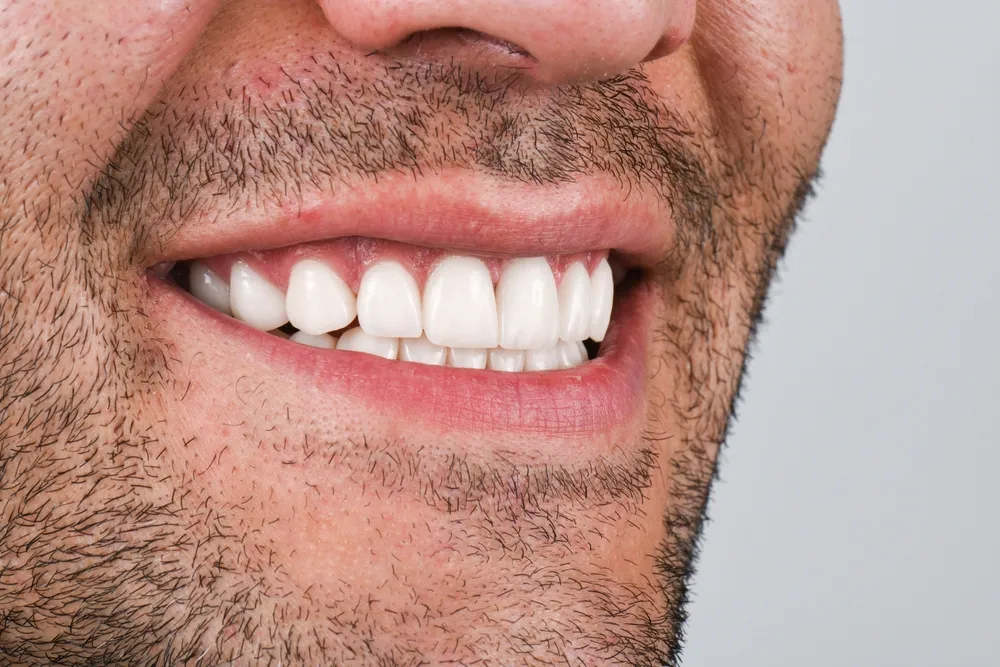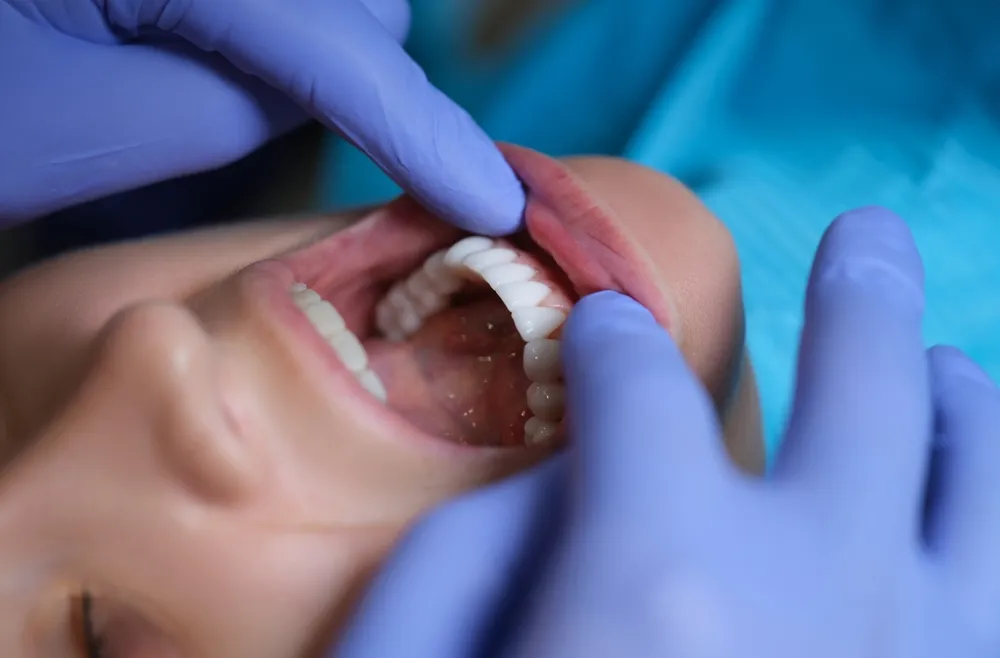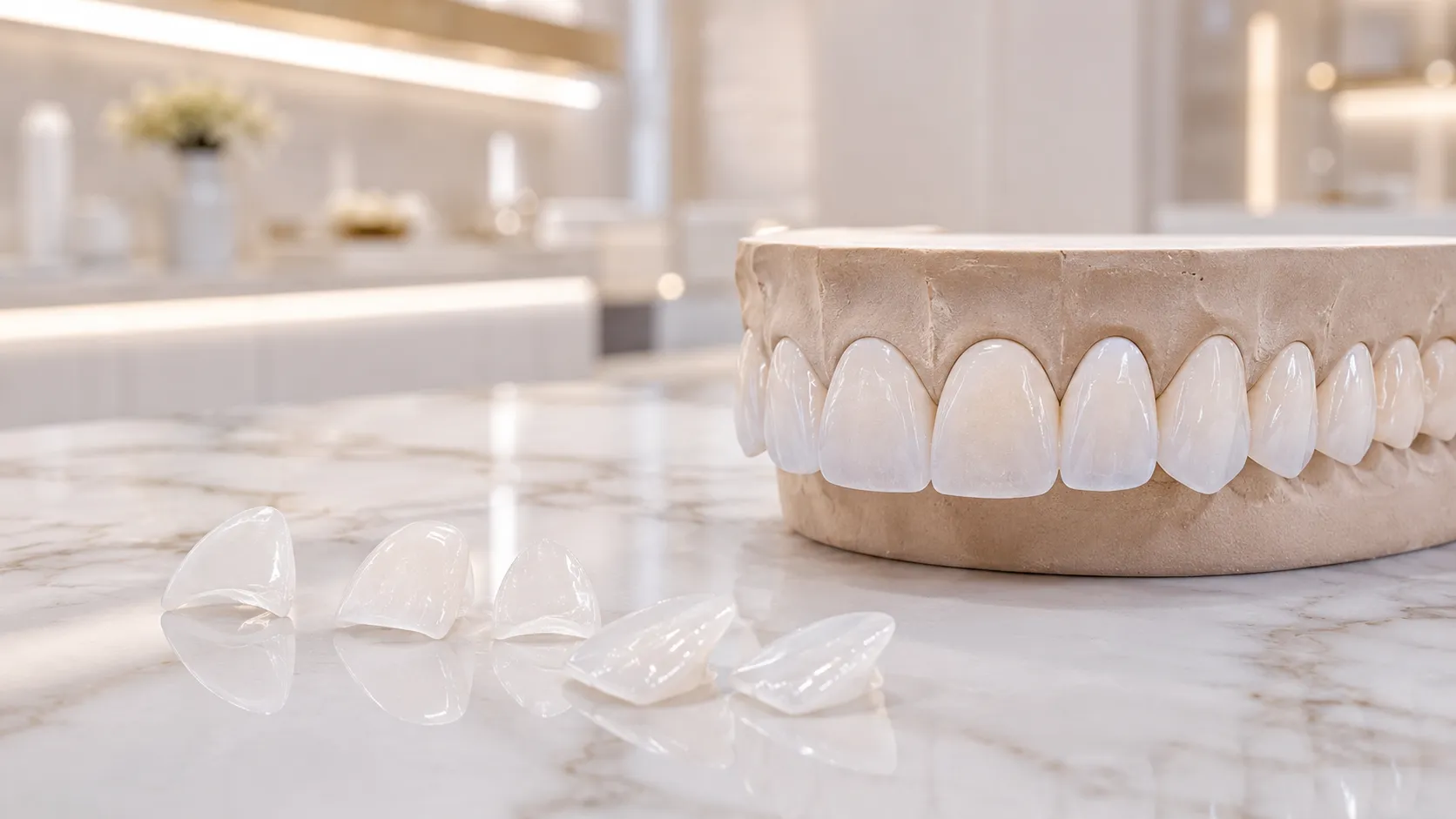
E.max veneers are thin ceramic shells that dentists place over the front surface of teeth to improve appearance. These restorations use lithium disilicate glass-ceramic, a material that mimics natural tooth enamel in both strength and beauty. Patients choose E.max veneers to fix discoloration, chips, gaps, and minor misalignment without removing large amounts of healthy tooth structure. This guide explains what E.max veneers are, how they work, who benefits from them, and what patients should know before starting treatment. You will learn about the science behind lithium disilicate, the clinical procedure, long-term outcomes, and how E.max compares to other veneer materials. Every section uses current scientific evidence to give you clear, trustworthy information.
What Are E.max Veneers Made Of?
E.max veneers are made from lithium disilicate glass-ceramic, a high-performance material developed by Ivoclar Vivadent under the IPS e.max brand. This material combines silica glass with lithium disilicate crystals to create a restoration that looks natural and resists fracture. The composition allows light to pass through the veneer much like it passes through natural enamel. Dentists and dental technicians value this material because it offers both esthetics and durability in a single system.
What Is Lithium Disilicate Glass-Ceramic?
Lithium disilicate glass-ceramic is a engineered material that contains lithium dioxide and silicon dioxide in a crystalline structure. The manufacturing process heats raw glass to form microscopic lithium disilicate crystals within a glass matrix. These crystals measure approximately 1 to 2 micrometers in size and make up about 70 percent of the material volume. This crystal structure gives the ceramic its strength while the glass phase provides translucency. Researchers classify lithium disilicate as a glass-ceramic because it starts as glass and transforms into a ceramic through controlled heat treatment. The material flexural strength reaches approximately 360 to 400 megapascals, which is significantly higher than traditional feldspathic porcelain (Pini et al. 12). This strength allows dentists to make very thin veneers that still resist cracking under normal chewing forces.
How Does the IPS e.max System Work?
The IPS e.max system offers two main fabrication methods for lithium disilicate restorations. The first method uses a heat-pressing technique where dental technicians wax a model of the veneer, invest it in refractory material, and then press molten lithium disilicate ceramic into the mold. The second method uses computer-aided design and computer-aided manufacturing (CAD/CAM) technology. In this digital workflow, a dentist or technician scans the prepared tooth, designs the veneer on a computer, and then mills the restoration from a pre-crystallized lithium disilicate block. After milling, the restoration undergoes a crystallization firing process in a special oven to reach full strength and esthetics. Both methods produce restorations with excellent marginal fit and consistent material properties. The pressed technique often provides superior esthetics for complex shade cases, while the CAD/CAM method offers faster turnaround and high precision (Ortensi et al. 538).
Why Is Material Composition Important for Veneers?
The material composition of a veneer directly affects how it looks, how long it lasts, and how much tooth structure the dentist must remove. Lithium disilicate offers a unique balance because its crystal content provides strength without sacrificing the optical properties that make teeth look natural. Traditional feldspathic porcelain contains more glass and less crystal structure, so it looks beautiful but fractures more easily. Zirconia contains much more crystal structure and offers higher strength, but it often looks more opaque and less lifelike. The lithium disilicate composition sits in the middle of this spectrum. It gives dentists enough strength for thin veneers while maintaining the translucency and fluorescence that patients want for natural-looking smiles (Al-Fetlawi et al.).
What Makes E.max Different from Traditional Porcelain Veneers?
Traditional porcelain veneers typically use feldspathic porcelain, a material that has served dentistry for decades. Feldspathic porcelain looks highly esthetic because it transmits light well, but its flexural strength ranges only from 60 to 100 megapascals. This lower strength means technicians must make feldspathic veneers thicker to prevent fracture, which requires dentists to remove more enamel. E.max lithium disilicate offers roughly four times the flexural strength of feldspathic porcelain. This higher strength allows E.max veneers to be thinner, often as thin as 0.3 to 0.5 millimeters in some cases. The IPS e.max system also provides better color stability over time and resists surface wear better than older porcelain systems. Patients who choose E.max benefit from a more conservative preparation and a restoration that maintains its appearance for many years (Magne and Magne 10).
How Do E.max Veneers Work?
E.max veneers work by covering the visible front surface of teeth with a thin, custom-made ceramic shell. The dentist bonds this shell to the enamel using a strong adhesive resin cement. This bonding process creates a unified structure where the veneer and the tooth act together to resist functional forces. The success of E.max veneers depends on careful treatment planning, precise tooth preparation, accurate laboratory fabrication, and meticulous adhesive bonding.
What Is Conservative Tooth Preparation?
Conservative tooth preparation means the dentist removes only a small amount of enamel to make room for the veneer. For E.max veneers, this reduction typically ranges from 0.3 to 0.7 millimeters on the facial surface. The dentist may remove slightly more enamel near the incisal edge to allow for proper veneer thickness and esthetics. The goal is to stay entirely within the enamel layer because enamel provides the best surface for adhesive bonding. When preparation extends into dentin, the bond strength decreases and the risk of complications increases. Research shows that bonding to enamel creates significantly stronger and more durable adhesion than bonding to dentin (Rojas-Rueda et al.). Some cases even allow for no-preparation or additive veneers where the dentist places the restoration without removing any tooth structure. This approach works best when the teeth are small or when the patient wants to close gaps.
How Does Digital Smile Design and Treatment Planning Work?
Digital Smile Design (DSD) is a planning protocol that uses digital photographs, videos, and three-dimensional scans to design the ideal smile before any tooth preparation begins. The dentist takes standardized facial photographs and imports them into specialized software. This software allows the dentist to analyze facial proportions, tooth position, gingival levels, and smile dynamics. The dentist then creates a digital mock-up of the proposed veneers directly on the patient photographs. Patients can see a preview of their future smile and provide feedback before treatment starts. This visual communication reduces misunderstandings and sets realistic expectations. Studies confirm that digital planning improves the accuracy of final restorations and increases patient satisfaction (Gonzaga et al. 455). The digital mock-up also serves as a guide during tooth preparation, helping the dentist remove exactly the right amount of enamel.
What Are CAD/CAM and Press Manufacturing Techniques?
CAD/CAM and press techniques are the two ways dental laboratories fabricate E.max veneers. In the CAD/CAM method, the dentist scans the prepared tooth with an intraoral scanner or takes a digital impression. The laboratory technician designs the veneer using dental CAD software and then mills it from a lithium disilicate block using a computer-controlled milling machine. The milled restoration is then fired in a crystallization oven to achieve full strength. In the press technique, the technician creates a wax pattern of the veneer, invests it in a special ring, and then presses heated lithium disilicate ingot into the mold using a special furnace. The press technique often produces superior surface detail and is preferred for complex multi-unit cases. The CAD/CAM method offers speed, digital precision, and the ability to produce same-day restorations in some clinics. Both techniques yield clinically acceptable results when performed by skilled technicians (Ortensi et al. 540).
What Is the Adhesive Bonding Process?
The adhesive bonding process permanently attaches the E.max veneer to the tooth surface. The dentist first treats the inner surface of the ceramic veneer with hydrofluoric acid for 20 seconds. This acid etching creates microscopic pores in the ceramic surface. The dentist then applies a silane coupling agent for 60 seconds. Silane acts as a bridge between the ceramic and the resin cement. Next, the dentist treats the tooth enamel with 37 percent phosphoric acid for 15 to 30 seconds to create micro-retentive tags in the enamel. After rinsing and drying, the dentist applies a bonding agent to the tooth. The dentist then places a light-cured or dual-cured resin cement between the veneer and the tooth. After seating the veneer in the correct position, the dentist removes excess cement and cures the material with a high-intensity blue light. Each surface receives adequate curing time, typically 20 seconds per surface. Complete isolation with a rubber dam during this procedure prevents saliva contamination and ensures maximum bond strength (Rojas-Rueda et al.).
What Happens During Final Placement and Finishing?
During final placement, the dentist first tries in the veneer without cement to check the fit, margins, and shade. The dentist may use try-in paste to preview the final color. Once the patient and dentist approve the appearance, the dentist proceeds with the bonding protocol described above. After bonding, the dentist removes any excess cement from the margins using a sharp scaler. The dentist then checks the bite to ensure the veneer does not hit the opposing tooth too hard. Minor adjustments may be needed to perfect the occlusion. Finally, the dentist polishes the margins and the surface to a high gloss. This polishing step ensures the veneer feels smooth to the tongue and resists plaque accumulation. The patient can then see the final result immediately, though the gums may take a few days to fully settle around the new margins.
What Are the Advantages of E.max Veneers?
E.max veneers offer multiple advantages over other cosmetic dental treatments. These benefits include superior esthetics, high strength, minimal invasiveness, reliable bonding, and excellent long-term performance. Patients and dentists alike appreciate the predictable outcomes that E.max provides.
Why Do E.max Veneers Offer a Highly Natural Appearance?
E.max veneers offer a highly natural appearance because lithium disilicate transmits and reflects light in a way that closely resembles natural tooth enamel. Natural teeth are not solid opaque objects. Light enters the enamel, scatters through the dentin layer, and reflects back out. This interaction creates depth, vitality, and subtle color variations. E.max captures this effect through several optical properties. First, its translucency allows light to penetrate the veneer rather than simply bouncing off the surface. Second, its fluorescence causes the material to emit a slight glow under ultraviolet light, just like natural teeth. Third, its color stability prevents the veneer from changing shade over time. Dentists can also layer different shades of ceramic or use specialized cements to fine-tune the final color. Clinical studies show that patients and observers rate E.max veneers as highly esthetic, with color matching scores consistently in the excellent range (Imburgia, Lerner, and Mangano).
How Can E.max Veneers Be Strong Despite a Thin Design?
E.max veneers can be strong despite a thin design because lithium disilicate contains a high volume fraction of interlocking crystals. These crystals stop cracks from spreading through the material. The flexural strength of lithium disilicate reaches approximately 360 to 400 megapascals after full crystallization. This strength is more than enough to withstand normal chewing and biting forces on anterior teeth. Because the material is so strong, technicians can fabricate veneers as thin as 0.3 millimeters in some areas. Thinner veneers mean dentists can preserve more healthy enamel. The strength also comes from the adhesive bond. When the dentist bonds the veneer to enamel, the tooth and veneer work together as one unit. This adhesive reinforcement further reduces the risk of fracture under functional load (Pini et al. 12).
Why Does E.max Require Minimal Tooth Reduction?
E.max requires minimal tooth reduction because its high strength allows for very thin restorations. Traditional porcelain veneers often need 0.8 to 1.0 millimeters of enamel removal to achieve adequate strength. E.max veneers frequently need only 0.3 to 0.7 millimeters of reduction. This conservative approach preserves more of the patient's natural tooth structure. Preserving enamel matters because enamel provides the best substrate for adhesive bonding. More enamel retention means a stronger bond, less postoperative sensitivity, and better long-term prognosis. In some cases, dentists can place E.max veneers with no tooth preparation at all. This no-prep approach works well for patients with small teeth, spaces between teeth, or teeth that are set back from the ideal arch position (D'Arcangelo et al. 173).
Why Does E.max Allow Strong Adhesive Bonding?
E.max allows strong adhesive bonding because its glass-ceramic composition responds well to hydrofluoric acid etching. The acid creates a micro-porous surface that resin cement can penetrate. The silane coupling agent then forms chemical bonds with both the ceramic and the cement. This dual mechanism creates a durable connection between the veneer and the tooth. Research demonstrates that lithium disilicate veneers bonded to enamel achieve bond strengths comparable to or exceeding those of other ceramic systems. The adhesive bond not only holds the veneer in place but also strengthens the underlying tooth. This strengthening effect is unique to adhesive ceramics and is one reason E.max veneers show such high long-term survival rates (Rojas-Rueda et al.).
What Is the Long-Term Clinical Performance of E.max Veneers?
The long-term clinical performance of E.max veneers is excellent according to multiple peer-reviewed studies. A prospective study following 79 lithium disilicate anterior veneers for a mean of three years reported a cumulative survival rate of 98.7 percent. Only one complication occurred during the observation period, and the dentist successfully rebonded that veneer (Malchiodi et al.). Another retrospective study evaluated 1,075 CAD/CAM lithium disilicate veneers with feather-edge margins over a mean observation period of 30.8 months. This study found a cumulative survival rate of 99.83 percent, with only one adhesive failure reported (Imburgia, Lerner, and Mangano). A 14-year prospective study on pressed lithium disilicate restorations in patients with severe wear found an overall survival rate of 98.6 percent and an annual failure rate of just 0.1 percent (Klein et al.). These numbers confirm that E.max veneers perform reliably over many years when dentists select cases properly and follow correct bonding protocols.
Why Do E.max Veneers Resist Wear and Staining?
E.max veneers resist wear and staining because lithium disilicate has a dense, non-porous surface. Unlike natural enamel or composite resin, the glazed ceramic surface does not absorb pigments from coffee, tea, wine, or tobacco. The material also resists abrasion from toothbrush bristles and toothpaste. Studies comparing lithium disilicate to other ceramics found that E.max maintains its surface gloss and color stability over time. In a three-year controlled trial comparing E.max to high-translucency zirconia, researchers observed no significant surface discoloration in either material group. Minor surface stains that did appear were easily removed with professional polishing (Al-Fetlawi et al.). Patients who maintain good oral hygiene and attend regular dental cleanings can expect their E.max veneers to retain their original shade for many years.
Why Do E.max Veneers Feel Comfortable and Function Naturally?
E.max veneers feel comfortable and function naturally because their thin design and precise fit allow them to integrate seamlessly with the patient's bite. The dentist polishes the margins until they are flush with the tooth surface, eliminating any ledge that the tongue might detect. The ceramic material itself is biocompatible and well-tolerated by gum tissue. Patients rarely report allergic reactions to lithium disilicate. Because the veneer adds minimal bulk to the tooth, patients adapt quickly to the new shape and thickness. Speech patterns return to normal within a few days. The material's hardness is similar to natural enamel, so it does not cause excessive wear on the opposing teeth during chewing.
Who Is a Good Candidate for E.max Veneers?

Good candidates for E.max veneers are patients with healthy teeth and gums who want to improve the appearance of their smile. The ideal candidate has adequate enamel, good oral hygiene, and realistic expectations. E.max veneers can address many common cosmetic concerns.
Can E.max Veneers Fix Discolored Teeth?
E.max veneers can fix discolored teeth that do not respond to bleaching. Some stains come from within the tooth structure, such as tetracycline staining, fluorosis, or trauma-induced darkening. These intrinsic stains often resist whitening treatments. An E.max veneer covers the entire visible surface of the tooth, masking the underlying color. The dentist can select an opaque version of lithium disilicate for severely discolored teeth to block the dark shade completely. For mildly discolored teeth, the dentist may use a more translucent veneer that allows some natural character to show through.
Can E.max Veneers Repair Chipped Teeth?
E.max veneers can repair chipped teeth by restoring the missing enamel with a ceramic layer that matches the surrounding tooth structure. Small chips on the incisal edges of anterior teeth are common and often result from accidents, biting hard objects, or minor trauma. The dentist designs the veneer to replace the lost tooth structure and restore the original contour. Because E.max bonds directly to enamel, the restoration adds strength to the weakened tooth.
Can E.max Veneers Restore Worn Enamel?
E.max veneers can restore worn enamel by adding length and volume to teeth that have shortened over time. Tooth wear happens from aging, acidic diets, grinding, or aggressive brushing. Worn teeth can make a person look older and affect the overall smile proportions. E.max veneers rebuild the lost tooth structure and re-establish proper incisal edge position. The dentist can also use the veneers to correct the plane of the incisal edges for a more youthful smile.
Can E.max Veneers Close Small Gaps Between Teeth?
E.max veneers can close small gaps between teeth, also known as diastemas. By making the veneers slightly wider than the underlying teeth, the dentist can eliminate spaces without braces. This approach works best for gaps of 1 to 3 millimeters. Larger gaps may require orthodontic treatment first. The dentist must also ensure that closing the gap does not create an unnatural tooth width or affect the bite.
Can E.max Veneers Correct Mild Misalignment?
E.max veneers can correct mild misalignment by reshaping the visible surface of crooked teeth. This technique is sometimes called instant orthodontics. It works well for teeth that are slightly rotated, tilted, or out of line. The dentist prepares the teeth to create a new facial surface that aligns with the ideal arch form. However, E.max veneers cannot correct severe crowding, major bite problems, or jaw discrepancies. These cases need orthodontic treatment.
Can E.max Veneers Improve Uneven Tooth Shape?
E.max veneers can improve uneven tooth shape by giving each tooth a more ideal contour. Some people have teeth that are too short, too narrow, or oddly shaped due to genetics or developmental factors. The dentist designs each veneer to create symmetry and balance across the smile. Because E.max allows for very thin restorations, the dentist can make these shape changes without adding excessive bulk.
Are E.max Veneers Good for Patients Seeking Conservative Cosmetic Dentistry?
E.max veneers are excellent for patients seeking conservative cosmetic dentistry because they require minimal enamel removal and preserve tooth structure. Patients who value long-term dental health often prefer this minimally invasive approach. The adhesive bonding technique also means the dentist can remove the veneer later if needed, though this rarely happens. The conservative nature of E.max veneers makes them a preferred choice among dentists who follow biomimetic principles.
Who May Not Be Suitable for E.max Veneers?
Not every patient qualifies for E.max veneers. Certain oral conditions, habits, or structural problems make other treatments more appropriate. A thorough dental examination helps the dentist identify contraindications before starting treatment.
Why Does Severe Teeth Grinding (Bruxism) Disqualify Some Patients?
Severe teeth grinding disqualifies some patients because the excessive forces can crack or debond veneers. Bruxism generates forces far beyond normal chewing, especially during sleep when the patient cannot control the pressure. While E.max is strong, repeated heavy loading can cause chipping or adhesive failure. Patients with mild grinding may still qualify if they agree to wear a custom night guard. However, those with severe, uncontrolled bruxism should address the grinding habit first or consider stronger materials like zirconia crowns.
Why Does Extensive Tooth Structure Loss Rule Out E.max Veneers?
Extensive tooth structure loss rules out E.max veneers because veneers need adequate enamel for bonding and support. When a tooth has lost large portions of its crown due to decay, fracture, or previous restorations, a veneer cannot provide enough coverage or strength. These teeth need full-coverage crowns instead. Crowns wrap around the entire tooth and offer structural protection that a thin veneer cannot match.
Why Does Poor Oral Hygiene Affect Candidacy?
Poor oral hygiene affects candidacy because plaque and bacteria accumulate at the veneer margins and cause gum inflammation or decay. Veneers do not prevent cavities. If a patient does not brush and floss properly, the tooth structure around and under the veneer can still decay. The dentist must treat existing cavities and ensure the patient commits to good oral care before placing veneers.
Why Must Untreated Gum Disease Be Resolved First?
Untreated gum disease must be resolved first because inflamed or receding gums compromise both the esthetics and the longevity of veneers. Active periodontal disease causes gum swelling, bleeding, and bone loss. Placing veneers on unhealthy gums leads to poor margin placement, increased risk of decay, and unattractive results. The dentist must stabilize the periodontal condition through scaling, root planing, or other therapies before starting cosmetic treatment.
Why Do Large Existing Fillings Cause Problems?
Large existing fillings cause problems because they reduce the amount of available enamel for bonding. Composite or amalgam fillings do not bond to veneers the same way enamel does. When a tooth has a large filling, the dentist may need to remove it during preparation, leaving mostly dentin exposed. This weakens the adhesive bond and increases the risk of veneer failure. Teeth with large fillings often need crowns rather than veneers.
When Are Crowns or Orthodontics Better Options?
Crowns or orthodontics are better options when the tooth needs structural reinforcement or when the misalignment is too severe for veneers. Orthodontics moves teeth into proper position without removing enamel. Crowns provide full coverage for teeth that are heavily restored, cracked, or structurally compromised. The dentist evaluates each tooth individually and may recommend a combination of treatments for optimal results.
What Is the Procedure for Getting E.max Veneers?
The procedure for getting E.max veneers involves several steps that ensure accurate, beautiful, and long-lasting results. Each step builds on the previous one, from initial consultation to final follow-up.
What Happens During the Initial Consultation?
During the initial consultation, the dentist examines the patient's teeth, gums, and bite. The dentist takes photographs, X-rays, and sometimes impressions to document the current condition. The dentist asks about the patient's goals, concerns, and expectations. This visit establishes whether E.max veneers are the right choice and identifies any oral health issues that need treatment first.
How Does Smile Analysis Work?
Smile analysis works by evaluating the relationship between the teeth, lips, gums, and face. The dentist assesses tooth proportions, symmetry, midline alignment, incisal edge position, and smile width. Digital photographs help the dentist measure these parameters precisely. The dentist also evaluates the patient's skin tone, lip line, and facial features to design veneers that complement the overall appearance.
What Role Does Digital Scanning Play?
Digital scanning plays a central role in modern veneer treatment. The dentist uses an intraoral scanner to capture a three-dimensional model of the teeth and surrounding tissues. This digital impression is more comfortable than traditional putty impressions and provides greater accuracy. The scan file goes directly to the dental laboratory or CAD/CAM milling unit. Digital scanning also allows the dentist to simulate the final result and share it with the patient before any irreversible work begins (Ortensi et al. 538).
How Does Shade Selection Work?
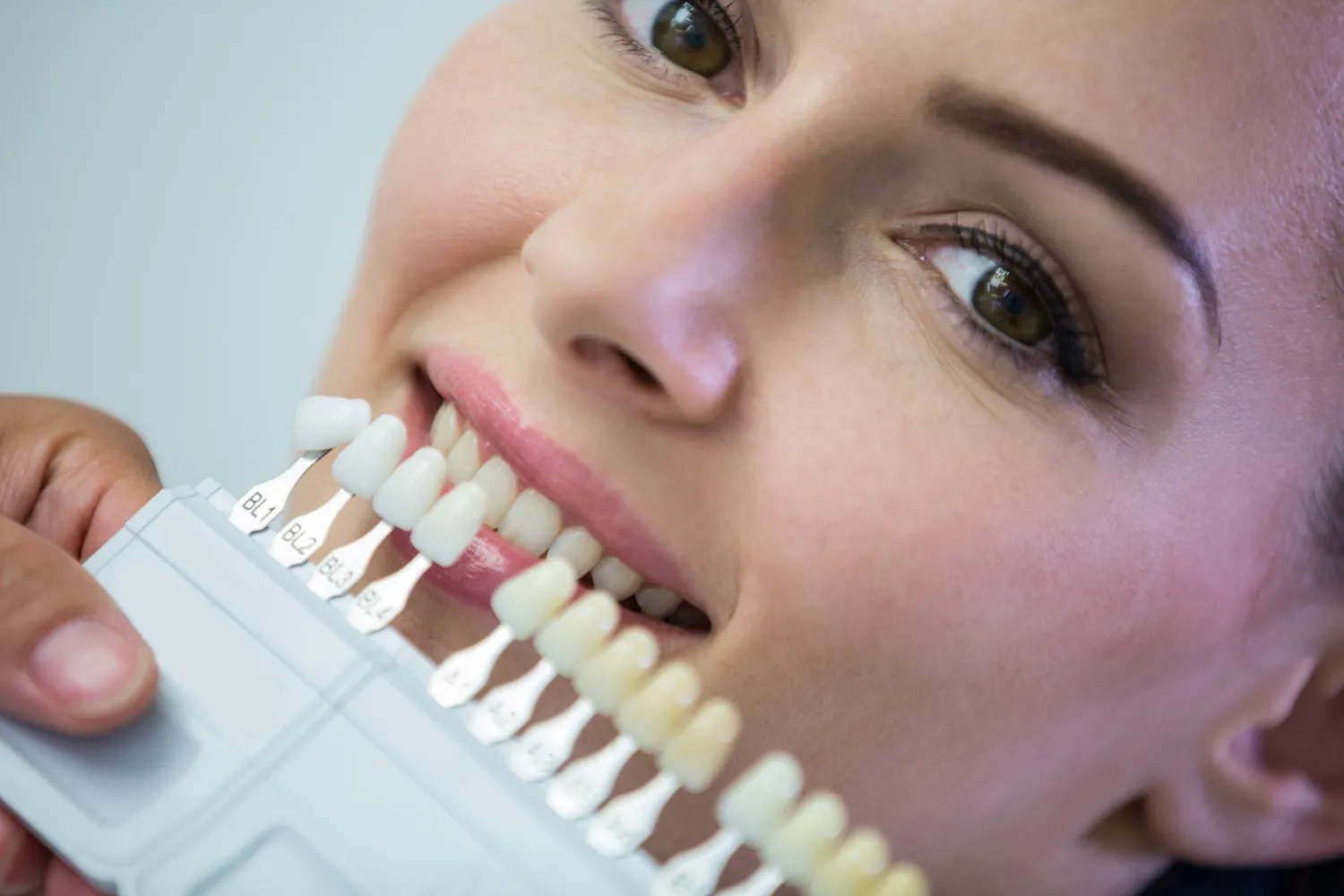
Shade selection works by matching the veneer color to the patient's natural teeth and desired outcome. The dentist uses a standardized shade guide under proper lighting conditions. The dentist considers the tooth stump color, the cement shade, and the ceramic translucency. For a full set of veneers, the patient can choose a lighter shade. For single veneers, the dentist must match the adjacent teeth exactly. Photographs with shade tabs in the image help the laboratory technician reproduce the correct color.
What Happens During Tooth Preparation?
During tooth preparation, the dentist removes a thin layer of enamel from the front and sometimes the biting edge of the tooth. The amount of reduction depends on the desired outcome and the starting tooth position. The dentist uses diamond burs and follows the digital mock-up or a silicone guide to ensure precise reduction. The dentist then polishes the prepared surface to create a smooth finish. Local anesthesia keeps the patient comfortable during this step.
Why Are Temporary Veneers Used?
Temporary veneers are used to protect the prepared teeth and maintain appearance while the laboratory fabricates the final E.max restorations. The dentist makes these temporaries from a tooth-colored resin using a mold of the digital wax-up. Temporaries allow the patient to test the new shape and length. They also protect the enamel from temperature sensitivity and physical damage. The dentist removes the temporaries at the bonding appointment.
How Does Laboratory Fabrication Work?
Laboratory fabrication works by transforming the digital design or physical impression into a finished ceramic veneer. A skilled dental technician uses either the press or CAD/CAM method to create the restoration. The technician layers additional ceramic if needed to achieve the ideal shade and characterization. The technician then glazes and polishes the veneer to a high shine. Quality control checks ensure the fit, contacts, and occlusion are correct before sending the veneer back to the dentist.
What Happens During Final Bonding?
During final bonding, the dentist places the E.max veneers on the teeth using adhesive resin cement. The dentist first tries in each veneer to verify fit and shade. Then the dentist treats the ceramic intaglio surface with hydrofluoric acid and silane. The dentist etches the enamel with phosphoric acid and applies a bonding agent. The dentist coats the veneer with resin cement, seats it on the tooth, and cures it with a blue light. The dentist removes excess cement and checks the bite. This appointment typically takes one to two hours for multiple veneers.
Why Is Post-Treatment Follow-Up Important?
Post-treatment follow-up is important because it allows the dentist to verify that the veneers function properly and the gums remain healthy. The dentist checks the occlusion, polish, and marginal integrity. The dentist also addresses any patient concerns about sensitivity or comfort. Regular follow-up visits help catch minor issues before they become major problems.
How Long Do E.max Veneers Last?
E.max veneers last many years when dentists place them correctly and patients care for them properly. Clinical research provides strong evidence for their longevity.
What Is the Expected Lifespan of E.max Veneers?
The expected lifespan of E.max veneers ranges from 10 to 15 years on average, though many last much longer. Some studies report survival rates exceeding 95 percent at the 10-year mark. The 14-year prospective study by Klein et al. found an overall survival rate of 98.6 percent for lithium disilicate restorations. This means that out of hundreds of restorations, only a small fraction failed over more than a decade. With excellent oral hygiene and regular dental visits, patients can expect their E.max veneers to remain functional and beautiful for well over a decade.
What Do Clinical Success Rates Show?
Clinical success rates show that E.max veneers outperform many other cosmetic restorations. A systematic review and meta-analysis comparing different ceramic veneer materials found that lithium disilicate veneers achieved survival rates comparable to or higher than feldspathic and leucite-reinforced ceramics (Hui et al.). The retrospective study of 1,075 CAD/CAM lithium disilicate veneers reported a 99.83 percent cumulative survival rate over a mean follow-up of nearly three years (Imburgia, Lerner, and Mangano). These high success rates reflect the material's strength, the reliability of adhesive bonding, and the precision of modern fabrication techniques.
What Factors Affect Veneer Longevity?
Several factors affect veneer longevity. Oral hygiene plays a major role; patients who brush and floss daily keep their gums healthy and reduce the risk of decay at the margins. Diet matters too; patients who avoid biting hard objects like ice or pens protect their veneers from fracture. Bruxism significantly shortens veneer lifespan unless the patient wears a night guard. The dentist's skill in preparation and bonding also affects outcomes. Finally, the quality of the laboratory work influences how well the veneer fits and how natural it looks over time.
When Do Veneers Need Replacement?
Veneers need replacement when they fracture, debond, or no longer meet the patient's esthetic standards. Fracture is rare with E.max but can happen from trauma or extreme forces. Debonding occurs when the adhesive fails, sometimes due to moisture contamination during bonding or excessive loading. Over many years, the gum tissue may recede slightly, exposing the veneer margin. If the margin becomes visible or stained, the patient may choose to replace the veneer for cosmetic reasons. Regular dental visits help the dentist monitor veneer condition and recommend replacement when necessary.
How Should You Care for E.max Veneers?
Proper care keeps E.max veneers looking beautiful and functioning well for many years. The care routine is simple and similar to caring for natural teeth.
What Does Daily Oral Hygiene Involve?
Daily oral hygiene involves brushing twice a day with a non-abrasive toothpaste and flossing once daily. Patients should use a soft-bristled toothbrush to avoid scratching the ceramic surface. Electric toothbrushes work well as long as the bristles are soft. Flossing removes plaque from between teeth and along the gumline where veneers meet natural tooth structure. Patients should also consider using an alcohol-free mouthwash to reduce bacteria without drying out oral tissues.
Which Foods and Habits Should Patients Avoid?
Patients should avoid biting directly into very hard foods like hard candy, ice, or bones. They should not use their teeth as tools to open packages or bottles. Chewing on pens, fingernails, or other hard objects creates point pressure that can chip veneers. While E.max resists staining, excessive consumption of coffee, tea, red wine, and tobacco can still discolor the cement margin or the natural teeth next to the veneers. Moderation and rinsing with water after consuming these items help maintain a bright smile.
Why Do Bruxism Patients Need Night Guards?
Bruxism patients need night guards because these custom-made appliances absorb grinding forces and protect veneers during sleep. A night guard fits over the upper or lower teeth and creates a barrier between the upper and lower arches. The dentist takes an impression and has the laboratory fabricate a hard or dual-laminate guard. Wearing the guard every night significantly reduces the risk of veneer fracture and debonding.
How Often Should Patients Schedule Professional Dental Check-Ups?
Patients should schedule professional dental check-ups every six months. During these visits, the dentist examines the veneers for signs of wear, debonding, or marginal problems. The dentist also checks the health of the gums and the integrity of the bite. Early detection of minor issues prevents major complications. Patients with a history of gum disease may need more frequent visits.
What Professional Cleaning Recommendations Apply?
Professional cleaning recommendations include informing the dental hygienist about the veneers so they can use appropriate instruments. Metal scalers can scratch ceramic surfaces, so hygienists should use plastic or Teflon-coated instruments around veneer margins. Polishing pastes designed for composite or ceramic restorations maintain the surface gloss. Air polishing with sodium bicarbonate is generally safe for lithium disilicate but should be used with care near the margins.
What Are the Risks and Limitations of E.max Veneers?
E.max veneers are safe and effective, but like all dental treatments, they carry some risks and limitations. Understanding these helps patients make informed decisions.
What Causes Veneer Debonding?
Veneer debonding happens when the adhesive bond between the ceramic and the tooth fails. Common causes include moisture contamination during bonding, inadequate enamel surface, excessive occlusal forces, or improper cementation. A debonded veneer may come off completely or feel loose. The dentist can often rebond the same veneer if it is intact. The study by Malchiodi et al. reported one debonding event out of 79 veneers, and the dentist successfully rebonded it.
Can E.max Veneers Chip Under Excessive Force?
E.max veneers can chip under excessive force, though this is uncommon. The material's flexural strength of 360 to 400 megapascals resists normal chewing well. However, direct trauma from a blow to the face, biting metal, or severe bruxism can cause fractures. Small chips may be polishable, but large fractures usually require veneer replacement. Patients who play contact sports should wear a mouthguard to protect their veneers.
Does Tooth Sensitivity Occur After Veneer Placement?
Tooth sensitivity can occur after veneer placement but usually resolves within a few days to weeks. The tooth preparation removes a thin layer of enamel, which may expose microscopic dentinal tubules. These tubules transmit temperature changes to the tooth nerve. The bonding process and cement layer typically seal these tubules and reduce sensitivity. If sensitivity persists, the dentist can apply desensitizing agents or check the bite for high spots.
Why Is Tooth Preparation Irreversible?
Tooth preparation is irreversible because the dentist removes enamel that the body cannot regenerate. Even with minimal reduction, the enamel loss is permanent. This is why dentists emphasize conservative preparation and thorough planning. Patients must understand that once they choose veneers, they commit to maintaining or replacing them for life. The good news is that E.max preparation removes far less structure than crowns.
Why Does Proper Case Selection Matter?
Proper case selection matters because placing veneers on unsuitable teeth leads to predictable failure. Dentists must evaluate enamel quality, bite forces, gum health, and patient habits before recommending E.max. A well-selected case with healthy enamel, stable occlusion, and good oral hygiene has a very high success rate. A poorly selected case may suffer from debonding, fracture, or esthetic disappointment.
E.max Veneers vs Traditional Porcelain Veneers
Comparing E.max veneers to traditional porcelain veneers helps patients understand why lithium disilicate has become the preferred choice in modern cosmetic dentistry.
Factor | E.max Veneers | Traditional Porcelain Veneers |
Material | Lithium disilicate glass-ceramic | Feldspathic porcelain |
Flexural strength | 360–400 MPa | 60–100 MPa |
Minimum thickness | 0.3–0.5 mm | 0.8–1.0 mm |
Tooth reduction | Minimal (0.3–0.7 mm) | Moderate to aggressive |
Translucency | High, enamel-like | High, but weaker |
Color stability | Excellent | Good, may fade over time |
Bond strength to enamel | Very high | Moderate to high |
Survival rate at 10 years | ~96–99% | ~87–94% |
Best use | Anterior esthetic zone | Highly esthetic, low-stress cases |
How Do Material Compositions Differ?
Material compositions differ significantly between E.max and traditional porcelain. E.max uses lithium disilicate crystals in a glass matrix. Traditional porcelain uses feldspar, quartz, and kaolin in a glassy phase with minimal crystalline reinforcement. This difference explains why E.max is stronger and can be made thinner.
Which Material Offers Better Esthetics?
Both materials offer excellent esthetics, but E.max provides better long-term color stability and more predictable shade matching. Traditional feldspathic porcelain looks very natural when new but may lose some luster over time. E.max maintains its surface gloss and fluorescence for many years.
Which Material Is Stronger?
E.max is significantly stronger than traditional feldspathic porcelain. Its flexural strength is roughly four times higher. This strength allows E.max to function reliably even in thin sections where traditional porcelain would fracture.
Which Material Requires Less Thickness?
E.max requires less thickness because its higher strength allows for thinner restorations. Traditional porcelain needs greater bulk to resist fracture, which means more enamel removal.
Which Material Lasts Longer?
E.max lasts longer according to clinical data. Studies show higher survival rates for lithium disilicate over 10 to 14 years compared to feldspathic porcelain. The stronger material and better adhesive bonding contribute to this improved longevity.
What Are the Clinical Indications for Each?
Clinical indications for E.max include most anterior veneer cases, especially where minimal preparation is desired. Traditional porcelain indications are limited to cases with very low functional demands or where the dentist wants maximum translucency on a tooth with adequate structure. E.max has largely replaced traditional porcelain in modern practice.
E.max Veneers vs Zirconia Veneers
Zirconia is another popular ceramic material. Comparing E.max to zirconia helps clarify which material suits different clinical situations.
Factor | E.max Veneers | Zirconia Veneers |
Material | Lithium disilicate glass-ceramic | Zirconium dioxide (polycrystalline) |
Flexural strength | 360–400 MPa | 900–1200 MPa |
Translucency | High | Moderate to high (depends on type) |
Tooth reduction | Very minimal | Minimal to moderate |
Bonding mechanism | Etch + silane + resin cement | Sandblast + primer + resin cement |
Best for front teeth | Yes | Sometimes |
Best for heavy bite | No | Yes |
Natural appearance | Excellent | Good to very good |
Which Material Looks More Natural?
E.max usually looks more natural than zirconia because it transmits light more like enamel. Zirconia is more opaque, especially older generations. Newer high-translucency zirconia has improved, but E.max still leads in optical properties for anterior teeth. A three-year clinical trial found that E.max scored better than cubic zirconia in esthetics and translucency (Al-Fetlawi et al.).
Which Material Is Stronger?
Zirconia is stronger than E.max. Its flexural strength can reach 900 to 1,200 megapascals, roughly two to three times that of lithium disilicate. This makes zirconia the better choice for patients with heavy bite forces or bruxism.
Which Material Requires Less Tooth Reduction?
E.max often requires less tooth reduction for standard veneer cases because its excellent esthetics at thin sections allow for ultra-conservative preparation. Zirconia can also be thin, but its opacity sometimes requires more reduction to mask dark tooth stumps.
Which Material Bonds Better?
E.max bonds better to enamel because hydrofluoric acid etching creates a superior micro-mechanical surface for resin cement. Zirconia does not respond to acid etching and requires sandblasting and special primers containing 10-MDP monomer. Both materials achieve reliable bonds when clinicians follow proper protocols, but E.max has a more forgiving and well-documented adhesive protocol.
Which Material Is Better for Front Teeth?
E.max is better for front teeth when natural appearance is the top priority. Its translucency, fluorescence, and ability to blend with adjacent teeth make it the gold standard for smile zone restorations.
Which Material Is Better for Patients with Heavy Bite Forces?
Zirconia is better for patients with heavy bite forces because its superior strength resists fracture under extreme loads. Patients with severe bruxism or those needing posterior restorations may benefit from zirconia's mechanical properties.
Can E.max Veneers Be Combined with Other Cosmetic Treatments?
E.max veneers combine well with other cosmetic treatments to create comprehensive smile makeovers. Dentists often use multiple procedures to achieve the best possible result.
Can Patients Combine E.max Veneers with Teeth Whitening?
Patients can combine E.max veneers with teeth whitening, but timing matters. The dentist should complete whitening first because veneers do not change color. Once the natural teeth reach the desired shade, the dentist matches the veneers to the new color. If a patient whitens after veneer placement, the natural teeth may become lighter than the veneers, creating a mismatch.
Can Gum Contouring Improve Veneer Results?
Gum contouring can improve veneer results by creating a symmetrical gum line and exposing more tooth structure. Some patients have uneven gums or a gummy smile that makes teeth look short. Laser or surgical gum contouring reshapes the tissue before or during veneer treatment. This combination produces longer, more proportioned teeth.
Can Invisalign and E.max Veneers Work Together?
Invisalign and E.max veneers can work together when patients need both alignment and shape or color changes. The dentist may recommend Invisalign first to position the teeth ideally. Straight teeth require less preparation for veneers and produce better long-term results. In some cases, the dentist places veneers on a few teeth while Invisalign moves the others.
When Do Dental Crowns Complement E.max Veneers?
Dental crowns complement E.max veneers when some teeth need more structural support than a veneer can provide. For example, a tooth with a large filling or crack may need a crown while the neighboring teeth receive veneers. The dentist designs the crowns and veneers to match perfectly in shade and shape.
How Does Smile Makeover Planning Work?
Smile makeover planning works by evaluating the entire mouth as an integrated system. The dentist considers tooth color, shape, size, position, gum health, and facial features. Digital Smile Design helps the dentist create a blueprint that may include veneers, whitening, gum contouring, and other treatments. This comprehensive approach ensures all elements work together harmoniously.
What Factors Influence the Cost of E.max Veneers?
The cost of E.max veneers varies based on several factors. Patients should understand these variables when budgeting for treatment.
How Does the Number of Veneers Affect Cost?
The number of veneers affects cost directly because each veneer requires individual design, fabrication, and placement. A single veneer costs less than a full set of eight to ten veneers, though some dentists offer package pricing for larger cases.
How Does Dentist Experience Affect Cost?
Dentist experience affects cost because highly skilled cosmetic dentists charge more for their expertise. Experienced dentists produce better esthetic outcomes, use advanced techniques, and handle complex cases more effectively. Their fees reflect years of training and a track record of successful results.
How Does Laboratory Quality Affect Cost?
Laboratory quality affects cost because master dental technicians command higher fees for their artistry. Top laboratories use premium materials, advanced CAD/CAM systems, and detailed hand-layering to create lifelike veneers. Cheap laboratories may cut corners on shade matching and surface characterization.
How Does Digital Technology Affect Cost?
Digital technology affects cost because intraoral scanners, design software, and milling machines represent significant investments. Digital workflows improve accuracy and patient comfort but may add to the overall fee. Some patients find the improved precision and faster turnaround worth the extra cost.
How Does Geographic Location Affect Cost?
Geographic location affects cost because dental fees vary by country, city, and neighborhood. Major metropolitan areas typically have higher fees than smaller towns. Countries with lower operating costs may offer E.max veneers at reduced prices, which explains the popularity of dental tourism.
How Do Additional Cosmetic Procedures Affect Cost?
Additional cosmetic procedures affect cost because treatments like gum contouring, whitening, or orthodontics add to the total investment. Patients should request a comprehensive treatment plan with itemized costs before starting.
What Questions Should You Ask Before Getting E.max Veneers?
Asking the right questions helps patients choose the best dentist and understand their treatment.
Is E.max the Best Material for My Case?
Ask the dentist if E.max is the best material for your case. A qualified dentist explains why lithium disilicate suits your specific needs or recommends alternatives like zirconia or orthodontic treatment if appropriate.
How Much Tooth Enamel Will Be Removed?
Ask how much tooth enamel the dentist will remove. The answer should be specific, ideally less than one millimeter for most E.max cases. If the dentist plans aggressive reduction, ask why.
Can I See Before-and-After Cases?
Ask to see before-and-after cases from the dentist's own patients. This portfolio shows the dentist's skill level and helps you set realistic expectations.
What Is the Expected Lifespan?
Ask what lifespan you can expect based on your oral habits and bite. The dentist should cite clinical data and explain how your habits might affect longevity.
What Warranty or Follow-Up Care Is Offered?
Ask what warranty or follow-up care the practice offers. Some dentists provide warranties against debonding or fracture for a certain period. Clarify what follow-up visits include and whether they charge for adjustments.
Frequently Asked Questions About E.max Veneers
Are E.max Veneers Permanent?
E.max veneers are permanent in the sense that the tooth preparation is irreversible. However, the veneers themselves may need replacement after 10 to 20 years. Patients commit to maintaining veneers for life.
Do E.max Veneers Stain?
E.max veneers do not stain easily because their glazed ceramic surface resists pigment absorption. However, the cement margin and adjacent natural teeth can discolor over time. Regular cleanings keep the smile bright.
Can E.max Veneers Chip?
E.max veneers can chip under extreme force, but this is rare. Normal eating and speaking do not damage them. Avoiding hard objects and wearing a night guard if needed prevents chipping.
Do E.max Veneers Look Natural?
E.max veneers look very natural because lithium disilicate mimics the light transmission and fluorescence of enamel. Skilled dentists and technicians create results that are nearly indistinguishable from natural teeth.
Are E.max Veneers Painful?
E.max veneer treatment is not painful. The dentist uses local anesthesia during preparation. Some patients experience mild sensitivity afterward, but this resolves quickly.
How Many Appointments Are Required?
E.max veneer treatment typically requires two to three appointments. The first visit includes consultation and planning. The second visit includes preparation and temporaries. The third visit includes bonding and final adjustments. Digital workflows may reduce this to two visits.
Can One E.max Veneer Be Replaced?
One E.max veneer can be replaced if it fractures or debonds. The dentist removes the damaged veneer, prepares the tooth again if needed, and places a new restoration. Matching the shade of older adjacent veneers can be challenging.
Are E.max Veneers Better Than Composite Veneers?
E.max veneers are better than composite veneers for most patients because they last longer, resist staining, and look more natural. Composite veneers cost less but typically survive only 5 to 7 years and are more prone to discoloration and wear.
Can Smokers Get E.max Veneers?
Smokers can get E.max veneers, but smoking affects gum health and may stain the cement margins. Dentists recommend quitting smoking before cosmetic treatment for the best long-term results.
Are E.max Veneers Suitable for Everyone?
E.max veneers are not suitable for everyone. Patients with severe bruxism, extensive decay, poor oral hygiene, or inadequate enamel may need alternative treatments. A thorough dental examination determines candidacy.
Conclusion
E.max veneers represent one of the most reliable and beautiful options in modern cosmetic dentistry. Lithium disilicate glass-ceramic combines exceptional strength with natural optical properties, allowing dentists to create thin, durable restorations that preserve healthy tooth structure. Clinical studies confirm survival rates above 98 percent over 10 to 14 years, making E.max a proven long-term investment in your smile. The material works best when dentists select cases carefully, prepare teeth conservatively, and follow strict adhesive bonding protocols. Patients who maintain good oral hygiene, avoid harmful habits, and attend regular dental visits enjoy the best outcomes. While E.max excels in the anterior esthetic zone, it is not the right choice for every situation. Patients with heavy bite forces or severe structural loss may benefit from zirconia crowns or other alternatives. The key to success lies in individualized treatment planning, clinician expertise, and realistic expectations. If you are considering E.max veneers, consult a qualified cosmetic dentist who can evaluate your specific needs and design a smile that looks natural, functions well, and lasts for years to come.
References
Al-Fetlawi, Huda, et al. "A 3-Year Controlled Clinical Trial Comparing High-Translucency Zirconia (Cubic Zirconia) with Lithium Disilicate Glass Ceramic (e.max)." BMC Oral Health, vol. 24, 2024.
Calamita, Marcelo, et al. "Occlusal Vertical Dimension: Treatment Planning Decisions and Management Considerations." International Journal of Esthetic Dentistry, vol. 14, 2019, pp. 166–181.
Coachman, Christian, and Paravina, Rade. "Digitally Enhanced Esthetic Dentistry - From Treatment Planning to Quality Control." Journal of Esthetic and Restorative Dentistry, vol. 28, 2016, pp. S3–S4.
D'Arcangelo, Camillo, et al. "Protocol for a New Concept of No-Prep Ultrathin Ceramic Veneers." Journal of Esthetic and Restorative Dentistry, vol. 30, 2018, pp. 173–179.
Fahl, Newton, Jr., and Ritter, Alvaro. "Composite Veneers: The Direct-Indirect Technique Revisited." Journal of Esthetic and Restorative Dentistry, vol. 33, 2021, pp. 7–19.
Gonzaga, Carla, et al. "Digital Smile Design and Mock-Up Technique for Esthetic Treatment Planning with Porcelain Laminate Veneers." Journal of Conservative Dentistry, vol. 21, 2018, pp. 455–458.
Gürel, Galip, et al. "Clinical Diagnosis and Treatment Planning in Esthetic Dentistry." Quintessence, 2012.
Hui, et al. "Survival and Complication Rates of Feldspathic, Leucite-Reinforced, Lithium Disilicate and Zirconia Ceramic Laminate Veneers: A Systematic Review and Meta-Analysis." Journal of Dentistry, 2021.
Imburgia, Mario, et al. "A Retrospective Clinical Study on 1075 Lithium Disilicate CAD/CAM Veneers with Feather-Edge Margins Cemented on 105 Patients." Journal of Prosthetic Dentistry, 2020.
Klein, et al. "Over 14-Year Survival of Pressed e.max Lithium Disilicate Glass-Ceramic Complete and Partial Coverage Restorations in Patients with Severe Wear: A Prospective Clinical Study." Journal of Prosthetic Dentistry, 2025.
Magne, Pascal, and Magne, Michel. "Use of Additive Waxup and Direct Intraoral Mock-Up for Enamel Preservation with Porcelain Laminate Veneers." European Journal of Esthetic Dentistry, vol. 1, 2006, pp. 10–19.
Malchiodi, Luca, et al. "Clinical and Esthetical Evaluation of 79 Lithium Disilicate Multilayered Anterior Veneers with a Medium Follow-Up of 3 Years." European Journal of Dentistry, 2019.
Ortensi, Luca, et al. "Digital Planning of Composite Customized Veneers Using Digital Smile Design: Evaluation of Its Accuracy and Manufacturing." Clinical and Experimental Dental Research, vol. 8, 2022, pp. 537–543.
Peumans, Marleen, et al. "Porcelain Veneers: A Review of the Literature." Journal of Dentistry, vol. 32, 2004, pp. 163–177.
Pini, Núbia, et al. "Advances in Dental Veneers: Materials, Applications, and Techniques." Clinical, Cosmetic and Investigational Dentistry, vol. 4, 2012, pp. 9–16.
Reshad, Mamaly, et al. "Diagnostic Mock-Up as an Objective Tool for Predictable Outcomes with Porcelain Laminate Veneers in Esthetically Demanding Patients: A Clinical Report." Journal of Prosthetic Dentistry, vol. 99, 2008, pp. 333–339.
Rojas-Rueda, et al. "Bonding Protocols for Lithium Disilicate Veneers." PMC, 2025.